Join the discussion

Write your take first — we'll ask for email only when you're ready to publish.

  • Hacker News
  • Ha. The title lead me to believe this was about Erlang. But this is great too.
  • Yes, I also got briefly very confused about the top comment.
  • When I clicked on the link, I first thought it was going to be about, well, steam engines. Then I realized this is Hacker News, so it's probably about the Erlang VM. Turns out my first thought was actually the correct one!

    Glad to not be the only person to expect Erlang instead of steam.

  • The first steam engines were vacuum engines, fill a cylinder full of steam and as it condenses it sucks the piston down, Watt's improvement and patent was on a separated condenser unit so you did not have to reheat the whole cylinder each time. This doubled the efficiency, that is, reduced the amount of coal you had to burn by half. But Watt would not sell manufacturing rights to his patent he sold operating licenses, If you had an engine that utilized Watts patent idea you owed him half the price of the coal you did not have to burn by using it. Consequently there were a lot of "pirate" engines, the most common method of working around Watts patent was to claim that your condenser was integrated into(as opposed to separated from) the cylinder some how.
  • why are you badly summarizing the post?

    It wasn't a vacuum engine, as per post the water just cooled the cylinder. And it wasn't half of the coal, it was a third.

  • Yes, great details! Not sure if you've read it, but "Richard L. Hills, Power from Steam: A History of the Stationary Steam Engine (1989)." is a truly wonderful overview, that really digs deep into the business. It has many letters directly from Watt, including the problems they had getting these huge engines built (before any decent roads!).
  • The interactive article is so good!

    (Sorry I am pasting my old comment.)

    Some Model Engineering related resources:

    Engineering drawings of small model engines used in model aircraft making. These designs are intended for manufacturing and practical operation, rather than merely for display, and can be used to build fully functional engines.

    https://www.modelengineeringwebsite.com/Beam_Engine_drawings...

    https://modelengineeringwebsite.com/Classic_ME_beam_engine.h...

    https://outerzone.co.uk/plans.asp?cat=Engines&Xcardsperpage=...

    https://modelenginenews.org/midge/index.html

    https://modelengineeringwebsite.com/Midget_gas_engine_1.html

    https://www.adriansmodelaeroengines.com/catalog/product.php?...

  • Thanks!

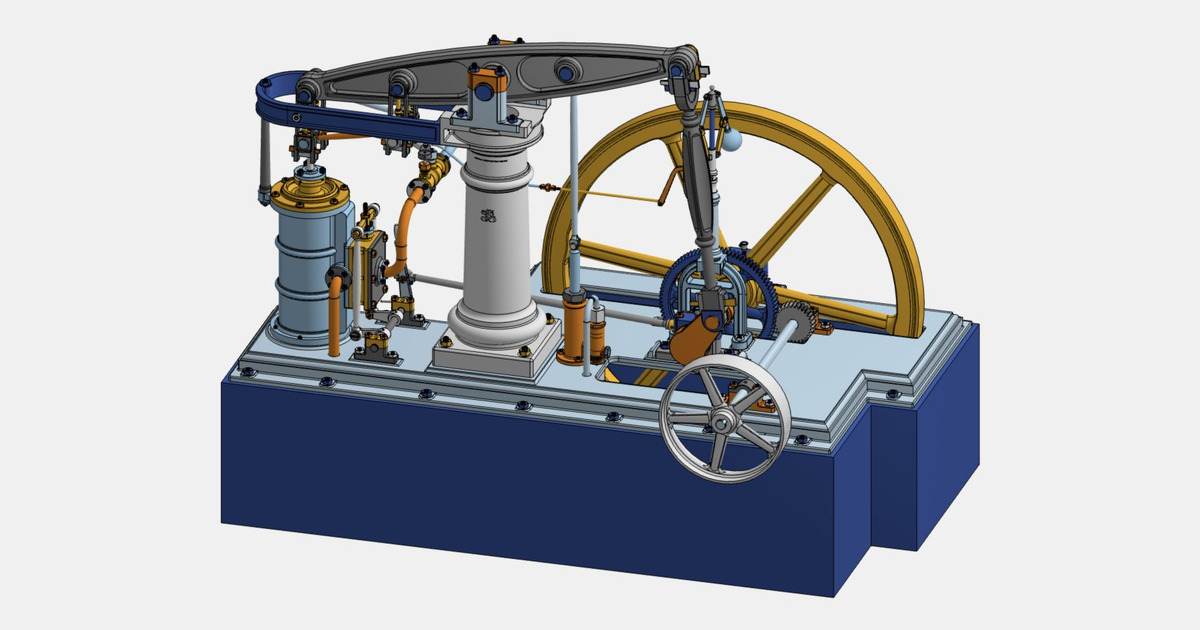
    And https://modelengineeringwebsite.com/Classic_ME_beam_engine.h... is almost exactly the CAD model behind this beam engine. Designing that on paper would have been quite a challenge.

  • Quinn (Blondihacks) on youtube is a model engineer machinist and has, IMO, the most outsider-watchable content on building boilers and steam engines like this.

    Highly recommend this primer titled "The Model Engineering Learning Curve" https://www.youtube.com/watch?v=Ps_BQJEMnGA

    She's been building a model locomotive for years now, there are over 100 videos: https://www.youtube.com/watch?list=PLY67-4BrEae-xhrvZX33gPk4...

    One more: a little engine I'd never encountered before called a wobbler is, apparently, the hello world of machining model engines: https://www.youtube.com/watch?v=HrHDrIms7-0

  • See also Wreck2Restored, a channel that documents the ongoing restoration of a 2-foot gauge steam locomotive. Crossheads and sliding valves featured!

    https://www.youtube.com/@Wreck2Restored

  • I'm only ~5 minutes into that first video and every single thing she has said so far rings so stupid true that its almost painful hearing it said so bluntly. Making things takes a lot of time, requires lots of fundamental skills, is expensive to do yourself, generally isn't going to be better than something other people are selling, and should be fun the entire time you're doing it.

    This should be the comment that people read on this post. Watch these videos.

  • Wow, that Blondiehacks video opened my eyes to a whole unknown world. Thanks!
  • Blondihacks is amazing. Beware though, you may be buying a lathe and a milling machine soon after you start watching :).

    It's a great hobby. Manual machining is totally different from writing code, but you get into a similar state of flow.

  • On the topic of steam-related machinery YouTube channels, Keith Rucker gets my recommendation: https://www.youtube.com/channel/UCyjwQ6oz4cqqtEcWGboSU3g
  • For those in London who want to see one of these in the flesh, as it were, there's one in Tottenham: https://www.mbeam.org/
  • There’s also the amazing Crossness, which does have occasional steaming days. And if you’re in Manchester the Museum of Science and Industry has a great collection of small and large engines which they run
  • Fred Dibnah's BBC series "Age of Steam" is a fine overview of the development of steam engine technology and the industrial revolution in the United Kingdom.

    https://www.youtube.com/watch?v=kl_UA36ouzM&list=PL2vJ5Cg-wl...

  • Whenever I see an explanation of an old technology, I don't wonder "How do that work" but rather "How did they even build this"

    How did they make vacuum and be sure it was indeed a vacuum ?

    How did they melted that metal alloy into the right shape ?

    How did they built those precise mirrors ?

    How many times did they fail before succeeding ?

    How did they lubricate and seal properly all components ?

    I know I could explain 80% of those inventions easily by studying them for a few days each. I know I would never be able to build 1% of those machines myself, I'd constantly run into technical issues and it'd take me years for each

  • You might enjoy How to Make Evertything on YT.
  • For this reason, I always point out that toolmaking was an essential and often forgotten part of Manchester’s Industrial Revolution.
  • One of the most conceptually simple ways to make a vacuum is a Sprengel pump. You have, from top to bottom, a pipe full of mercury, a restriction so it comes out in drops to the next stage, a chamber where the vacuum is developed, and an exit pipe. Mercury drops fall through the chamber, trapping air between them as they fall down the exit pipe. The energy comes from lifting the mercury back to the top.

    A way that's easy to execute, but doesn't produce a perfect vacuum, is to fill a chamber with steam (actual high temperature steam, not the clouds coming off a kitchen pot), seal it and cool it. This is only a near-vacuum because it's filled with low pressure water vapor, but it's very easy to do.

  • This reminds me a lot of https://ciechanow.ski, down to the body typeface. (IBM Plex Sans?) Also, the SI units everywhere here make me beam. Thank you :)
  • 100% - his articles were a major inspiration, and first line in the credits: - Thanks to Bartosz Ciechanowski, whose exceptionally well written and designed articles inspired this one.

    Glad you enjoyed the units :).

  • Ancient Greeks had a steam engine. They called it a Hero's engine. They used it as a toy.

    They couldn't use it as anything else than a toy. The reason they couldn't because they didn't have the metallurgy and the machining to create pistons, valves, etc.

    There's an important lesson that can be applied to every technology, I think: technological progress is always iterated, never revolutionized. If your novelty - a programming language, a framework, a methodology, whatever - doesn't stand on the shoulders of the giants, then you have simply nothing to apply this novelty to.

  • > The reason they couldn't because they didn't have the metallurgy and the machining to create pistons, valves, etc.

    It was a turbine. You don’t use pistons in a turbine. They lacked knowledge of turbine blades, the metallurgy to make pressure vessels, and the tools to make parts with the tolerances needed to spin at high RPM and withstand high temperatures.

  • That was a reaction engine, something like a steam rocket confined to rotate in a circle, and not a positive-displacement engine: https://en.wikipedia.org/wiki/Aeolipile

    They couldn't use it as anything else than a toy. The reason they couldn't because they didn't have the metallurgy and the machining to create pistons, valves, etc.

    IMHO they definitely had the processes to basically add a PTO to one, but it was probably dismissed as impractical.

  • Ever hear the phrase "Balls out" when referring to pushing something to the max? Comes form the balls of the centrifugal engine governor. At maximum speed the balls extended all the way outward giving us the term "Running balls out."

    https://en.wikipedia.org/wiki/Centrifugal_governor

    edit: I once said this phrase at a work meeting and someone objected to my use of a crude term which I then explained much to everyone's surprise. They thought it had something to do with testicles.

  • What about the phrase "testicles out"?
  • I suppose this is also the less colorful true origin of "balls to the wall" than the phrase itself suggests?
  • > When the engine slows, the balls fall and open the cock again.

    The choice of wording makes me suspect that they intended both entendres. ;)