Join the discussion
Write your take first — we'll ask for email only when you're ready to publish.
- Hacker News
- Cool, but Boeing is doing it first with the 777X.by 4fterd4rk
- Foldable wings have been on aircraft carriers for a while as well.by throw0101d
- by xnx
- Is that the plane that is already 7 years late due to certification issues?by fransje26
- Cool, but then you'd be forced to fly on a Boeing.by esskay
- No, Boeing did it first with the original 777, way back in 1994. A folding wingtip was designed, the folding mechanism was built and qualification tested, the engineering drawings were all released, it was added to the option catalog, but no customer ever ordered the option.
https://simpleflying.com/boeing-once-offered-the-original-77...
You used to be able to see the qualification test rig mechanism at the Museum of Flight restoration center in Everett, but they scrapped it during the pandemic.
by buildsjets - Let's hope, it doesn't fall off...by dr_faustus
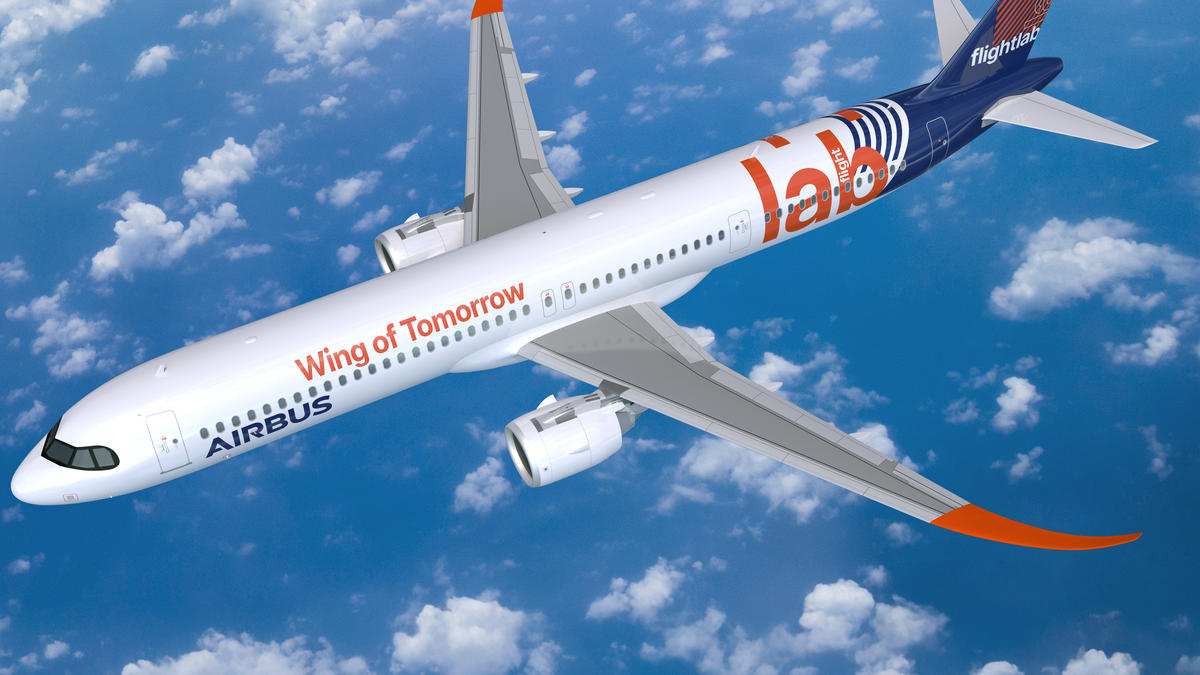
- Title: Airbus launches new flight test programme for Wing of Tomorrow
... doesn't look like there's any folding being tested here, just the resulting wing shape to see what the benefits might. Full scale foldable wings would be years off.
by gnabgib - Not just the shape, but also the mass placement and rigidity. I explain this in another comment, I don't want to cut and paste redundant info here but keep scrolling and you'll find it ))by dotancohen
- You're right, it's a proof of concept: "The extensions, each measuring several metres, will replicate a folding wing in the fully extended position during a flight. They will be fitted with comprehensive testing equipment to capture behaviour in flight and evaluate how the longer wingspan impacts aircraft handling."by r2sk5t
- What’s the purpose of doing this? (Site won’t load for me)by bilsbie
- Operation from aircraft carriers, obviously. /sby jabl
- > The Wing of Tomorrow programme is centred around creating longer, lighter, and more slender wings to maximise aerodynamic efficiency and reduce fuel burn. The wing extensions will be assembled at Airbus’ Wing Technology Development Centre in the UK and flight tested in Toulouse.by ceejayoz
- Ground infrastructure.
E.g. for the 777X it fits in Category E. Without folding tips it would be in Category F. Less gates can accommodate Category F.
https://skybrary.aero/articles/icao-aerodrome-reference-code
by OptionOfT - An airliner weighs a certain amount. In cruising flight, the lift on the aircraft is exactly equal to the weight (because it's neither climbing nor descending). Aerodynamic drag falls into 3 buckets: parasitic drag, wave drag, and lift-induced drag. Lift-induced drag is drag created by the wings producing lift.
Longer, thinner wings (higher aspect ratios) create less lift-induced drag for a given wing area, so ideally you want a super duper long and skinny wing, which will create less drag for a given amount of lift, and thus improve your fuel efficiency. Fuel is a massive portion of the total cost of operating an airliner, so there is a large financial incentive from the airlines to reduce fuel costs.
Unfortunately really long wings make airliners too wide to park at most airport gates, and in some cases too wide to taxi safely around obstacles, so they're experimenting with ways to make the wings fold and get a "best of both worlds" situation.
by stackghost - My 2c:
The goal is longer, thinner wings than usual. Long and thin wings are far more efficient—think gliders and the U2. But beyond a certain width, those wings become incompatible with existing airports and other facilities for handling commercial aircraft. So the idea is to mount folding extensions that are extended for flight, but likely fold when being hangered or navigating taxiways.
by a4isms - It looks like you can get ~10-20% efficiency gain from these kinds of wings. https://www.technologyreview.com/2013/11/18/175391/folding-w...
That's a meaningful improvement but not that big. Perhaps the limits to this kind of technology are ~50% fuel gain? https://www.technologyreview.com/2013/01/24/180345/hybrid-wi...
We've got AI, but I'm still waiting on exponential technological gains. So far I've mostly gotten exponential enshittification of my google experience. Is AI going to unlock the detonation engine and bring down the cost of my plane ticket? https://www.technologyreview.com/2012/11/23/181486/exploding...
by jsrozner - The first paragraph of your comment is very informative. The rest, not so much. I highly suggest editing the rest out.by dotancohen
- 20% would be an absolutely massive accomplishment. Think about how many decades of incremental improvement have gotten us to the efficiencies we have today.by adamweld
- This is a massive improvement for airliners where margins are a few %. Tube and wing configuration is already highly optimized. This is a physical problem with a hard limit. Can you make a sphere "exponentially" rounder?by carabiner
- 10-20% efficiency is enormous considering fuel is by far the dominant lifetime cost of operating an aircraft.
New fuels (SAF) and the technology to use them have been developed for less.
This is all to say nothing of the continuous work done over decades now to make aircraft more efficient; as these effects compound, intuition says that returns would start diminishing, so 10-20% is even more impressive.
by _verandaguy - 20% efficiency means you can open single isle flights on 25% longer distances, which open a lot of routes that are not profitable with regular long haul planes.
I've flown on the A321LR a few times, and it's always crazy to think about that tiny plane cruising over the Atlantic without stops.
by mtrovo - Orville Wright could have explained the reduced drag asociated with a higher aspect wing in 1902, perhaps useing his own terminology as airodynamics as a concept was still stuck in he and his brothers heads for the most part, but was very well known by 1910 and on up. Airbus should probably stick to structural engineering refinement, which they are rather good at, and not try and sell themselves as inovators, which they are not.by metalman
- No pics?by MaxikCZ
- It begs for a video too!by flybrand
- by carabiner
- by r2sk5t
- >The Wing of Tomorrow programme is centred around creating longer, lighter, and more slender wings to maximise aerodynamic efficiency and reduce fuel burn. The wing extensions will be assembled at Airbus’ Wing Technology Development Centre in the UK and flight tested in Toulouse.
I can't say for certain, but I believe Boeing may have explored this concept at some point. The idea would be to equip aircraft with mechanically extendable wingtips that could expand outward by several meters during flight and retract while on the ground.
The primary challenge is that most airport gates cannot accommodate aircraft with a significantly larger wingspan. Retractable wingtips would allow the aircraft to benefit from the improved aerodynamic efficiency and fuel savings of a longer wing in flight, while still fitting within existing gate infrastructure during boarding, deplaning, and parking.
by sleepyguy - Yes this is on the 777x, which is in pre-production and flight testing, seeking approvals from the FAAby bglazer
- Military aircraft have done this for decades to deal with the confined space on aircraft carriers. It's not a new idea, nor any kind of new technology.by SoftTalker