Join the discussion
Write your take first — we'll ask for email only when you're ready to publish.
- Hacker News
- I know everything is told from a perspective, but I find the Marxist “aristocrat / bourgeois” lens rather tired and severely anachronistic. This is told as if Luther and the Magisterial Reformers were just “siding with the aristocracy” and didn’t have any other reasons for opposing a violent uprising on anarchy. The Reformers were trying to effect spiritual and theological change. But when the magistrate, who was supporting the Reformation, encountered radicals who used those ideas for violence and their own ambition, the Reformers had a conundrum. Carl Truman writes in his book “Luther in the Christian Life” (Crossway, 2015), ‘This latter concept, often known as “the priesthood of all believers” or “the general priesthood of all believers” was explosive in Luther’s day because it struck at the very structure of medieval piety. … The problem became acutely significant for the Reformers, and especially Luther, in 1525, with the Peasants’ War. At that time, radicals used Luther’s language of freedom as part of the rhetoric of rebellion, for understandable reasons. Such language resonates powerfully with the oppressed and disenfranchised in every age. The problem, of course, was that Luther was using such words in a manner that assumed their refraction through the cross. The same applied to the language of universal priesthood: the obvious democratizing tendency of the language was popular with those seeking more social equality. Yet the anarchy of the war placed Luther in an impossible position: he was no democratizing radical; he needed to reassure his secular lords that reformation did not mean revolution; and he needed to make sure that his teaching was clearly understood.’ The simple Marxist interpretation is rubbish — the situation was far more complicated than oppressor / oppressed.by jadar
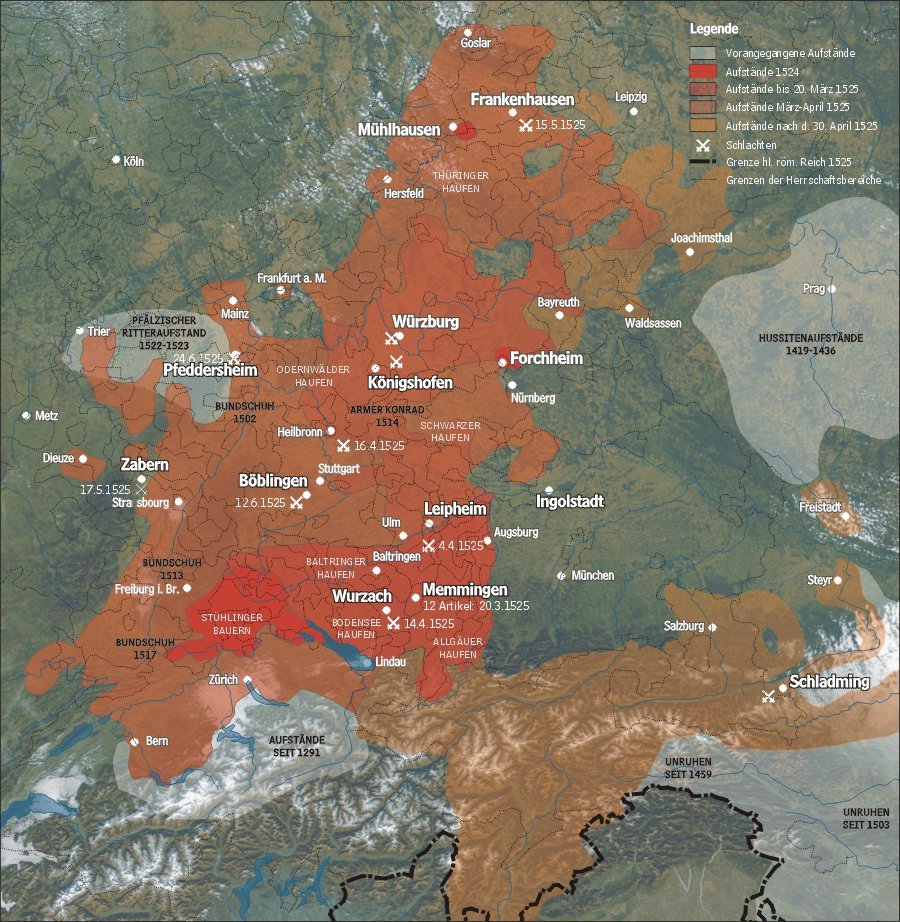
- "The revolt failed because of intense opposition from the aristocracy, who slaughtered up to 100,000 of the 300,000 poorly armed peasants and farmers."
Quite a slaughter. Today we also have indirect slaughter - billionaires versus the rest of the world.
The medieval days, though, were quite tragic because those peons and farmers were factually slaves, depending on the area (there were a few with less restrictions for a while, but ultimately it was slavery). Some of those wars were briefly won by the peons, but in just about any case where they had some victory, lateron they had a huge defeat. Even those who survived were either later executed, or lost their wealth because those who fought for the aristocrats were often rewarded with possessions of others here. In some european countries there is still "nobility". They still have unfair wealth. They should give that to the people.
by shevy-java - This was not about religion but about constitution. Basically they were influenced more by the Magna Carta than by reformation. Anyway, nice to see people interested in how rights were aspired, lost and revived.by BikDk
- Pentiment is a Peabody award winning video game that covers this period. It's terribly engaging and well written. I'd use the word "educational" but that might make it sound dry, which it is not.by vvpan
- Curtis Yarvin in a New York Times interview said that there were no wars under monarchy in Europe. Imagine that.by vvpan
- Historical context:
https://en.wikipedia.org/wiki/Peasant_republic
Notably Handeln and the communes of the Swiss Cantons are considered to have "survived" into 19th C.
- If anyone’s interested about this period of time (and the Anabaptist revolution) a great novel: Q by Luther Blisset
- i discovered this event by reading Sartre's play "The devil and the good lord" (Le diable et le bon dieu): not historical in any way, simply takes the uprising as context, but a masterpiece nonetheless.by constantius
- Thomas Müntzer is one of the unsung heroes of this revolt, unfortunately very little is left of him, most biographies take about 100 pages or lessby wolfi1
- Agreed, and the fact that he's not today recognised as a martyr is telling.by constantius
- The peasants’ war happened over and over again in Chinese history among the gaps of dynasties. That’s a result of autocracy.by alexwwang
- “ After defeating the peasants and their town allies in 1525, the lords continued raising rents to the point that, by the 1570s, peasants were paying 60 to 80 percent of their harvest on rents and debt. This unsustainable amount meant that the farmers could not adequately feed themselves or their livestock, nor refertilize the soil. This led to declining grain yields, widespread malnutrition, and famines, which opened the door to the return of the plague. Social tensions grew at all levels of society, producing witch hunts and repeated outbreaks of war. The growing burden of war taxes and staggering debt loads further crippled the economy, ending in general collapse into the Thirty Years War. The Thirty Years War was the inescapable result of the defeat of the peasants in 1525. Farmers in England, meanwhile, won their freedom from serfdom, which allowed them to produce the growing agricultural surpluses that fueled England’s rise to world power.”
Proving again that a harmony of interests is better than domination.
by dr_dshiv - An episode of history I had never heard about. 100-300,000 peasants killed.
As someone who reads a lot about the early history of religion, the most interesting part of this for me was the role of Martin Luther, the founder of Protestantism: "In Against the Murderous, Thieving Hordes of Peasants, Luther condemned the violence as the devil's work and called for the aristocrats to put down the rebels like mad dogs". My study of history of Christianity had left Protestantism relatively unscathed up to now. Well, no longer.
by constantius - I mean, see also Cromwell. There’s a natural tendency to try to sort historical conflicts into good and bad. The reformation and counter-reformation were very much bad v. bad. But they did ultimately produce change which was probably, on balance, good.by rsynnott
- the protestants have a long history of violence, beginning with the persecution of the Anabaptists, the witch burning and even running concentration camps for the Nazis (KZ Kuhlen), they are not really unscathedby wolfi1
- Just wait until you get to the part concerning Luther's attitude towards the jews...by a2800276
- I can recommend The White Ribbon by Michael Hanekeby croes
- ‘Q’ by the pseudonymous ‘Luther Blissett’ is a great historical fiction book about the period that really gets into what was happening in Europe in the 16th century. The Peasants’ War isn’t even the half of it. European Christian history is brutal.
https://en.wikipedia.org/wiki/Q_(novel)
https://www.alibris.com/Q-Luther-Blissett-pse/book/5481947
Bonus fact: some believe that the ‘Q’ of ‘Q’ is the inspiration for the naming of the pseudonymous ‘Q’ of Q-Anon fame :-| Don’t let that put you off the book though; its politics are not the same!
by jrmg - > Let everyone be subject to the governing authorities, for there is no authority except that which God has established. The authorities that exist have been established by God. Consequently, whoever rebels against the authority is rebelling against what God has instituted, and those who do so will bring judgment on themselves. For rulers hold no terror for those who do right, but for those who do wrong. Do you want to be free from fear of the one in authority? Then do what is right and you will be commended. For the one in authority is God’s servant for your good. But if you do wrong, be afraid, for rulers do not bear the sword for no reason. They are God’s servants, agents of wrath to bring punishment on the wrongdoer. Therefore, it is necessary to submit to the authorities, not only because of possible punishment but also as a matter of conscience.
Romans 13. Is it any surprise that such a religion has consistently, throughout the centuries, been on the side of the rich and powerful, of the lords and emperors, the reactionaries of all stripes?
by andrepd - Not a historian nor economist, but to my layman's mind, these revolts seem like a recurring phenomenon whenever long running economic cycles reach that point at which the aristocracy overreaches while trying to suppressing growing public sentiment against them, not unlike in Polybius' anacyclosis. But unlike Polybius' cycles, as technology improves, the likelihood of a successful reset at the end of a cycle, gradually diminishes with each cycle. I've recently started on Piketty's Capital, and he too alludes to the possibility that the post-industrial-revolution spiral into inequality could have continued uninterrupted into the 20th century and beyond, had it not been for the socioeconomic shock of the world war. Looking at the current trajectory of automation of intellectual labour and surveillance technology, I too am starting to worry that the odds of breaking the current cycle are slim.by hliyan
- The revolts kept on coming back because people hated to being slaves and working for others for (almost) free.by shevy-java
- The world war helped via wealth destruction and redistribution. Polybius' theory also has Arabic (Khaldun) and Chinese analogues. In China it looks like a 300-ish year cycle driven by wealth/land concentration and elite corruption which ends with peasant revolts, a power vacuum, peasants taking back their own land, and a new dynasty formed by rebels or invaders, after which the new elite slowly begins encroaching on the peasants and taking their land again.by faidit
- If I generalize a bit: sometimes conditions change enough for the system as a whole to become unviable, but the entitled part of the population still tries their utmost to keep those entitlements.
Usually, it was a tiny elite, but nowadays, in the time of heavy pension systems, we might actually have succeeded in building an untenable system for a massive part of the population.
by inglor_cz - I know there are some criticisms of Capital in the 21st Century and Picketty himself, but the book changed how I see the world profoundly, I cannot recommend it highly enough to anybody interested in these topics. The audiobook is a good way to digest it for the average person.by IrishTechie
- Something else is going to happen this time, or really is happening already: people vote with their feet and stop having children.
On one hand wealth is being pooled into a smaller number of people, on the other it's becoming difficult to have anyone invested in working harder - and for good reason, as there's little payoff in that.
by Tade0