Join the discussion
Write your take first — we'll ask for email only when you're ready to publish.
- Hacker News
- I too find myself going down the time-nut rabbit hole. I want a perfect 10 Mhz reference, not necessarily a time of day clock.
I was tempted to go the Atomic Clock route, based on actual cesium oscillators, having found a cheapish ($999) used CSAC on ebay[1]. However, once I started digging into the data sheets[2], I found something unacceptable, Pin 1, labeled "Tune", an analog tuning input.
It was then that I learned that while the Cesium vapor cells were accurate, they aged, and drifted, unlike a properly degaussed and Zeeman harmonic calibrated Cesium Beam atomic clock, which is a primary standard.
Further demotivating was learning they have a 5-10 year service life. That's a lot of money to pay for what's essentially a better OXCO.
I'll stick with GPS disciplined oscillators for now.
[1] https://www.ebay.com/itm/327134074179
[2] https://www.mouser.com/datasheet/2/523/Microsemi_CSAC_Space_...
by mikewarot - I feel this article's premise too much. That's exactly the sort of clock I wanted to get my mom as a gift.
Why is it so dang impossible to find a not trash simple LED clock that's 'large print', 'the right color', and not annoyingly too bright?
A deluxe model might include a day of the week bar or dot and a month / day in month number (smaller than the time, mostly people care about the time)
by mjevans - If you're in the UK, just use the MSF radio signal to sync your clock [1].
> The end result exactly matched my expectations—the best criterion for success that I can think of. With an LLM providing the heavy code lifting and the CAD work, I think I spent more time waiting on supplies to arrive than on anything else—something attributable to my lack of planning and the ease of next-day delivery.
I think the author robbed themselves of a deeper understanding.
[1] https://www.npl.co.uk/products-services/time-frequency/msf-r...
by bArray - This reminded of this other clock project: https://mitxela.com/projects/precision_clock_mk_iv
Also: I reckon the closest best-value watch alternative that ticks most(?) of the author's boxes is the Casio GW-M5610-1ER, so long as you are inside a radio-controlled time area.
by sudb - The atomic time radio station WWVB does in fact broadcast a daylight saving time bit. A good atomic time clock should accurately update for DST (though Amazon reviews for a clock like this one is pretty mixed: https://www.amazon.com/Crosse-Technology-617-249-Curved-Atom...)by linehedonist
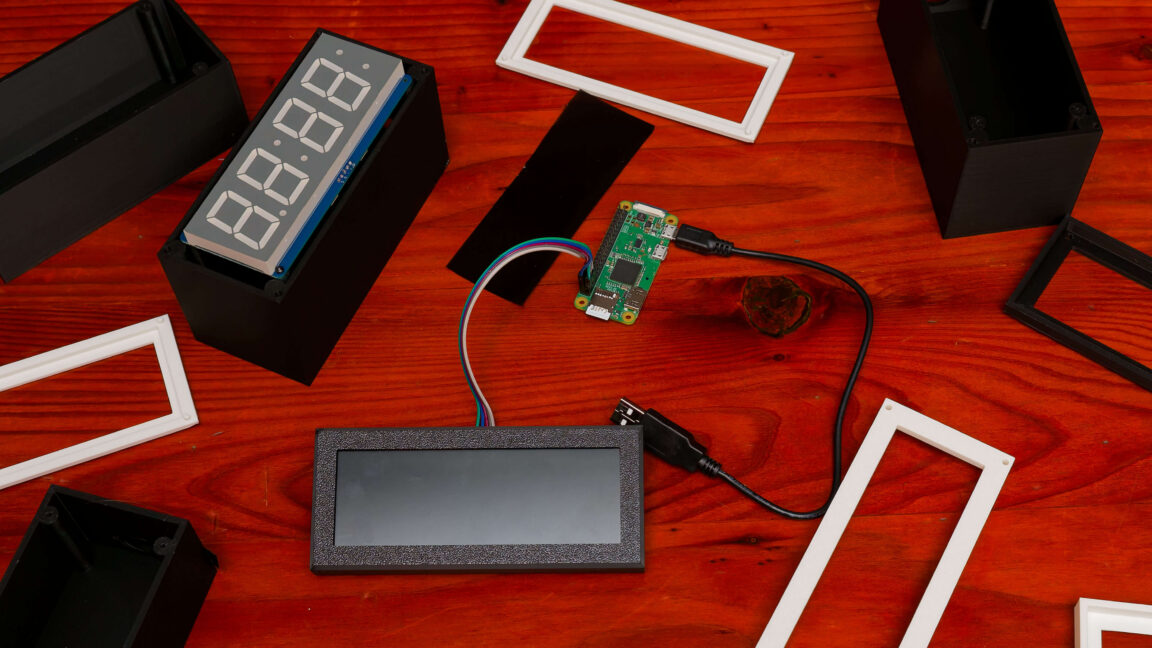
- "One, the path not taken, started with an Arduino or Arduino-like microcontroller. The other began with a Raspberry Pi or Pi-like computer-y thing. I went with the Pi, variously using both a Raspberry Pi Zero W and Zero 2 W."
Ok, so instead of bumping your clock +- one hour twice a year you preferred distro upgrades?
by sasaf5 - It's a clock. Does it really have to have remote updating, a command line interface, an Internet connection, and HomeKit integration? That's too IoT.
I have three La Crosse clocks that run off the NIST time signal out of Boulder, CO, and need their AA battery replaced maybe once a year. The real challenge is running such a thing on a small battery for a year.
I once made a small clock that displayed "A LITTLE AFTER SIX" and such, changing its text every five minutes. Needed a power connection, though.
by Animats - I’ve had a Phillips “atomic” alarm clock beside my bed for 23 years that just sets based on radio signal and auto restores if the power is lost, to which it has a backup 9v battery.
There’s a time zone setting offset slider and a DST slider. I basically touch it twice a year, maybe another if I move time zones. I’ve only had to touch it for DST (never switched time zones). Takes me conservatively 10 seconds to find and flip, so it’s taken me 460 seconds or a little under 8 minutes in the past 23 years to do time adjustments.
While these efforts are definitely fun hobby projects, there are cheap reliable solutions out there with minimal intervention that consume the NIST radio signal for time.
Just for anyone interested who wasn’t aware there’s some “old school” time broadcast solutions out there too besides NTP: https://www.nist.gov/pml/time-and-frequency-division/time-di...
by Frost1x