Join the discussion

Write your take first — we'll ask for email only when you're ready to publish.

  • Hacker News
  • This is really interesting. Investment firms could incorporate this kind of simulation into their products.
  • Yes, and the network setting is flexible enough to allow smaller supply chains where nodes don't have price setting power
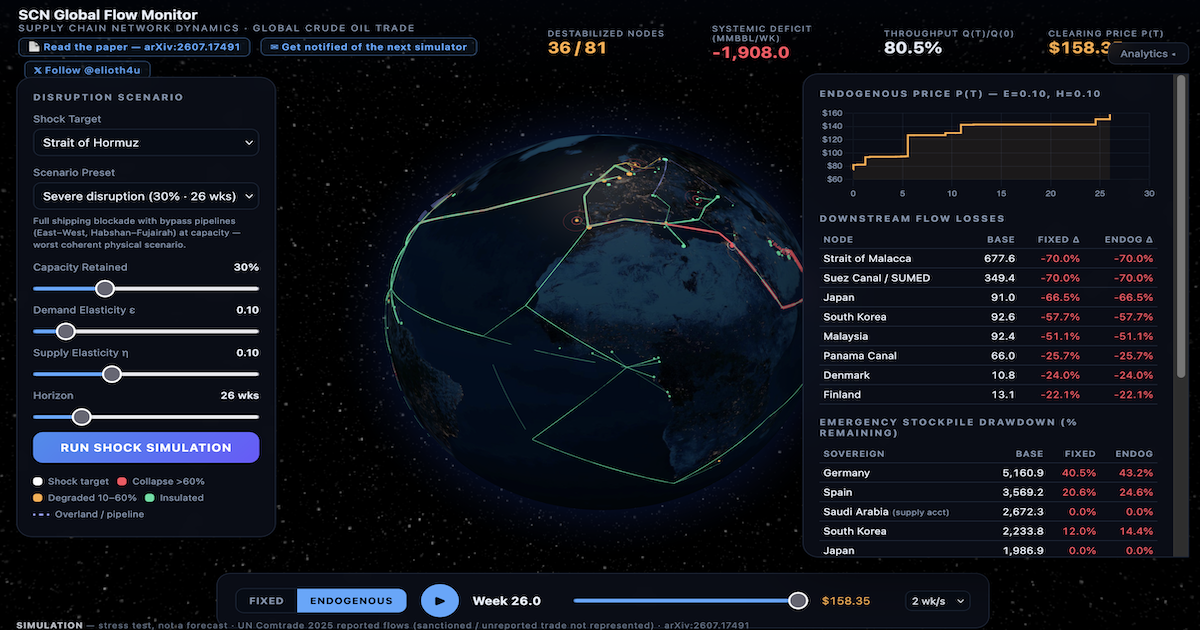
  • Nice. How does this stand up against backtesting with recent data? Also, i thought China's emergency stockpile is about 1.4b barrels or close 5 months of domestic consumption, and they are building it up atm. In the sim, it shows China's stockpile depleted after 1.2 wks?
  • Thanks! Two answers (repeated in other comments): UN Comtrade data doesn't include sanctioned oil (Iran), and nobody (except their government) knows China's actual stockpile. The model is more of a sensible baseline/stress testing tool than a prediction, the cool part is that anyone can BTON (bring their own numbers) and rerun their scenarios
  • Something seems to be wrong with the simulation: some countries run on reserves, and out of them, even with 100 % delivery.

    OP blames "Market elasticity parameters" for that, but they should offer a reasonable reset, or shouldn't they even oversteer towards filling up tanks, not clearing them out of no supply shock is seen?

    by a3w
  • OP, please add India as a shock target option if possible. It imports close to 80+% of its crude oil and gas requirements and is highly vulnerable to oil flow shocks.
    by wtmt
  • Thanks, added to list of possible UX improvements
  • btw this website tracks actual ships passing though (vs not)

    click on YTD for the shock of what's coming by the end of this year

    100+ per day vs 5-10 per day, you can see the tiny cease-fire and when it ended

    * https://en.macromicro.me/charts/94482/imf-strait-of-hormuz-n...

    * https://i.imgur.com/fDmbaPa.png

    oh and Strategic Oil Reserve is about to bottom out to the point where any lower brings permanent damage, imagine this going on through 2029 because you cannot "bomb your way to peace"

    by ck2
  • Nice that you allowed readers to customize the parameters! I personally thought the demand demand elasticity was too low and I was able to adjust it.
  • Maybe I missed it looking over the paper, or maybe they are implicit, but are you taking into account Saudi Arabia’s East-West Crude Oil Pipeline (Petroline) , I believe it does about ~7m bpd and Habshan-Fujairah (Abu Dhabi Crude Oil Pipeline / ADCOP) about ~1.5m bpd? If not you might be underestimating things, though they do take a bit of a warmup to get into capacity, and can't match completely Hormuz's flow.
  • This pipeline predates the data but its oil is routed to Bab-el-Mandeb which is in the network. That being said, the numbers are more of a sensible baseline as the actual flows for many countries are unknown/sanctioned.
  • The biggest missing piece is China. Assuming actual delivered price is not subsidized by Western countries, you need to put in what if China demands that reflect the current price. Chinese in reality don't consume that much oil as what we thot they do from the oil purchases in the past. I assume Chinese just ramp down the purchase even though their consumption is well below that. Plus the hidden supplies from Iran and Russia to China via land route.
  • Someone shared a video on this above:

    https://news.ycombinator.com/item?id=49043797

    Another crucial element is land transport. The Gulf countries have developed a fleet of trucks to help offset some of the crude oil passing through the Strait.

  • Very interesting. Here in India people were very concerned about potential cooking gas shortages (LPG) when the disruptions began which is also a good example of usually-overlooked dependencies on the the Strait
  • and the interesting thing is that the common factor is that all these crises (oil, financial, gas) spread silently until a node collapses and there is a domino effect over the whole network
  • What concrete predictions does your model make?

    What developments in pricing/other would indicate that your model is wrong or incomplete?

    Nice website regardless, but I'm a bit skeptical that the dynamics of the global oil/energy market can be accurately predicted.

  • >What concrete predictions does your model make?

    Well, the model is less of a prediction and more of a stress testing tool. But under the hypothetical closure scenarios it shows the timing the oil reserves of distant countries exhaust, as well as the systemic effects on pricing (the France paradox).

    >What developments in pricing/other would indicate that your model is wrong or incomplete? The model has a stylized way of incorporating pricing as a function of the total supply. In practice, when countries ration their oil that's beyond the scope of the model. That being said, the implied pricing trajectory is estimated and could be tested (the staircase graph showing prices constant while countries absorb the shock with their reserves and rebalanced whenever there is a reserve depletion).

    >Nice website regardless, but I'm a bit skeptical that the dynamics of the global oil/energy market can be accurately predicted. Thank you! Indeed, but I think having at least a stylized testing tool might be useful for policymakers :$ (assuming decisions are ever data-driven lol)

  • It's making crude predictions.
  • Tangentially related but just watched this pretty interesting youtube mini-doc-thing about the recent moves China has been making regarding oil (and its bigger picture): https://www.youtube.com/watch?v=BkA0bkb6ZO0
    by neom
  • Clicked it and was greeted by a YouTube ad opening “How the fuck am I going to get a big dick from eating gelatin?” And then the woman in scrubs on the cowboy’s front porch explained it all to him.

    It’s nice because it ensures I’m never going to get over-smart from watching YouTube. Plus I gotta go get some Jell-O.

  • That video was masterfully done, and it’s shocking how quiet the mainstream and financial media has been about this topic. Everything is an AI chip story, and the looming oil crisis is completely under discussed because we have goldfish memories and can’t appreciate what a massive move China made.
  • An interesting fact to consider is that the US stockpile (the Strategic Petroleum Reserve) is reported as the total of sour (high sulfur) and sweet (low sulfur) crude oil. The sweet stock makes up about 1/3 of the reserve and hardly varies at all. This is because US refineries are virtually all configured for sour crude: due to a mistaken belief in the 1990s that sweet crude was running out, the industry bet the farm on sour crude refining, and if sour crude runs low, it's extremely economical to switch.

    As a result, almost all the draw from the SPR is of sour crude (currently ~5 million barrels/week). However, you can't just use up all the reserve because as levels get lower brine must be pumped into the storage chambers to retain pumping pressure, and the more brine that is pumped, the more the output quality declines.

    The weekly reports indicate a total in the SPR of about 300mbb, of which ~100 are sweet and 200 sour. But for the reasons above, output becomes unusable one the sour levels fall to ~140-150mbb, at which point there is almost certainly a severe diesel supply shock. At current drawdown rates, that would be sometime around October/November, right in the middle of harvest season when demand for diesel is highest.

    There's more complexity to this than I want to type out in a HN comment, but not that much more. Draw your own conclusions.

  • I can't believe Joe Biden did that!
  • Isn't this the reason why they specifically targeted Venezuela, to get their oil?
  • > virtually all configured for sour crude

    They have retooled them in the past 40 years for the actually accessible inputs and desired distillates.

    by veqq
  • Well that's also election time so the timing could not be better
  • This is an interesting insight, as usable reserves < reported reserves the clocks in the model are optimistic
  • > would be sometime around October/November, right in the middle of harvest season

    Right in the middle of election season.

  • I think the reserves have more complex dynamics. The law requires 250 million barrels to be kept but the pumping rate decreases as more is pumped. Also, there's various estimates that indicate that the storage areas will lose structural integrity and start to collapse at levels higher than 250M barrels. I'm not sure anyone really knows about the levels for sure and the best estimates are probably kept secret for security reasons.
  • Should have said 'extremely uneconomical to switch. Sorry for the confusion.