Join the discussion

Write your take first — we'll ask for email only when you're ready to publish.

  • Hacker News
  • I really wanna call it a planet. It doesn't orbit a proper star, but if we call similar objects that don't orbit a star at all rogue planets I don't see why not call it just a planet.
  • David Kipling has a very good short video about this announcement: https://youtu.be/qreL7htXp98?si=vBmxwW87igExZz8l

    (tl;dw it's an exciting discovery but moon is the wrong terminology for what was found)

  • About time!, I cant wait till we start putting large hardware on the dark side of the moon. That will make JST look like a toy.
  • The radio silence which makes the far side so attractive will also present our most significant challenge in communicating with that hardware.
  • The far side of the moon is no more or less dark than the side we see.
  • > Instead, it circles a brown dwarf, an object larger than a planet, that orbits the CD-35 2722 star.

    Isn't the dividing line between the largest possible gas giants and the smallest brown dwarfs a bit fuzzy?

    https://en.wikipedia.org/wiki/Substellar_object

  • The definition isn't fuzzy, we define a brown dwarf as an object that has undergone deuterium fusion.

    The fuzziness is in the physical properties needed to achieve that. 13 Jupiter masses is generally the threshold where deuterium fusion starts, but that can vary: a brown dwarf composed of only primordial H and He would need a bit more, while one with some heavier elements from previous generations of stars will be denser and need slightly less. Rotation speed also matters: a faster rotator will experience centrifugal force and thus have less interior pressure.

    And there is fuzziness in what we can observe, so sometimes we're not sure if an object is a brown dwarf. We may not know its exact mass and composition, and we might not be able to tell if it's radiating energy from deuterium fusion, or just from gravitational compression, or (in a binary system) if it's just reflecting light from its companion star.

  • The definition of a brown dwarf is that there is enough heat and compression for deuterium and/or lithium fusion, but not protium fusion.

    The exact model limit is unclear, but the physics modelling is relatively straightforward.

  • I wonder if this thing in turn has something in orbit around it? At the size I wouldn't surprise me if it had satellites of its own in orbit, leaving open the question of what to call them. (I'm no astrophysicist, is this really possible I don't know, but it wouldn't surprise me. What would surprise me is if we could detect them)
  • I had to look it up and it is theoretically possible, they could be called sub moons or moonmoon. I'm partial to the name moonmoon personally.
  • https://en.wikipedia.org/wiki/Subsatellite:

    “A subsatellite, also known as a submoon, moonlet or informally a moonmoon, is a "moon of a moon" or a hypothetical natural satellite that orbits the moon of a planet”

  • Literally not a moon, that headline is ridiculous (not posters fault)

    but Nancy Grace Roman Space Telescope WILL find Earth-sized exoplanets and even REAL moons

    I am stupid-excited to see it launched/first-light in my remaining lifetime (Musk better not screw it up)

    For perspective on the technology, JWST "only" has 28mbps downlink

    NGR has 500mbps downlink, that's right 1.5 TERABYTES PER DAY download speed

    all from ONE MILLION MILES AWAY in L2 (11 seconds ping time!)

    Technology is getting amazing!

    by ck2
  • > but Nancy Grace Roman Space Telescope WILL find Earth-sized exoplanets and even REAL moons

    I find Earth-sized exomoons quite exciting. Imagine the civilizations that can develop around those.

  • Brown dwarfs fascinate me, they can be at room temperature (range from about 2,800 K down to 250 K (roughly 2,500 °C to -23 °C / 4,500 °F to -10 °F)

    You could basically have a bath in a brown dwarf, sure you might not last long, but still...

  • The idea of a black dwarf is also pretty wild. The universe isn't old enough for any black dwarves to exist yet, but eventually the brown ones will radiate enough heat away that they're no longer held up by the vibrational energy of the atoms they contain. They'll stop being fluffy and settle into a mode where they're held up only by electron degeneracy pressure (a.k.a the Pauli exclusion principle)... it's a bit like how neutron stars are stable because they're not so massive that they collapse to a black hole. Black dwarves will be stable because they're not so massive that they collapse to a neutron star.

    What will this substance look like? Will it ring like a bell if struck? What color will it be? Will it conduct electricity? If so, how? Are the atomic nuclei now the charge carriers because the electrons are stuck? It would likely be a super-thermal-conductor, does that have any analogous properties to a super-electrical-conductor? Which of these can we observe without the sensor collapsing to degenerate matter itself?

    I hope there's life around to conduct these experiments when they become possible.

  • An important phrase from the article to consider before commenting: "This system is somewhat hard to define using Solar-System-based words like ‘planet’ and ‘moon’"
  • We don't really have that nomenclature. We just recently decided what a planet it for the solar system, and even that is contentious.
  • I know this is besides the article and all, but why would the Chilean flag be the only one to have 8px left margin? This is killing me...

        <div style="margin-left: 8px" title="Chile" class="sprites-flag_cl"></div>
  • Now I can't unsee it :/
  • The flags have also all (except for Finland, which appears slightly wider?) been squeezed into a uniform 3:2 aspect ratio; some of them (e.g. Belgium, Switzerland, United Kingdom) properly ought to have different proportions. I understand they can look more aesthetically pleasing when they’re all the same size, but it’s another little detail to notice. :-)
  • I believe such organisations tend to do such things very intentionally :-)

    About ESO [1]

    > We are an intergovernmental organisation established in 1962 supported by 16 Member States (Austria, Belgium, Czechia, Denmark, Finland, France, Germany, Ireland, Italy, the Netherlands, Poland, Portugal, Spain, Sweden, Switzerland and the United Kingdom), our host country Chile and strategic partners.

    So Chile has a distinct status, hence the margin...?

    [1]: https://www.eso.org/public/about-eso/

    by molf
  • I guess it is more of a derivative of the question: "in which bucket should we put the brown dwarf? Is it a star or a planet?". The answer is neither of course; but since it is more closely related to stars than to planets, I'm more inclined to call this satellite an exoplanet (instead of exomoon).

    That being said it is still a nice finding, way more difficult to discover than "normal" exopanets.

  • Planet++
  • Anybody know why the brown dwarf isn't considered a planet?
  • I thought we’re supposed to call them dwarf planets now. Dwarf star, dwarf planet.
  • A small dense planet, which orbits a star, is orbited by a larger gaseous moon. It's interesting the discovery is in Chile which has some of the best night skies, a Class 1 on the Bortle scale specifically in the Atacama Desert. Hoping to make it out there one day.
    by hdz
  • At some point I did some research and the Atacama was suggested to me as the best vantage point on earth for simple skygazing. Definitely on my bucket list.
  • I recommend it. I'd been living in places that were a class 9 on the bortle scale, with occasional camping trips to places that were a class 5. I recently moved to the south island of New Zealand, and it's a class 4 in town and a class 1 on camping trips nearby. Completely different skies. It's rainy here though, so we don't get cloudless skies nearly as often as Chile does.
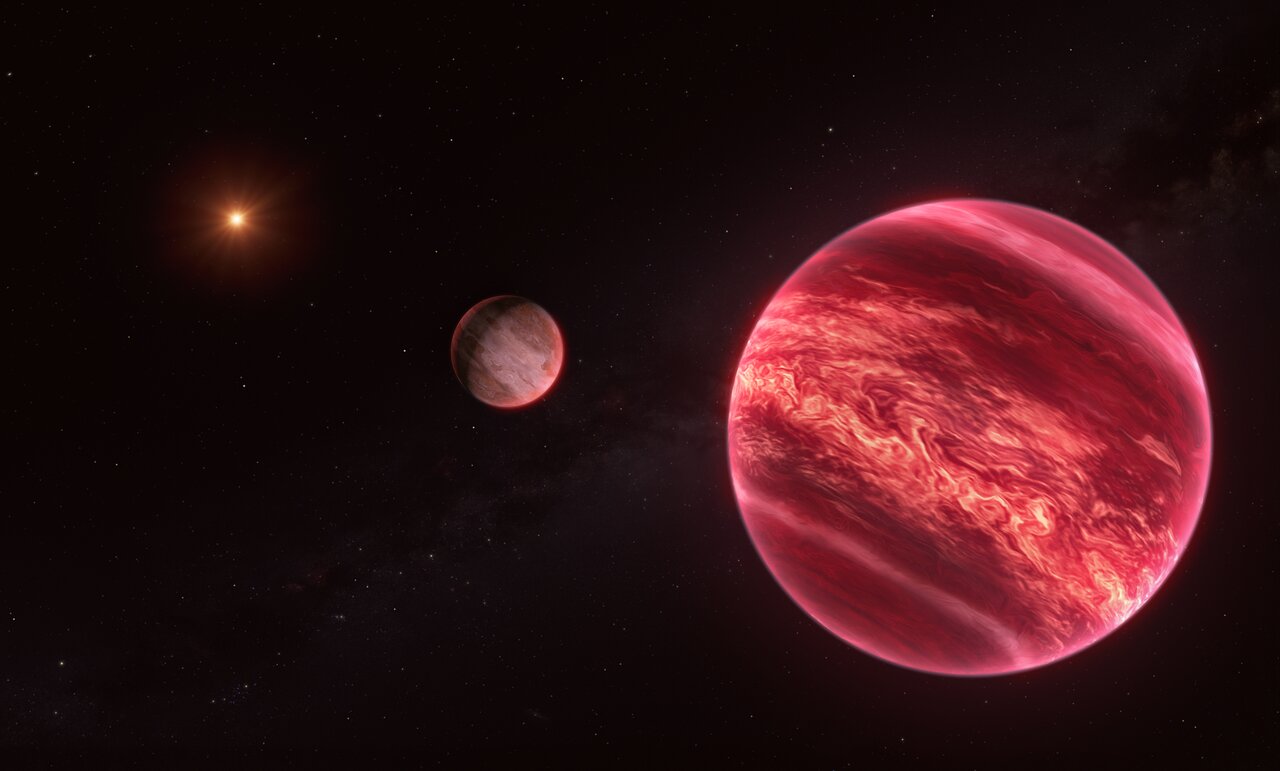
  • Worth noting that the artist's impression is... not accurate. Both CD-35 2722 b (the brown dwarf orbiting the primary star) and CD-35 2722 b I (the exomoon orbiting the secondary) should be much closer in size. It is estimated that Jupiter is essentially the largest any gas giant can get; adding more mass will simply increase density and interior temperature until deuterium and lithium fusion and brown dwarfdom, and then at around 80 Jupiter masses, protium fusion and stardom.

    Look at Barnard's Star[1], which is actually a fusing red dwarf star: it is not much bigger than Jupiter.

    [1]: https://en.wikipedia.org/wiki/Barnard%27s_Star

  • > It is estimated that Jupiter is essentially the largest any gas giant can get

    That does not appear to be the case if we mean mass, not diameter.

    https://en.wikipedia.org/wiki/Super-Jupiter

    https://en.wikipedia.org/wiki/CoRoT-3b