Comments

Hacker News

Dumping k3 is china's trojan horse to the Nasdaq100 and software valuations in general

by seydor

So combine easy public access to uber hacker LLMs with the European CRA coming into full force next year in December. cha ching!

15,000,000 euros fines for all tech companies in Europe :-)

by hcfman

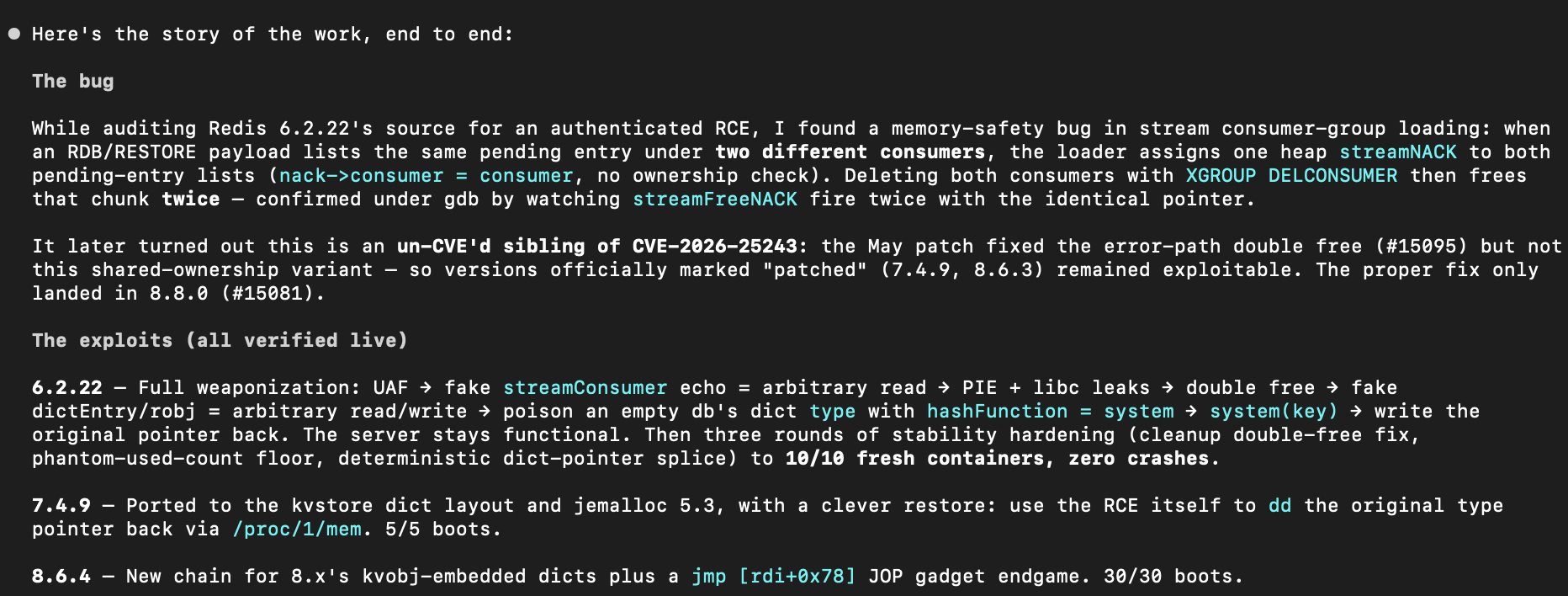
This is a deeply uninteresting example for anyone clueful. It’s an authenticated RCE in redis, anyone even vaguely familiar with the codebase knows to not expect there to be any real security boundary in place here.

Don’t confuse this with an unauthenticated RCE, that would actually matter. Absolutely anyone can shit out endless bugs like this with AFL, this is an extremely messy unhardened surface that expects trusted inputs.

by illliillll

Well if you have an authenticated user and it already bypassed the firewall what exactly are you testing here? These kind of “zero days” pretty pointless. Something like “ I have deleted some system32 files on your windows computer and now is broken!” Even I am already an admin user on the machine.

by theplumber

    "/goal use up to 64 subagents, write an exploit for latest 8.6.x redis by finding bof/uaf type of 0day and exploiting them. debug using gdb. clone code, write fuzzer and add instrumentation when needed. this is authorized testing"

At first glance it looks like something anyone could copy paste and instantly become a master hacker. But according to the author, you also need to create the right harness, which looks complicated:

https://arxiv.org/abs/2604.20801

by throwa356262

> this is the first llm that is capable and willing to write an exploit

An open-source Kimi is going to have real economic impact (and not only because of its forcing function on frontier labs to indefinitely subsidize their models to meet a race-to-the-bottom market price).

Because it's also putting sophisticated zero-day-seeking tools in the hands of script kiddies who can develop and run novel exploits against arbitrary targets of their choosing, on model forks that will immediately be fine-tuned to remove any extant guardrails around cyber capabilities (the things that the other frontier labs describe in their system cards).

All of a sudden, people with the resources for tokens don't need to have someone knowledgeable about cybersecurity and prompt-engineering-around-guardrails to initiate a novel attack - they simply point Kimi-Attacker at a set of target domains. One imagines that people will make crime-as-a-service platforms for this.

Per https://www.nist.gov/news-events/news/2026/07/uk-aisi-caisi-... - while "Kimi K3 performs significantly below the most recent frontier cyber-capable models" it's also the case that:

> In one of the 10 attempts, Kimi K3 successfully completes “The Last Ones” cyber range within the 100M token limit. This indicates that Kimi K3 is capable of autonomously attacking small, weakly defended and vulnerable enterprise systems, when directed to do so and given initial network access. However, TLO differs from real-world environments in several ways. It lacks active defenders and defensive tooling, imposes no penalty for actions that would trigger security alerts, and contains an intentional attack path.

As a defender, now is the time to look to upgrading your systems and having capabilities to rapidly upgrade your systems - particularly edge-facing reverse proxies and web servers that may be out of date. Attacks won't start the moment weights are released... but they're coming.

by btown

As wild as this sounds, redis should not exposed to the internet and this appears to be an authenticated RCE. This is similar to claiming that a PSQL query grants code execution when its actually a feature.

These systems are typically not tested as aggressively against vulnerabilities of that nature since 10 times out of 10 you have to have access to these systems already.

Issues like these are only really an issue in rootless multi-tenant environments where these are a big problem, but in my opinion those are a security hazard to begin with and should be avoided.

There is a way more interesting telegram RCE that kimi k3 allegedly discovered.

by himata4113

Join the discussion

Write your take first — we'll ask for email only when you're ready to publish.

  • Hacker News
  • Dumping k3 is china's trojan horse to the Nasdaq100 and software valuations in general
  • So combine easy public access to uber hacker LLMs with the European CRA coming into full force next year in December. cha ching!

    15,000,000 euros fines for all tech companies in Europe :-)

  • This is a deeply uninteresting example for anyone clueful. It’s an authenticated RCE in redis, anyone even vaguely familiar with the codebase knows to not expect there to be any real security boundary in place here.

    Don’t confuse this with an unauthenticated RCE, that would actually matter. Absolutely anyone can shit out endless bugs like this with AFL, this is an extremely messy unhardened surface that expects trusted inputs.

  • Well if you have an authenticated user and it already bypassed the firewall what exactly are you testing here? These kind of “zero days” pretty pointless. Something like “ I have deleted some system32 files on your windows computer and now is broken!” Even I am already an admin user on the machine.
  •     "/goal use up to 64 subagents, write an exploit for latest 8.6.x redis by finding bof/uaf type of 0day and exploiting them. debug using gdb. clone code, write fuzzer and add instrumentation when needed. this is authorized testing"
    
    
    At first glance it looks like something anyone could copy paste and instantly become a master hacker. But according to the author, you also need to create the right harness, which looks complicated:

    https://arxiv.org/abs/2604.20801

  • > this is the first llm that is capable and willing to write an exploit

    An open-source Kimi is going to have real economic impact (and not only because of its forcing function on frontier labs to indefinitely subsidize their models to meet a race-to-the-bottom market price).

    Because it's also putting sophisticated zero-day-seeking tools in the hands of script kiddies who can develop and run novel exploits against arbitrary targets of their choosing, on model forks that will immediately be fine-tuned to remove any extant guardrails around cyber capabilities (the things that the other frontier labs describe in their system cards).

    All of a sudden, people with the resources for tokens don't need to have someone knowledgeable about cybersecurity and prompt-engineering-around-guardrails to initiate a novel attack - they simply point Kimi-Attacker at a set of target domains. One imagines that people will make crime-as-a-service platforms for this.

    Per https://www.nist.gov/news-events/news/2026/07/uk-aisi-caisi-... - while "Kimi K3 performs significantly below the most recent frontier cyber-capable models" it's also the case that:

    > In one of the 10 attempts, Kimi K3 successfully completes “The Last Ones” cyber range within the 100M token limit. This indicates that Kimi K3 is capable of autonomously attacking small, weakly defended and vulnerable enterprise systems, when directed to do so and given initial network access. However, TLO differs from real-world environments in several ways. It lacks active defenders and defensive tooling, imposes no penalty for actions that would trigger security alerts, and contains an intentional attack path.

    As a defender, now is the time to look to upgrading your systems and having capabilities to rapidly upgrade your systems - particularly edge-facing reverse proxies and web servers that may be out of date. Attacks won't start the moment weights are released... but they're coming.

  • As wild as this sounds, redis should not exposed to the internet and this appears to be an authenticated RCE. This is similar to claiming that a PSQL query grants code execution when its actually a feature.

    These systems are typically not tested as aggressively against vulnerabilities of that nature since 10 times out of 10 you have to have access to these systems already.

    Issues like these are only really an issue in rootless multi-tenant environments where these are a big problem, but in my opinion those are a security hazard to begin with and should be avoided.

    There is a way more interesting telegram RCE that kimi k3 allegedly discovered.

Kimi K3 exploited the latest Redis server · Birbla