Join the discussion
Write your take first — we'll ask for email only when you're ready to publish.
- Hacker News
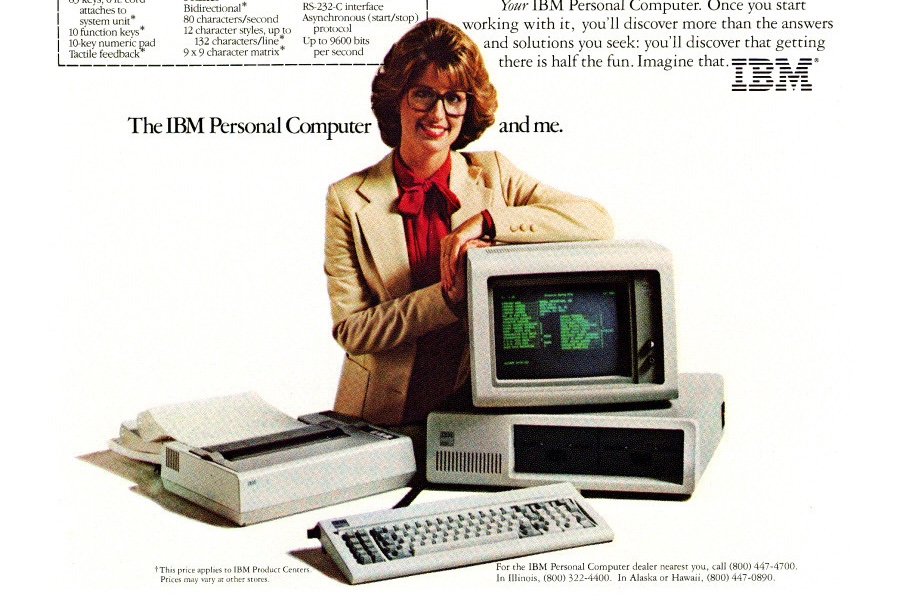
- In retrospect, I think IBM would have been much better off if it had done two things differently... Made the deal with MS such that any external sales had a minimal price with a kickback to IBM, and that IBM would license its BIOS directly to third party MFGs.
If they'd have done that, much like MS, they'd have a piece of every PC sale, not just their own hardware.
That said, I don't think IBM culture could ever have that level of foresight or for that matter hold back the greed to try to own the whole pie. Just watching what became of OS/2. By the time NT4 came out, it was pretty much over... NT4 was leaps and bounds nicer to work with than OS/2 had been, and the software much more plentiful.
Not that MS was much better in terms of monopolistic tendencies, they managed to leverage their position both better, and in many ways have better overall offerings. Then again, MS today is a poor shadow itself of what it could have been had they not tried to start leveraging their own desktop customers for pennies on the dollar. Linux will erode their market share over time, and frankly, I'm surprised that MS doesn't have an AppImage/Flatpak version of MS Office for Linux that they license. They still have relatively nice tools, and though their online versions mostly work, it's not nearly as good and a lot of the integrations are still clunky.
by tracker1 - One point I was not aware of is that Gates offered to put IBM in touch with SCP for SCP-DOS, but IBM turned down the offer because it preferred a single source!
(It's understandable. Microsoft, even if tiny compared to IBM, was a real company with a real business model. SCP was just a couple of guys in one office.)
by TMWNN - Not bad, but I like this one better: https://arstechnica.com/gadgets/2017/06/ibm-pc-history-part-...
And specifically for the IBM choosing Microsoft: https://nemanjatrifunovic.substack.com/p/why-ibm-turned-to-m...
by whobre - I quite clearly remember this magazine issue from the time.
A giant, god-like hand reaching out from the clouds. Tagline "THE JOLLY GIANT DELIVERS THE GOODS".
https://www.computinghistory.org.uk/det/1706/Personal-Comput...
by inguz - What happened to the little tramp with the walking stick? I had one of those sticks (as a biro) off an IBM salesperson, early to mid 80s, and IBM must have paid an ungodly amount to Chaplin for the IP.
But I really did love the IBM PC. And very sad about Don Estridge and his wife - if he had joined Apple they might still be alive today.
by zabzonk - When you think of it, Apple (and so Jobs) have really missed the mark with the Apple III. The Apple II (1977) was really good with its expandability capacities, its keyboard, its monitor, its floppies drive and its good installed base. It was a very advanced machine. The PC is a kind of copy. So the Apple III (1980) should have been the one which became the market standard. It miserably flopped.
Commodore with the PET (1977) was a pioneer too with a good installed base but the CBM-II (1982) was a poor upgrade which had no internal cards connectors. Not very appealing. And the C64 was not quickly upgraded in the way it could have be.
And those three machines were stuck with the brilliant 6502 (1975) but which did not appeared into a 16 bits version until 1985 thanks to Commodore which did not really invested to develop MOS Technology.
So the choice of the 8088 8/16 bits CPU (1979) by IBM was really a game changer. It made the machine open to the future and viable. Another reason to choose it.
by Instantix - Having lived through that time I find this article extremely accurate and focused on the important stuff.
I didn’t pay much attention to the PC at that point (I was programming Lispms, Dorados and KL-20s) but it was impossible to ignore.
by gumby - If you have a few hours to kill, the Youtube Channel "Another Boring Topic" has a multi part series on the "rise and fall of the IBM PC". The comparatively short Part 1 is here: https://www.youtube.com/watch?v=Er8wcWsG7sE
The Channel has similar video series on OS/2, VisiCalc, Microsoft Excel and early Windows (far from completion). The videos are generally very detailed and well researched, often contrasting accounts from different source or even reaching out to people involved.
The already slow pace of the channel has slowed down a lot. In an update video a while back, the author has announced that the background research for the IBM PC led down an unexpectedly deep rabbit hole and his script eventually spiraled into an unfinished book that will now probably turn into a two-parter itself.
by st_goliath