Join the discussion
Write your take first — we'll ask for email only when you're ready to publish.
- Hacker News
- So under most brewing conditions a nonzero amount of this microbe survive, but that count is 3 orders of magnitude lower what might be termed a “therapeutic dose?”
What even is a good experimental design for probiotic tea? Brew -> agitate in hydrochloric acid & digestive enzymes for X minutes -> mix with billions of existing gut microbes (that may kill this microbe or out-compete it for resources) and incubate at body temperature -> count the number of new colonies of this particular microbe?
- Spore forming bacterium are notoriously resistant to most ways of killing them. There's even a species that can resist radiation amounts that are 1000x the dose needed to kill a human.by weberer
- That was a fun read. The author has a really good storytelling style.
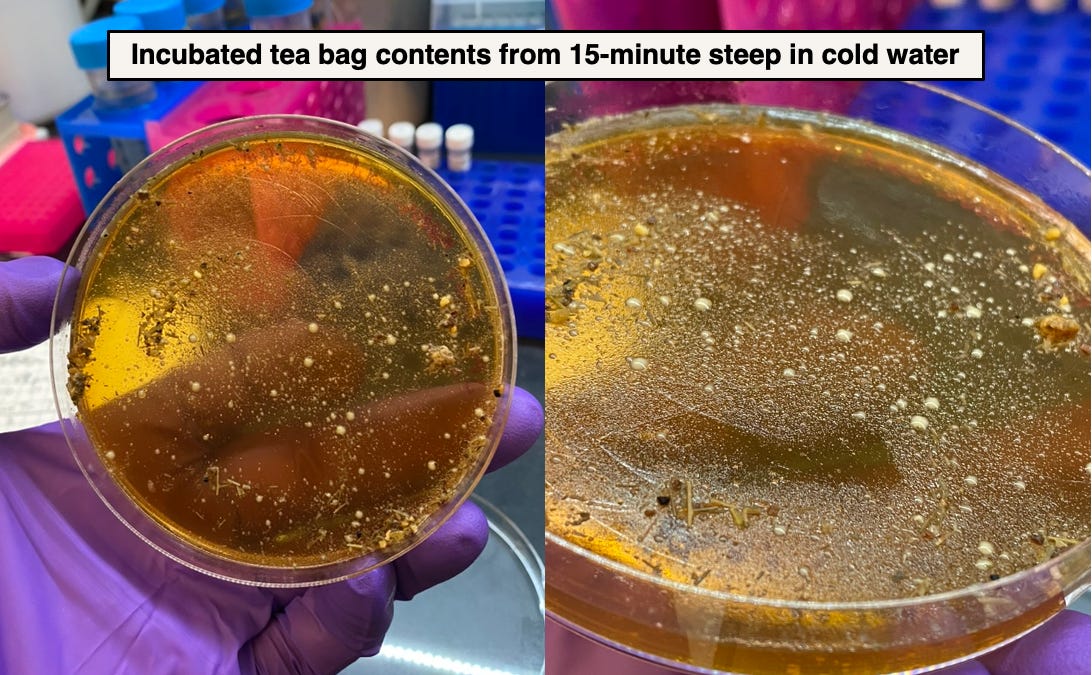
I dont understand why the cold brew test had fewer bacteria than the steeped teas. If the bacteria are shielded in spores, shouldnt it be expected that they have the same amount of bacteria?
by donkeyboy - This almost throwaway line from the article struck me as an example of what we can do with technology, if we choose to put our billions of dollars towards it: "I downloaded the BC30 genome".by cratermoon
- In case anyone else is curious about the current status:
> The Milk was declared missing on August 20th, 2022.
> The dorm’s extended mailing list of over 300 current students, alumni, and other assorted Random-adjacent humans was contacted, twice.
> In the end, no Milk.
https://mitadmissions.org/blogs/entry/guest-post-the-random-...
by thih9 - A great read from the author. It reminded me of my previous life as a bioprocess engineer, where I led investigations into biologically contaminated batches in biotech. It was fun stuff and I still remember some of the best advice I received from an Executive Vice President to never underestimate a microbe.
On this subject, I once led an investigation in which Bacillus cereus somehow survived in situ media sterilisation for 30 minutes and >121.1°C, despite there being no cold spots. At the end we realised it was the bioburden load of a media component and water temperature used during compounding.
by tippa123 - People interested in this: if you are ever in Amsterdam, I recommend to visit the Micropia museum: https://www.artis.nl/en/artis-micropia
Among many stunning things, they have a shelf full of foods and drinks (behind glasses) with age labels, ranging from days to years. It is fascinating to see how they evolve over time.
by carschno - > about 7 out of 10 people in the U.S. were prescribed antibiotics in 2024 according to <CDC data>.
This blew my mind so I double checked the source. It links to https://www.cdc.gov/antibiotic-use/hcp/data-research/antibio... which contains some numbers but not the claim. It links to various reports, the latest one (2024 at the time of writing) https://www.cdc.gov/antibiotic-use/media/pdfs/2024-Annual-Re... says at the top of page 2 that the prescription rate is 679 and 775 doses per 1000 people in 2024, depending on the gender. That matches the 7-in-10 number so I'm guessing this is where the statistic comes from
Doesn't that reflect how many prescriptions there were rather than what number of people got it prescribed? See also page 3 where Mississippi has 1167 doses per 1000 persons. Either the number of people is wrong (if the prescription given to a tourist and counted towards this statistic, the tourist should also be counted as person, but the CDC says they take the population count from a census) or it's about doses and not about what part of the population got an antibiotic in the last year. In both of these cases, you can't conclude 116.7% of people got antibiotics prescribed. The claim in the article based on that CDC data sounds to me like saying 520% of the people drink alcohol when, in reality, 10% drinks a bottle a week and the rest nil
I'm probably misunderstanding the CDC report but I'm not sure how I should be able to tell that
by Aachen