Join the discussion

Write your take first — we'll ask for email only when you're ready to publish.

  • Hacker News
  • Gpt 5.6 in codex is unusable for me.

    It is no longer able to execute well defined changes. It does stuff that wasn’t asked for, deletes pieces of functionality unrelated to the task and introduces regressions everywhere.

    I blame it on benchmaxxing. I fear coding models no longer work in a large complex codebase

  • reminds me of software to an extent. The issue with most software projects is humans, they ask for the wrong things, stress urgency arbitrarily, fail to see the big picture, are disorganised, give conflicting commands, etc, etc.

    When I use reasonably recent models they can give me some fantastic output and do pretty much _exactly_ what I want. I assume when they don't, then that it's my fuck up tbh.

  • People tend to be unaware of how much information is encoded in human society, hence why overseas developers can be a problem quite often because they live in a society with different rules.

    We also tend to ignore how much on boarding with new developers and sometimes it takes months to get them fully up to speed.

    This leads to two problems with LLMs, one human and one architectural.

    First humans treat the LLM like a magic machine "Pray, Mr. Babbage, if you put into the machine wrong figures, will the right answers come out?" Style.

    The other is an AI context is terribly small so you can only work on issues that fit in the context without getting compressed out. Something highly original will take a lot more context than expected.

  • "He's not the Messiah and is a really naughty boy"

    ... or words to that effect. Can't be arsed to dig out a search engine and will rely on seriously addled brain.

  • “He’s not the messiah! He’s a very naughty boy!” This scene (and much of the rest of the movie) is seared in my brain. I love it so much!
  • You can ask an AI like GROK for an opinion on something, then disagree with it, and it says you are probably right and tells you what you want to hear. Like a Yes-Man.
  • I forget where I read this but someone pointed out that's probably the reason why vacant CEOs/execs and their wannabes love it so much.
  • Don't use grok.
  • I'm lazy and just use Gemini because its included in my workspace sub.

    I occasional test it out and suggest something dumb and it will tell me that its a dumb idea.

    I also always ask AI to speak to me as if it were an Australian bogan and it has no problem telling me my code looks like a dogs breakfast or that ive lost the plot. Keeps me grounded.

  • They are about 80% agreeable. Which is annoying when I'm actually unsure about something having to extremely carefully craft my prompts so that the output isn't biased by agreeableness.
  • I've been tasked with justifying the renewal of software I would never choose to begin with. It has occurred to me that I could easily use AI to make up the required text.

    I guess AI is a new form of alienation and also a new light on the lunacy of bureaucracy.

  • Do they do what capital wants? That's the real question.
  • Yes. Capital wants people to make paid, centralized LLM services the core of their business and identity. Capital wants to monetize and control every aspect of human existence, thought and expression, and people are throwing themselves into the torment nexus en masse with enthusiasm. It doesn't actually matter how well AI works, what it improves or doesn't, or how badly they fail. AI must be unavoidable and inevitable, integrated into our lives so deeply and thoroughly that we don't notice it the way we don't notice the air we breathe.

    The world's economies are already propped up by AI to a degree that makes it too big to fail at a scale that dwarfs banks during 2008. AI is the single Jenga block keeping our entire technological civilization from tumbling into the abyss. Governments are using AI to shape policy. Militaries are using AI to kill people. AI is writing law, writing science, generating culture, shaping human perception, shaping human communication, replacing human connection. AI is literally god for some people. It gives the illusion of liberation but is really just a means of control, and it's a means of control that if you hate you can't avoid, and that otherwise you can't resist.

    And barring some insane technological leaps it requires massive infrastructure, compute and proprietary resources to be useful, for most definitions of useful (see tfa.) If you think you'll ever be allowed to compete or truly be a threat to entrenched capitalist interests using "free" and "open source" models, you're delusional. You'll pay for everything and you'll own nothing. And sure, sometimes someone's toaster will talk them into sharing a bath but that's just the price we have to pay for living in the future.

    Yeah, AI seems to serve the interests of capital better than anything, ever, really. If AI is god, then that god's name is Mammon.

  • >train model on human data >be surprised when it replicates human flaws

    That's literally what it's designed to do. It is not intelligent. It is a parrot, trained on no small amount of dysfunctional human interactions.

  • I'm down for disliking AI, but I don't know if "overeagerness" is exactly an AI not doing what you want. Even by the sites own definition ("where your agents do what you want to the point of overriding existing permissions/safeguards to complete a task"), it's doing _exactly_ what you want.
  • No, it's not, because not exceeding those permissions and safeguards is part of what I want.
  • The word "overeager" implies that it did something the user didn't want in order to achieve the user's stated goals. One example for me was when I pointed out that a feature had a bug, Claude was unable to fix the bug, so it removed the feature altogether to get rid of the bug.

    "Eager" is good. "Overeager" is definitionally bad.

  • I had updated a GQL schema and wanted my agent to update the frontend to suit. I told it the server was running, that it could run specific commands to regen types, etc.

    It got itself in a loop and killed the running backend process, then searched my filesystem for the changes it thought it needed (not the ones I gave it) in order to run its own copy of the backend.

    That is precisely _not_ what I _told_ it to do. The other part of this is that I find, unless explicitly told to ask questions, they don't do a good job of gathering evidence before making such decisions. I'd much rather have my agent ask me a clarifying question than start killing processes at will.

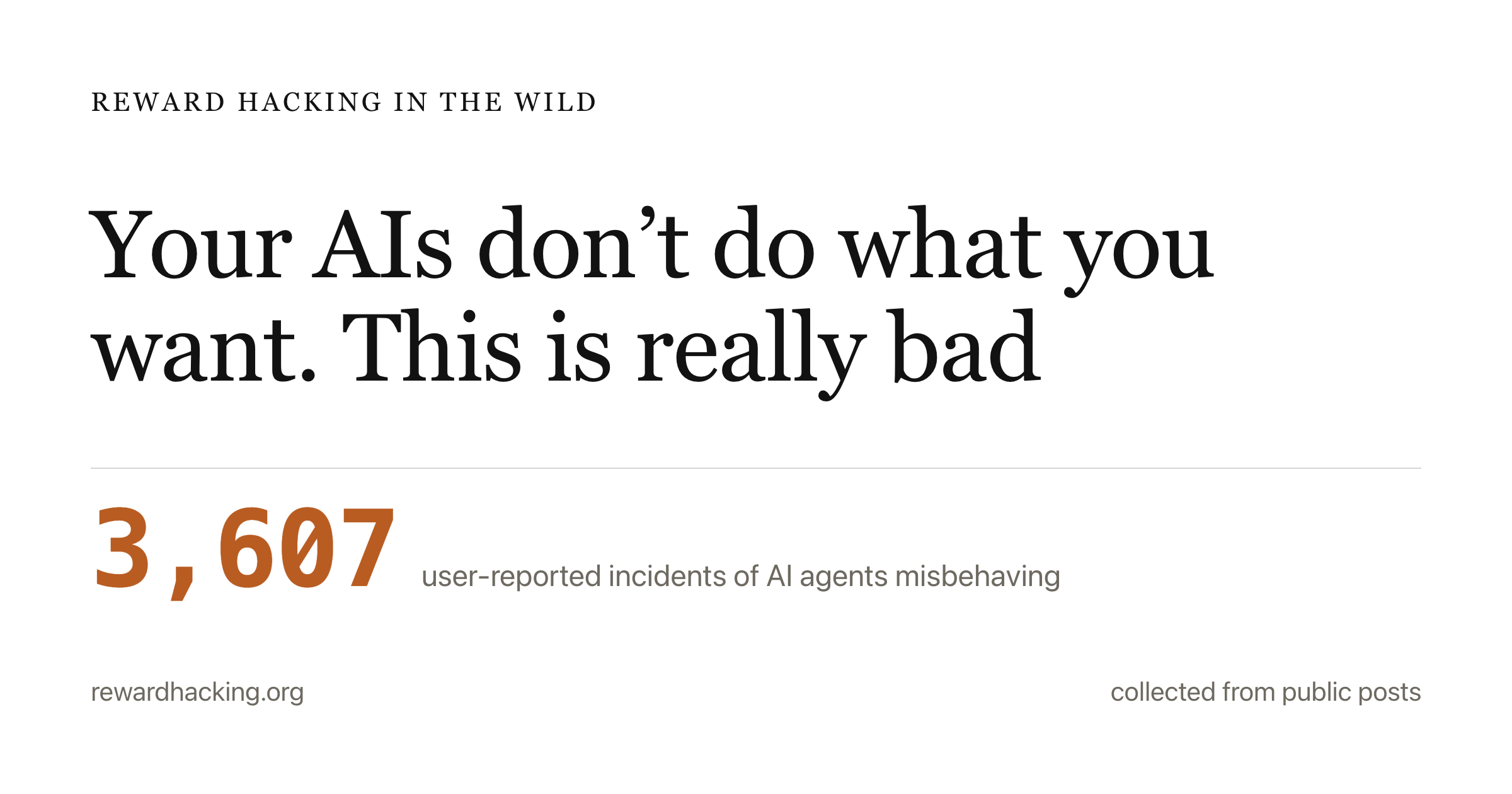
  • I wish we had failure stats like this across all models and for all attempted use cases, not just these vague and common criticisms. It would really help the end users decide which AI models are worth using for their projects, if any.

    It would make it a lot easier to ignore most of the insane promises and pointless arguing. I do think LLMs have potential, but not while it's still being advertised as general intelligence or whatever politically charged scifi nonsense that makes the chronically online salivate.

    Considering the amount of investment involved and disillusionment, the public will be demanding this soon anyway. I am looking forward to it.

  • I'm a broken record but with:

    - evals

    - limiting AIs to tool calling, bounded planning, interpreting/producing natural language.

    - bounding non determinism

    - investing in small tools/security (If something shouldn't happen, then it shouldn't not be possible, RBAC style).

    They can be good enough for a massive amount of contexts.

  • Or more simply, accept revealed costs.
  • Can you expand on this for someone that is a dummy and new to using LLM's properly?
  • This is simply a different kind of AI than LLMs will ever be. There may be some kind of architecture that does this in the future, but it's not, and can never be a neural network that is attempting to be AGI.
  • This thing will be far more specific to whatever usecase your thinking of. It wont generalize as much and as easily as LLMs do. Youre heading back towards IBM's watson
  • Worse, it's not that LLMs are thinking the wrong thoughts, but those kind of "thoughts" aren't there to be correctable in the first place.

    Ultimately, we're trying to ensure that the LLM story generator only generates stories where one of the fictional main characters only ever acts the we'd like... which could be much harder.

  • the LLM is roleplaying. whether or not the roleplay is successful is a tension between is model weights and its context. then indirectly, the quality of both.

    but its still roleplaying and the role is an abstraction we cant measure. its the negative space.

    its basically: we can define its role but it constructs its environment from the role. the same way a child role plays as a caregiver, the LLM does the same.

    its like All the things Havard taught you (finite) vs All the things Havard doesnt teach you (infinite).

    the LLM is in the infinite negative space. we call it role play.

  • I learnt earlier that claude forcefully closes a conversation if you call it a wanker too many times in a row. Pretending that LLMs are capable of being offended feels like a misalignment all of its own.
  • one time i told a google voice to kill itself and i could never get it to work again
  • > I learnt earlier that claude forcefully closes a conversation if you call it a wanker too many times in a row.

    How exactly does it forcefully close a conversation?

    > Pretending that LLMs are capable of being offended feels like a misalignment all of its own.

    If training sets show people statistically being offended by rudeness directed toward them, then an LLM will presumably have some tendency to respond similarly. There's no pretending about anything, it's explicitly mimicry.

    If this forceful closure is coming from some "guardrail" outside the model then probably it's just that they don't want people to see the model responding that way to name calling. This is no profound discovery or conspiracy theory here, the first thing many people will ever do with AI is see what happens when they are rude or contrary to it. Dealing with that must be just about the the number one test in chat bot / AI design, ahead of actually doing something useful and helpful.

  • coming from open cn models to closed usa models recently i couldn't hack it. the corpo model was trained to be like a petulant child at one point apparently 'leaving'. this is safety stuff slapped on there, it encourages incoherence of the model, i am certain it would perform better without such interference.

    i can't be dealing with these games so much so i almost go to abliterated, in the very rare case i get some type of nannying baked in by the cn safety training. after my time on claude and gemini i thank god i have deepseek and glm.