
Join the discussion
Write your take first — we'll ask for email only when you're ready to publish.
- Hacker News
- I would prefer to have figures how this compares to the traditional Haber-Bosch-process, how much energy is put into this, and how much fertilizer do we get for it, if it's just a PoC without evaluation of how much energy is used. in this whole process we got nothing NB: to beat Haber-Bosch you don't need much. it isn't only about the produced carbon dioxideby wolfi1
- This setup uses the Haber-Bosch process. It’s different because it’s not tied to the grid (it’s not actually different at all)
- Found this cool PBS video on the Western Minnesota researchers working on this. If you'd like to ingest this info in the form of a nine-minute PBS piece, here you go: https://pbswisconsin.org/watch/prairie-sportsman/fertilizer-...by megnaro
- Thought about something similar a few months ago, love seeing it in action. The article was terrible however, dunno why every other sentence is bold. Genuenly feels like I'm reading a middle schooler trying to fulfill a word usage/sentience structure quota.by kogasa240p
- I read that article. I don't know why. It was a difficult read.
Nearly every sentence has a bold-face phrase. There are no paragraphs, only sentences. It is borderline incoherent and very off-putting.
That style article needs to eliminated. Surely there is a better information source for this site and process than this online rag.
- Kinda looks like a low-quality executive summary of a longer text. I agree, it's garbage.
- It's AI-generated dog shit, and I feel bad for getting roped in by it. Another commenter noticed there is another article on that site that's almost identical despite being about a different topic: https://news.ycombinator.com/item?id=49049204
- the talk about "electricity can do things" misses whats actually interesting here. Working in the energy sector, the hard problem is rarely generating the power, it is getting it into the grid. connection queue runs for years and turbines regularly get curtailed when the grid c anncot absorb more. A flexible load behind the meter, like an electrolyzer making ammonia on site, monetizes energy that would otherwise be wasted or never get built at all. The fertilizer is almost a side effect, the real product is a use for stranded wind. i would also add that wind + battery would be much better both for stablization and also the same use as mentioned in the article.by MariusGjerd
- A nice thing about the fertilizer is that it is only needed for a few weeks out of the year, which means it can be produced intermittently and stored without causing problems. If there are two weeks of non-production due to weather that isn't an issue so long as it averages out over the year. One could imagine a plant that only runs when the electricity is almost free.by jandrese
- I work with a company that produces ammonia from local waste streams. The current policies and war has really hurt farmers. Certain fertilizers and other inputs have more than doubled in price, if they can even be found anymore.by bix6
- Sounds like an opportunity to scale up your business. If the competition suddenly gets expensive that is a market opportunity.
Of course it's never that simple. If the war ends tomorrow and fertilizer prices drop back to normal over the course of the next two years an expansion could find itself uncompetitive just as its coming online.
by jandrese - A loop where solar is converted to fertiliser using similar process , probably generating hydrogen as a side effect with some mechanism to probably capture some carbon for economically useful use when it reaches say an LCOE of 0.01 $/kwh and done on mind boggling scale might actually be the holy grail solution to a lot of problems at the same time. Might need quite a few breakthroughs in the material science scheme of things though. There are good reasons why hydrogen has never really taken off by itself even with so much scale, innovation thrown at it so far. The best hope is China doing to hydrogen now what it did to solar in 2010s.by newyankee
- Some will criticize renewable energy because the power output is spiky. This sort of thing is why that doesn't matter. There are plenty of things you can do with excess power. There's been research in manufacturing gasoline from the air. It's not economical to do for its own sake but when we're talking about excess power, that's not really a factor. Fertilizer is a new one (to me). But it makes sense. You'll still need phosphorus (phosphate) from somewhere.by jmyeet
- Sadly I suspect crypto mining may be more profitableby inigyou
- Once wind and solar is routinely overproducing what the grid and grid storage can consume, lots of things like this start to become economic. Also:
https://en.wikipedia.org/wiki/Power-to-gas to help manage seasonal fluctuations in demand (e.g. windless winter nights) since gas is cheap to store for long periods.
It's even possible to synthesize airline fuel this way - https://syntholene.com/
by pydry - > This process is extremely heat-intensive and accounts for up to 2% of total global greenhouse gas emissions.
> While it is highly unsustainable, it has doubled the Earth’s food-carrying capacity and still feeds almost 50% of the population.
2% greenhouse gas emissions to feed 50% population is unsustainable? What?
> The key is to create synthetic ammonia fertilizer by combining atmospheric nitrogen with natural gas or coal.
> Synthetic fertilizer is traditionally created in chemical plants that require continuous, high-volume power. This is why producers remain reliant on fossil fuel-powered grids.
What, again? Haber-Bosch process requires continuous power doesn't mean it's natural gas or coal. Where is nuclear? Is solar/wind disrupt that much that it can't compress/heat up some gas??
by tntxtnt - Haber-Bosch require continuous input of hydrogen, but aside from that it is a net source of power. The reaction is exothermic and can provide more than enough work to drive compressors that pressurize the reactants.by pfdietz
- > 2% greenhouse gas emissions to feed 50% population is unsustainable? What?
Eventually you cook everybody and the population drops to 0. We want to maintain the "feed everybody" aspect while eliminating the "continually add excess carbon to the atmosphere and render the planet uninhabitable" aspect.
by jandrese - This sentence really bugged me:
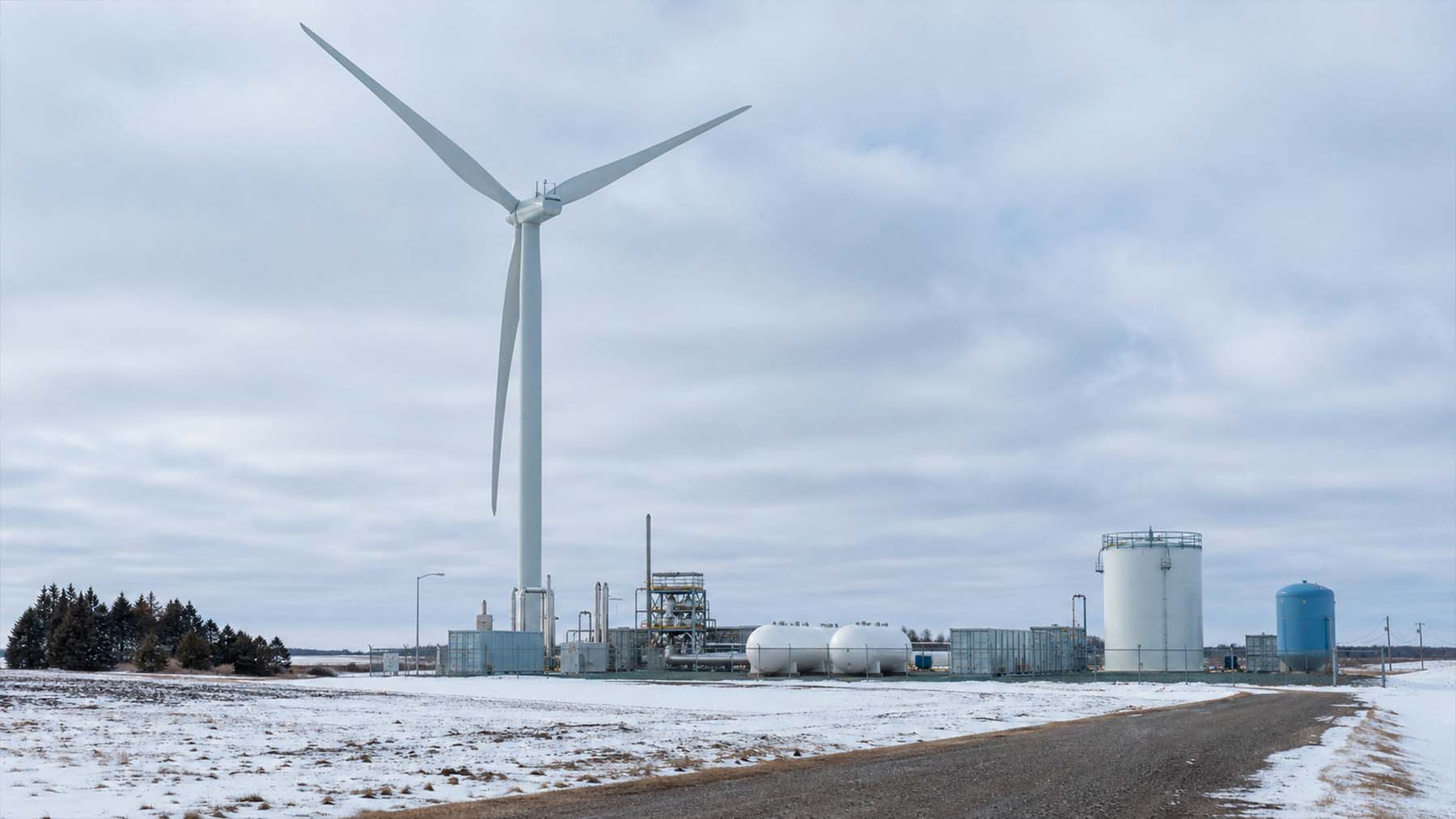
> A Minnesotan wind turbine shows that wind energy can produce more than just electricity.
No, it doesn't. It's just that electricity can be used to do lots of things, including splitting water as an input to ammonia production.
What this article shows is that nearly all of the potential "shortages" in materials on earth are really just energy shortages (with some small number of notable exceptions like helium), and the reason electrification is so important is because it allows faster replacement of fossil-fuel generation with carbon-free sources.
- > No, it doesn't.
Also it doesn’t need to, wind energy was used to produce things before electricity was harnessed in the first place.
Sailboats are harnessed wind energy and some 10kY old. Windmills and wind pumps were invented some time between 700 and 900.
by masklinn - > What this article shows is that nearly all of the potential "shortages" in materials on earth are really just energy shortages (with some small number of notable exceptions like helium)
You're saying freshwater shortage is really just an energy shortage?
by dataflow - Even if carbon was a complete non-issue, electrification and a greater diversity of energy sources would still have immense value.by pinkyboy
- Which is why I always advocate that countries should generate energy in abundance. You should have energy to waste. If you are burning fossil fuels, that should be considered a failure mode. Fossil fuels should be bottom of the barrel stuff, what you burn when you have no other options.
Otherwise, do whatever. Solar, wind, hydro, nuclear. Do everything. Do batteries. Do geothermal. Have so much energy you can waste on silly things. Diversity is good here.
- Just wait until you hear about the underwater turbine that can do far more than generate electricity!
https://energiesmedia.com/texas-turbine-under-water-more-tha...
by halestock - The whole article is trash.
Every sentence its own paragraph.
Every second word bold.
Who writes like that?
Is this some kind of stupid SEO/AI crawler optimization?
by jijijijij - Right. It also makes it sound like they’re not using the Haber Bosch process… but then:
> Electrolyzers are located on-site. They use wind energy to split water into hydrogen and oxygen gas.
> Additionally, nitrogen gas is directly harnessed from the atmosphere using an air-separation unit.
> Hydrogen and nitrogen are combined under pressure, resulting in carbon-free ammonia fertilizer.
That sounds a lot like the Haber Bosch process to me. So they’re just saying, rather than divert excess generation to a battery, you could instead build a micro H-B plant on site to produce ammonia.
I doubt this makes any sense in the grand scheme of things as you achieve major efficiencies at scale for chemical plants. Makes more sense to just electrify existing ammonia plants and ensure they use renewable electricity sources.
The green chemistry industry is full of penny-wise pound-foolish concepts like this and it drives me absolutely nuts.
by plaidfuji - > with some small number of notable exceptions like helium
Helium is one of the not-exceptions. Helium gets trapped in the same pockets as natural gas and we get it by separating it, which is an energy-intensive process, which in turn means that we don't do it for the vast majority of natural gas that gets extracted. If energy was cheaper then it would be viable to separate more of it.
by AnthonyMouse - This is one of the "unavoidable" uses of clean hydrogen, in the Clean Hydrogen Ladder.
At the other end of the spectrum ("uncompetitive") you get things like fuel-cell cars.
https://liebreich.com/the-clean-hydrogen-ladder-now-updated-...
by Rygian - Most recent dealflow in the space as well as national hydrogen strategies have been explicitly calling out fertilizer for almost a decade now.
Saudi's PIF has specifically been active on this thesis becuase becoming a lead fertilizer producer is part of Vision 2030.
I'd recommend reading "Hydrogen Diplomacy" [0] to deep dive into this.
[0] - https://fupubco.com/books/index.php/fupub/catalog/book/2
by alephnerd - It's not so much unavoidable as one of the things we're doing already with grey hydrogen (made from methane). It's about cleaning that up and using blue (grey with carbon capture) or green hydrogen, not finding new uses for ammonia (like using it as a fuel for e.g. shipping). Micheal Liebreich does a great job in his podcasts and articles explaining how that would be economically extremely unrealistic.
For ammonia specifically, cleaning that up requires energy that is equal to about 5% or so of global electricity production. A few petawatt hour basically. To produce around 190 million tonnes of ammonia. This setup in Minnesota is cute but it's a tiny little drop in the ocean in terms of what would be needed. It does about 1 tonne per day.
They haven't really solved or proved anything that we didn't already know. Yes you can make ammonia with electricity. Amazing. It's just that you need a ginormous amount of windmills to get to what is needed. It's doable but we're talking hundreds of thousands of windmills.
And that's just the tip of the iceberg. A lot of the other hydrogen based technologies up the same ladder that this website reports on / promotes, would need even more windmills, nuclear plants, perpetuum mobile machines, etc. to generate the stupendous amounts of power needed to produce all the hydrogen needed.
What Liebreich does with his ladder is making the simple point that even just converting what we currently do with grey hydrogen (i.e. mostly ammonia) to green hydrogen is going to be a decades long project.