Join the discussion
Write your take first — we'll ask for email only when you're ready to publish.
- Hacker News
- If you're looking to switch, difficulty around cooking technique for stainless steel, carbon steel & cast iron is overblown. Same with seasoning/cleaning the latter two. Trust me, if I can figure it out, you can too.by dfxm12
- My observations from experience: - Nonstick helps, but don't use it instead of a fat.
- Ceramic works well enough that I'm shocked Teflon nonstick still exists. No reason to risk it.
- Use real food. Real butter, real olive for most things, real peanut oil for high temp.
- If you don't overeat or or eat junk or indulgences too often, you can eat anything you want, just not every day.
- Variety and exploration inherently limits bad habits.
- Nobody has time to scratch cook every meal. Cook batches and freeze them. If you use occasions when you have time to do this, you'll build up a variety in your freezer that you won't hate anything before you run out of it. OTOH 16 chicken burritos is at least five too many. Trust me.
- All of this is much easier if you're cooking for yourself or for like-minded people.
by Zigurd - Isn't Teflon (PTFE) inert biologically?
(the precursor PFOAS are nasty forever chemicals that people should go to jail over dumping them in water, but once they're inert they're inert)
- I used to switch coated (teflon, ceramic, other fancy gadgets) pans every 1-2 years after eventually wearing them out. This seems so wasteful! I wish somebody had given me the following advice earlier: get 1-2 good uncoated steel pans. They build up a coating from cooking oils that works just as well. I've had mine for over 12 years now, and it's pristine and just a joy to use. I will probably never need another one.by wjakob
- PTFE is not the only way to get "nonstick" cookware.
The amount of stickiness perceived is 99% a skill / procedural issue.
by bob1029 - Thank you for these tests!
I've recently tossed all my coated pans (my favourite were the Anolon, but those too shed) and moved to stainless steel, save for a cast iron and carbon steel pan.
In the journey here the best I could find was a Hestan nanobond pan, which unfortunately laminated and has shown some pits after few months of use. They refunded me but titaniums isn't yet where stainless steel is.
Now I'm using a mix of Demeyere, De Buyer, and Made In.
It takes a bit of time to get used cooking in them without a ton of fat.
Look up Leidenfrost effect on youtube and you'll learn pretty quickly how to use stainless steel and do not let anything stick even fish.
by ndr - I don't have any nonstick. It's not that hard to cook anything or to clean stainless or cast iron. For cast iron/carbon steel 99% of the time I run it under water and rub it with my hand and it comes clean in 30 seconds. Rarely I use some soap.
Stainless comes clean easiest right after you use it. Especially if you pour a little water on it while it's still hot. I do occasionally use an SOS on stainless.
There's nothing I'm unable to cook with my pans. I make french omelettes in stainless steel pans and they come out perfect.
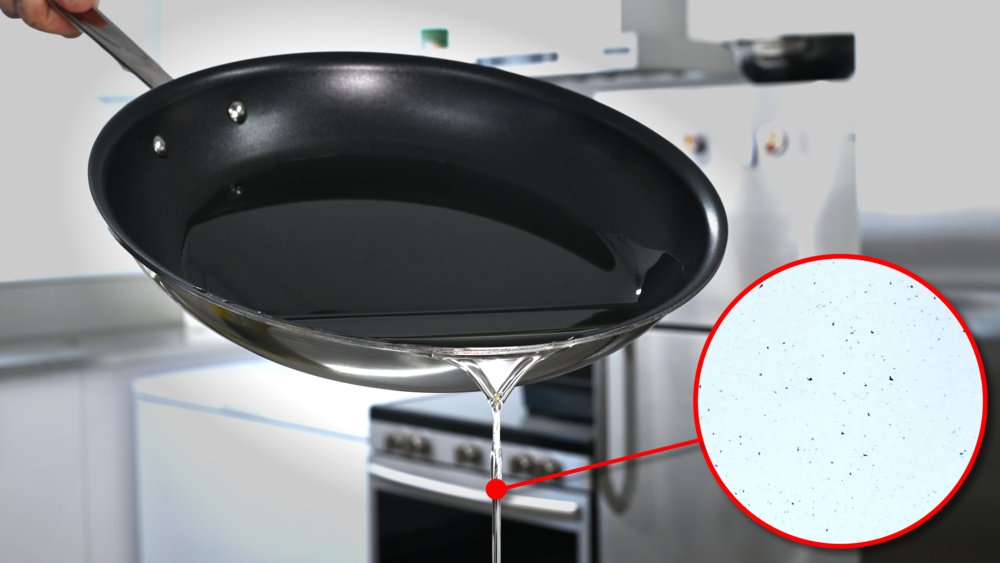
by breakyerself - I’m the founder of RTINGS.com. A few notes about this investigation:
- For each piece of cookware, we purchased and tested three separate units
- Before taking the “new” measurement, each unit was washed three times with dish soap and rinsed with isopropyl alcohol
- Oil blanks and uncoated cookware were included as controls
- We did not chemically identify the particles that were released
- This investigation measured particle release, not toxicity or health risk
by cdemer