Join the discussion
Write your take first — we'll ask for email only when you're ready to publish.
- Hacker News
- > On the whole, people far too often hold strong opinions about topics for which they have limited information. This can cause social and political movements to have plenty of people behind them with limited ideas of what they are even fighting for.by nothrowaways
- I don't know ... I actually think I'm quite aware of a lot of how complicated many things can be.
Perhaps it is because I was really curious as a kid about how things work, peeked into things, really tried to understand how it works, and figured it was far from easy.
I also tried to draw bikes, and figured you really have to think it through quite hard the first times, lol.
by samuell - > I also tried to draw bikes, and figured you really have to think it through quite hard the first times, lol.
The Science of Cycology: Failures to understand how everyday objects work (pdf) - https://link.springer.com/article/10.3758/BF03195929
by rramadass - A good test of this kind of thing is the "jump-start civilization" game. Basically imagine oneself sent back in time and think about how useful or likely useless all your modern knowledge would be at different periods.
in some sense you could push science so far ahead, germ theory, the structure of the atom, the immune system, silicon chips. All these "broad stroke" discoveries that you already know about. But when it comes down to brass tacks what is it worth? Like I know how a thermos works, and why it works, but heck if I know how one would actually consistently manufacture an evacuated double walled container. sent far enough back you would need to invent the vacuum pump, machines, maybe even steel itself just to produce a simple thermos.
makes you realize for all your knowledge you really never know absolutely everything, and that even simple things rely on chains of discovery, manufacturing and a whole lot of little details that we just don't think about ever.
- This is why have Maxwells Equations in my anki deck, you never know when you're gonna wake up in 1000BC and need to kick humanity 2500 or so years forward.by wpm
- Also see;
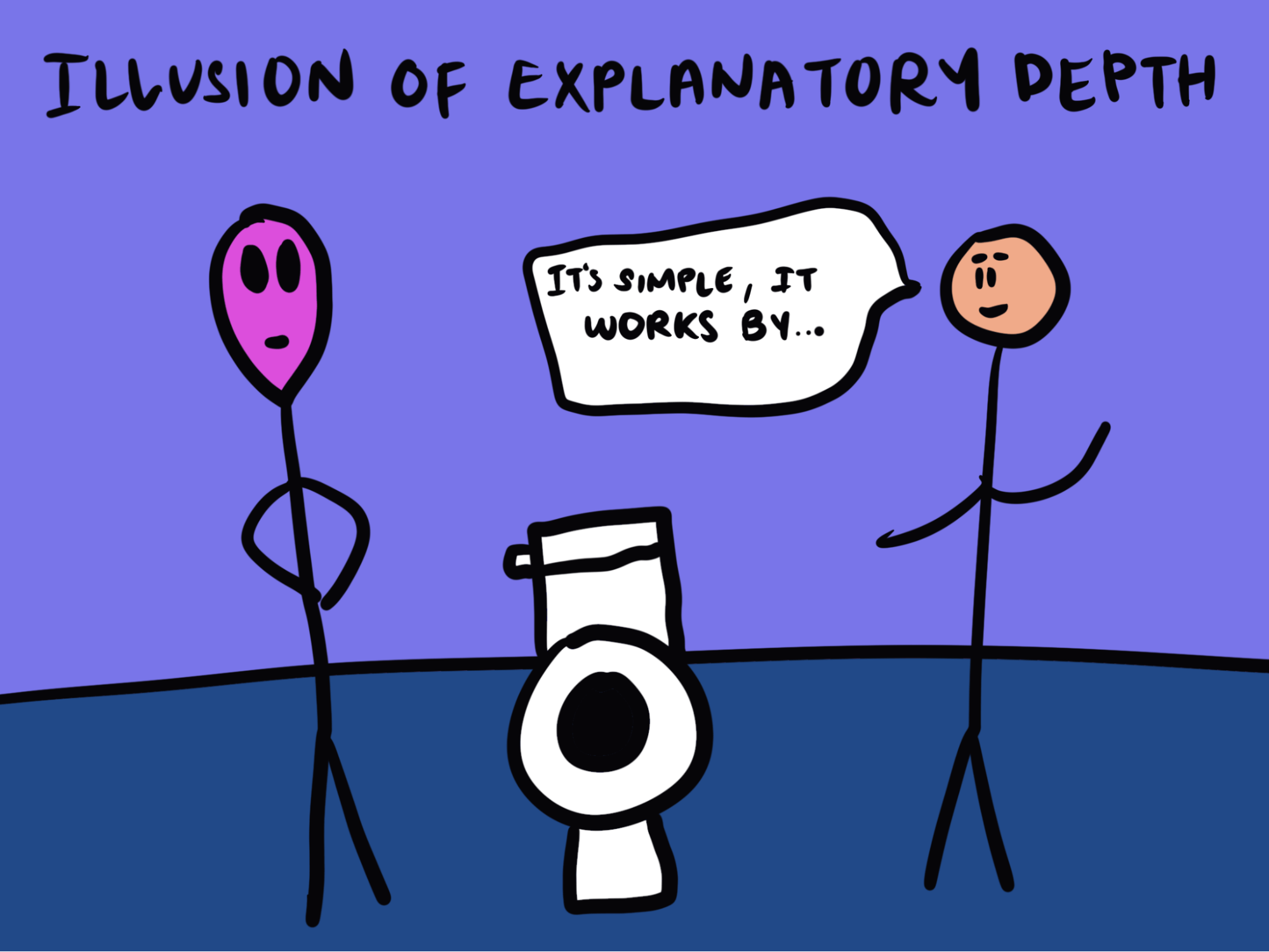
Wikipedia on Illusion of explanatory depth - https://en.wikipedia.org/wiki/Illusion_of_explanatory_depth
The misunderstood limits of folk science: an illusion of explanatory depth - https://pmc.ncbi.nlm.nih.gov/articles/PMC3062901/
How you can learn in a world of information overload - https://www.youtube.com/watch?v=cbiyPOn-__M
The structure and function of explanations - https://cognition.princeton.edu/publications/structure-and-f...
The Science of a Good Explanation with Tania Lombrozo - https://www.annieduke.com/the-science-of-a-good-explanation-...
by rramadass - I think it's because we don't really want to understand the world. I think it's because we mentally create microcosms that we more or less understand, at least from a practical perspective, and then try and fit the world within those frameworks. Some people get really good at constructing frameworks and manipulating them and they think they understand the world because for them especially, they've ceased to understand this process and they've sublimated it.by vouaobrasil
- I feel like its human psychology that as we get exposed to the world and we learn it, we feel like we form an understanding of the world around us at a sufficient level to survive in our current circumstances. Then we have all sorts of stimuli and feedback that tell us whether our understanding is correct or not overtime. Sometimes we challenge that understanding and realise that we were wrong. Life is an iterative process of that.
Then as we move into building a career, we essentially need to understand a topic or field to a degree that we're useful enough to sell it or provide it as a service compared to others.
Do I understand some things more than others? Perhaps. Do I need to understand everything about a particular thing to be knowledge on it, perhaps not.
> Unfortunately, when information is not directly in front of us, our memories and conceptions of it are shaky at best―but our egos are still intact.
I have often found this when as part of my job I have been exposed to a particular area of my field. But years later when presented with questions about it, whilst I can't extract all of the information I have learnt, but if my memory is jogged the information comes back. For example, lets say you learnt a particular skill 5 years ago, but now you struggle to perform it. Egotistically you know you've been able to do it, but your lack of training in recent years prevents you from doing it.
by NoPicklez - > Why do we think we understand the world more than we actually do?
To repurpose a quote originally about believing in good-versus-evil:
> Lord Vetinari gave [Vimes] a friendly smile.
> “Of course, of course,” he said. “You have to believe that, I appreciate. Otherwise you’d go quite mad. Otherwise you’d think you’re standing on a feather-thin bridge over the vaults of Hell. Otherwise existence would be a dark agony and the only hope would be that there is no life after death. I quite understand.” He looked at his desk, and sighed.
-- Guards! Guards! by Terry Pratchett
by Terr_ - "Science is prediction, not explanation" - Hoyle.
There needs to be more "prediction depth", vs. explanatory depth. If you can explain something but can't predict what's going to happen, you don't have an understanding of it sufficient for engineering.
This is why economics is not much of a science. Not enough predictive power.
by Animats - You have to be careful with the "Explanation(Understanding) vs. Prediction" dichotomy. They are related but Explanations should always have precedence since they are fundamental to creating a Theory in the first place that then can make Predictions.
David Deutsch actually argues for Understanding/Explanations over Predictions.
Here is a nice Reddit thread on this; David Deutsch argues that explanation, not prediction, is the primary goal of science. How widely accepted is this view? - https://old.reddit.com/r/PhilosophyofScience/comments/1trw2n...
David Deutsch: A New Way To Explain Explanation - (TED talk) https://www.youtube.com/watch?v=folTvNDL08A and (Transcript of the previous) https://medium.com/dorothyknows/david-deutsch-a-new-way-to-e...
Here he points out that "good explanations" should be "hard-to-vary". What does he mean by this?
It means that "a good explanation" cannot be arbitrarily modified without unraveling its internal coherent structure or contradicting the very facts that it seeks to explain. The evidence and the internal logic that holds up the explanation are tightly coupled together as one organic whole thing.
by rramadass - I suspect mainly because you don't and can't understand the world; you understand whatever simplified model of the world is inside your head and by default it's real unobvious just how simplified exactly.by Balinares
- At least recognizing that we hold simplified model of the world, and knowing that it is limited, is a reasonable place to be in and that helps to explore more.
- Pretty much. We just make the assumption that we can hold a model of the world in out head.
But like that old axiom about models goes 'All models are wrong, but some are useful.'
The taoists would argue that you shouldn't try to define everything because it will not help out after a certain point.
by ColdStream - I'm only here to first say I'm not like everyone else I do know things and can explain how things work. And computers work by making rocks think by putting magic smoke in them.by justaman123
- Sounds delightfully like something the Chongqing Punk would sayby clhodapp
- I can confirm that I've let the magic smoke out of multiple electronics parts, and they almost always stop working, afterward.by dlcarrier
- Here's an example making the rounds, originally from 2022: there is systemic bias in Americans' understanding of US national statistics about all kinds of subgroups:
https://yougov.com/en-us/articles/41556-americans-misestimat...
(Although, apparently the poll didn't ask how uncertain they were. The question was, "If you had to guess, what percentage of American adults...")
by skybrian - Did they really estimate that 30% of us adults live in New York?by faeyanpiraat
- The total of the estimates of minority group percentages is well over 100%!by graemep
- I wouldn't be surprised if this were a general cognitive bias having to do with estimating proportions, and nothing to do specifically with minority groups.by fasterik
- I refuse to believe that the average american thinks a third of their population lives in New York City, Texas and California.
And that Black Americans think half of America is black???
- Everyone should be required to sign up for a year of being followed around by an inquisitive child who will pockmark the landscape of their knowledge with exploratory boreholes.
I have multiple environment and science degrees and feel generally knowledgeable and my oldest will put on his best Feynman face and be entirely unsatisfied when I offer and explain “Rayleigh scattering.”
I love it. I love it so much. I love how curious he is. I love how there is so much to not know. I would hate to know it all because I love exploring it with him.
by Waterluvian - I remember my dad getting a lamp, and some coffee cups and using them to explain day/night to me. Thats the energy I want to bring for my own kiddos questions.by protocolture
- Reminds me of this comedy set https://youtu.be/Tf17rFDjMZw?si=QRyLMlfuKhavUnE7by Jonovono
- > pockmark the landscape of their knowledge with exploratory boreholes
I've got a PhD in particle Physics. I develop the geometry module of machine tools.
I got lost when an auntie tried to explain crochet to me.
by pif - Has anyone here found ways to actively cultivate this kind relentless curiosity within themselves?
People sometimes describe me that way when I start asking unbridled questions. Personally, I find that I can activate this mode when trying to connect answers to some sense of life meaning and the myriad ways that unfolds. Many on the receiving end find the experience frustrating, though.
I think we get used to repeatable patterns more than develop comprehensive understanding. The former feels like accomplishment, while the later feels like perpetual confusion, IME.
by xelxebar - 100 percent can relate on the relentless curiosity of a child. I was dumbfounded yesterday by this question -> if cars go at high speed, and breaks stop it suddenly, how come the friction doesn't generate enough heat to start a spark?
- On a somewhat related point, a lifestyle blogger & parent had coined the "fourth question" theory of sorts a few years ago - that, the fourth follow-up question a young child asks generally requires the parent to attempt to explain the meaning of existence, universe, and the like. I have also found this to be true.by c-flow