Join the discussion
Write your take first — we'll ask for email only when you're ready to publish.
- Hacker News
- For how long?by melling
- The same principle of "just one more lane, bro", can be applied to "just one more tax, bro". You give the burocracy more money and they will find new, inefficient ways to spend it between them and their cronies, until it is not enough, and a new tax has to be created.by johen8
- the budget doesn't have to be balanced, they can fund it with deficitby mono442
- The last thing the EU needs is a higher budget. Unelected bureaucrats that control a trillion dollar budget and have the ability to introduce legislation that supersedes national laws, what could possibly go wrong?by geertj
- Can we stop parrotic absurdly stupid "unelected bureaucrats" mantra? EU and it's bodies is not more "unelected" than in any other government body -- in the UK people don't vote for the PM, members of Lords or civil servants ("unelected burocrats managing money")… same goes for most of other countries…by ktosobcy
- EU needs more integration ("federalisation") as internal borders amount to something like 40% tarrifs… :/by ktosobcy
- Europeans make around half of what similar roles make in US and pay up to 70% of their income in taxes (50% income + 20% vat). What are they spending all that money on?by AntronX
- free or heavily subsidized healthcare, childcare, higher education, and excellent public transportation?by autoexec
- Unlike the US, wealth takes on the EU could perhaps raise revenue without disrupting innovation, because here in the EU, we have little innovation and self made wealth to begin with - so there's nothing to disrupt.
But taxing inheritances would still be preferred mechanism rather than taxing unrealized gains I think. That would target the EU's unproductive rent seeking heirs the best.
by Sol- - I don't know where in the EU you're thinking of applying that, but here in France inheritance are heavily taxedby baud147258
- I don’t agree with wealth taxes. The ultra wealthy will find the ways to avoid them and it will end up disproportionately landing on the middle class like everything else.
If it has to be done, it should be at the sources of the wealth so that they can’t be dodged. Things like property taxes, corporate taxes, taxation of stock buybacks (which is a way to pay dividends without paying income tax on them). The middle class will still be paying these, but at least the ultra wealthy will be contributing on their share of the wealth generation too.
- Middle class in Europe where?! In Germany in 1990s?
- > The ultra wealthy will find the ways to avoid them
That is only because the system (at least in the US) is designed specifically to enable this. Tax code is mind boggingly complex because there are a million loopholes and special cases, so that if you can afford the top-tier accountants, you won't ever pay any taxes.
But there is nothing inherently necessary about this. We can know the net worth of people and tax them if the government just cared to do so.
by jjav - > taxation of stock buybacks (which is a way to pay dividends without paying income tax on them
I don't think you've got the mechanism correct here. If a corporation has cash, they can pay dividends which lands in the pocket of every shareholder equally. Or they can buy those shares back from shareholders who are willing to cash in. If I hold shares and don't sell in the face of a buyback, I'm not getting a dividend. Instead, my on-paper wealth has increased by the amount that the buyback juiced the price of my shares. If I do sell, then I pay short term capital gains (which are effectively the same rate as income tax) or long term capital gains (which are lower but probably not low enough to offset the extra tax created by inflation)
by coredog64 - I don't see how a wealth tax that starts at $100M could possibly disproportionately (or at all) land on the middle class.
I'm sure the parasitic class will always find ways to partially dodge taxes but compared to income and capital gains taxes a strongly worded wealth tax would be much more difficult to avoid. We just need to be careful with the wording of the law to make sure lobbyists are not allowed to carve out any loopholes that can be abused by tax planners.
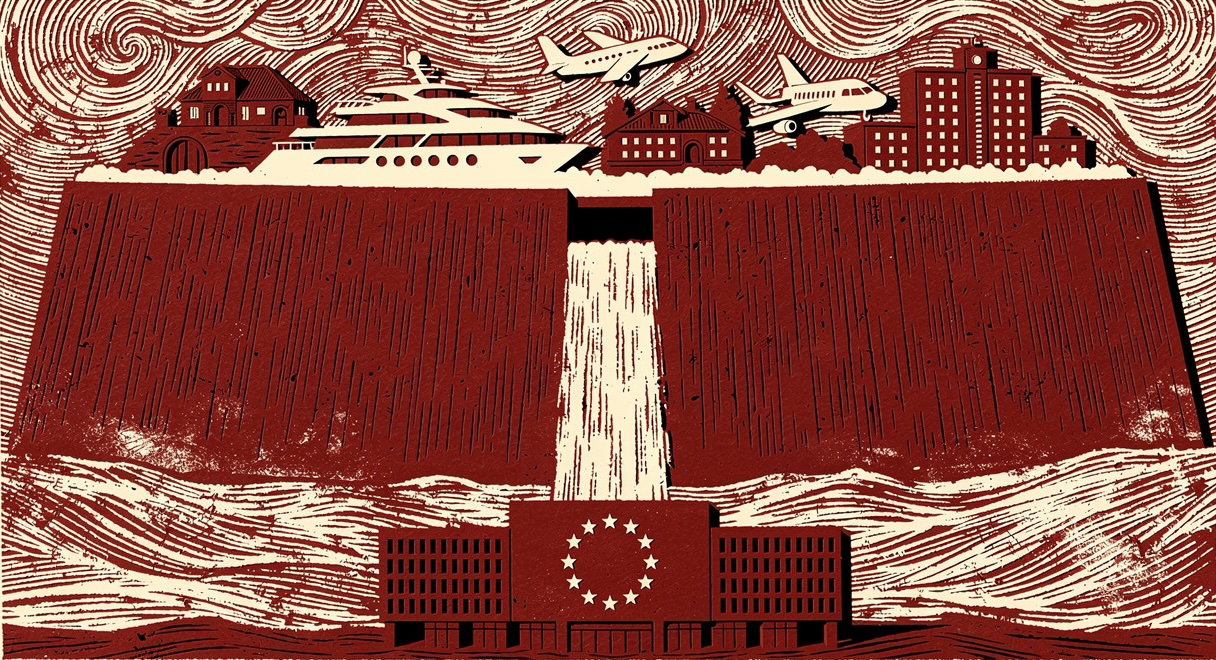
- > Europe’s Ultra-Rich Could Fund a Substantial Part of the EU’s Budget
> Taxes on wealth, crypto and financial trades could raise billions no single member state can collect alone.
The sad reality is that as soon as the EU introduces this, these families won't be Europe's Ultra Rich anymore. They'll soon be the UK/Swiss/Dubai/Israel/US Ultra Rich.
What the EU needs is:
- Less bureaucracy
- One capital market
- More venture capital
What the EU doesn't need is a larger budget. Is is really an issue if a family has a net worth north of 100 million if 90% of that is invested (directly or indirectly) in future growth of the EU?
> A financial transaction tax would not only generate additional revenue for the EU budget; it would also make short-term and speculative trading in financial markets more expensive.
This goes *directly* against the https://en.wikipedia.org/wiki/Efficient-market_hypothesis. Potentially creating more friction and less efficient capital allocation in an continent already struggling with growth and innovation.
> A tax on ultra-high wealth would have particularly high revenue potential. One possible approach would be a minimum tax for individuals with net wealth exceeding €100 million, ensuring that the taxes paid annually by this group amount to at least a specified proportion of their wealth. Such a tax would specifically target individuals whose effective tax burden is lower than that of other groups. At the same time, it could help to limit tax competition between member states for particularly wealthy residents.
The biggest competition does not from member states, rather it comes from Switzerland and the United Kingdom. Two countries where citizenship is (for most ultra-rich) a plane ride and a few administrative meetings away. USA, the middle-east and Israel offer other options, slightly further away.
by LaurensBER - In general more integrated EU with easier flow of capital and easier investments…by ktosobcy
- Pretty sure Israel has even higher taxes. The people who live there don’t live there because of the tax situation, they live there because they are Jewish. You really can’t offset that with a revised tax code.by xenospn
- > The sad reality is that as soon as the EU introduces this, these families won't be Europe's Ultra Rich anymore. They'll soon be the UK/Swiss/Dubai/Israel/US Ultra Rich.
Yeah, but the physical assets they own can’t move freely. The EU can still tax or seize assets within the EU.
by neerd - This is a shortcut for taxing unrealized gains.
They start with NW >100 million and start decreasing the concept of Ultra-Rich until everyone non-broke eventually pays it.
In Spain it happened with the Work Tax which from >60k EUR (68k USD) goes to 45% as if earning 3k EUR (3.4k USD) per month made you rich.
by leugim - shouldn't it be 5k per month?by mono442
- > In Spain it happened with the Work Tax which from >60k EUR (68k USD) goes to 45% as if earning 3k EUR (3.4k USD) per month made you rich.
Sounds worse than it is since it's progressive taxation meaning the effective tax rate for the entire 60k EUR is somewhere like ~29%, not 45.
€0 to €12,450: 19%
€12,451 to €20,200: 24%
€20,201 to €35,200: 30%
€35,201 to €60,000: 37%
Source: Gemini so it could be complete bullshit.
To be fair, VAT is heaver in Europe than for example US, so the overall tax burden might still feel more onerous.
by ninininino - 60k is now worth somewhere around 49k in pre-Covid Spanish Euro. The highest income tax rate on employment contract is brutal. Why would anyone work there at all? No wonder I meet young Spanish anywhere I go, and they are not tourists. Then Europeans moving to Spain are not moving there to work either.
- As long as there are reasonable countries they can move to and moving doesn’t impact their business enough, people will move to more favorable tax environments even if they have qualms about the new options politics if taxes get too high. A few years ago France imposed larger taxes and a few wealthy people left and some even took debatable citizenship options.
Some people may not like this to happen but it does and would.
by mc32 - A marginal tax rate of 45% above USD68K seems unsurprising for any developed country with public health care. Presumably the realized rate at EUR60K is a lot lower than 45% and 45% is only the marginal rate.
American tax numbers are only a little lower, but do not include health care. An American employer is likely paying around $8K for a single person or $20K for somebody with a family. That's a real and very heavy tax that Americans pay.
by bryanlarsen - Let them start somewhere. Inequality has only accelerated in the past decades, undoing the fabric of the fair and democratic society which many/most people perceive as a condition for long-term stability. If taxing wealth isn't it, then what else do you propose? We seem to agree that taxing income stinks while news like "50 richest families own 50% of the country" abound. Those didn't get there by working a job or being clever/lucky about betting their pension money on some ETF. Only extraordinary measures will make a dent on this extraordinary accumulation.by ezst
- There’s a long way between NW >100 million and making 60K EUR.
Maybe if they taxed NW >100 million, you wouldn’t need a 50% tax on work.
by JimBlackwood