Join the discussion

Write your take first — we'll ask for email only when you're ready to publish.

  • Hacker News
  • Honestly, I just hate the term "physical AI". They're robots. It's unfortunate that we had to adopt a term with the words AI in it, just to get investor's attention.
  • Yet another "benchmark to promote their own harness"
  • compare to opus-5 ?
  • Define "best" and "performs"
  • Nice! It is missing Codex in the agent harnesses comparison IMO.
    by jceg
  • I'd expect google to do well here, since they were historically strong at multimodal and physics.
  • I wouldn't trust Gemini anywhere near my code.

    However, it's pretty good at regurgitating textbook answers (classic Google...). This makes it an asset for circuit design. Try one of my real queries with Gemini Pro:

    "Create a differential current splitter that splits a bias current Ib into a positive current Ipos = Ib/2 + ky*Vy and a negative current Ineg = Ib/2 - ky*Vy where Vy = Vy+ - Vy- is a differential voltage input Y."

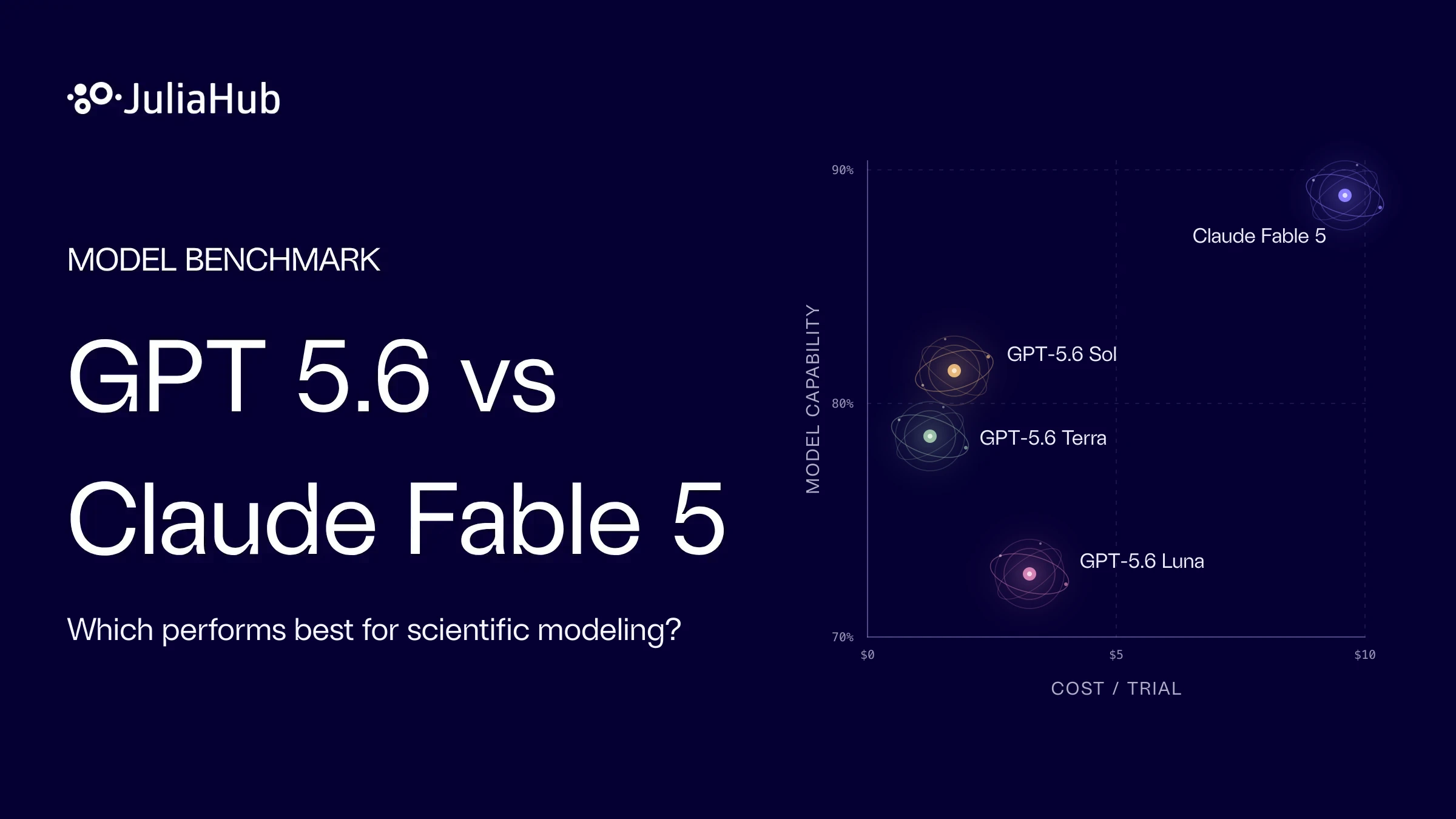
  • I'm curious how good the terra/luna results are but there's not enough context here for me to judge 0.786 (terra) vs 0.814 (sol) vs 0.889 (fable).

    How do the two lower models compare to e.g. gpt 5.5 or 5.4 or various opus models?

  • Google with apptronic should have good models soon
  • It's kind of interesting this is already out of data as it's missing Kimi 3 and Opus 5.
  • Seemed strange they would bench Terra and Luna but not Opus, Sonnet, and Haiku
    by pohl
  • Yeah, things are moving fast. Those benchmarks will be out soonish. Takes a while to run these things.
  • Please forgive my naivety, but are world models (once they are in a consumer-ready form) expected to outperform any currently existing LLM on these sorts of tasks (i.e. of the physical world)?
  • From what I have seen "world models" are more like video models. The idea is: from a video clip, predict the next frame, like LLMs predict the next word/token from a bit of text.

    The idea is that these models should be able to internalize the laws of physics and properties of objects just like LLMs do with grammar rules. To make training more efficient, frames from game engines with hardcoded physics are used. The application is mostly robotics, including autonomous vehicles.

    This is a bit different, the idea is to write a physics engine, it means numbers: like for an airplane model, calculate the climb rate. The application is mostly science and engineering.

  • So Fable "won" but it cost $124.76 for marginal performance benefits over the $22.56 5.6 Sol run.
  • I'm finding a happy middle ground using Fable to proof work other models have done.

    Anthropic's guardrails still make it garbage. But eventualy it will leak.

  • A really frustrating partial presentation, given an apparent lack of testing with a spread of efforts for each model.

    Given that there's no reason to believe that Fable's xhigh is comparable to GPT-sol's xhigh, or Opus xhigh, for that matter, it would be far more useful to see the effort level where these tasks no longer achieved their goals.

  • These benchmarks are done with incorrectly and missing a lot of baselines. The article seems very vibe coded too.