Join the discussion

Write your take first — we'll ask for email only when you're ready to publish.

  • Hacker News
  • TLDR: The new variant is that the word "repair" was changed to "service" in the user manual.
  • That was only one of the differences mentioned; the others were on the cartridge itself and included a different sticker on the back and different manufacturing codes.
  • Now that is a new variant I actually like to hear about. Thanks for the story behind it!
  • Posted yesterday: "Unreleased Versions of Super Mario Bros. Duck Hunt Discovered in Warehouse" https://news.ycombinator.com/item?id=49099113
  • Talk about a barn find. According to ChatGPT, this box might be worth $1 million or more.

    Good thing the owner talked to the author before putting them up for $15 each...

  • Ah yes, because a probabilistic text generator should be trusted to appraise a rare collectible that wasn't even known to exist as of the time it was trained.
  • Is ChatGPT well known for its skills in appraising NES cartridges?
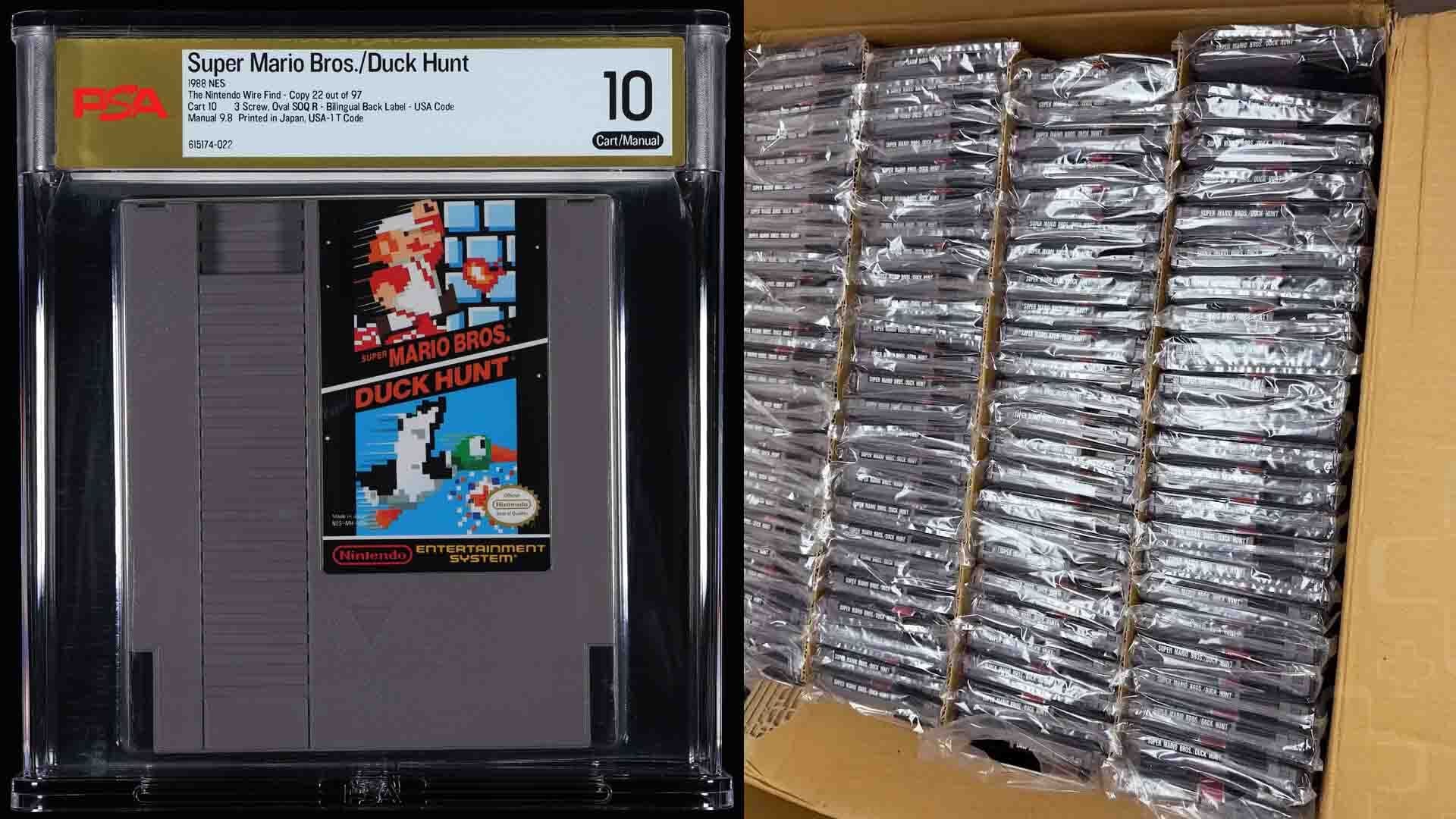
  • Why are some copies of the game "graded" higher than the others if they are all the same copy of the same game?
  • The physical quality of the cartridge itself: Some might have scratches or off-centered stickers for example.

    While most of them would be pristine to a regular user, these small nitpicky details might matter to collectors and help differentiate between two of them.

  • I don’t really have any doubt that these are ‘real’ - but the article author has, to me, a strange amount of confidence in video game ‘grading’, especially since he himself is an expert:

    From what they could see, there was very little doubt that these games were real. Of course, the grading process would 100% confirm that, but at face value, this looked like the real deal.

    by jrmg
  • confirming a game is real is one of the things psa is good at. the problem is a lot of graders act in suspicious ways when it comes to assigning scores at the high end.

    you get a lot of reports about collectors sending a game in, getting a score thats obviously low for what they have and sending it again just to get what they originally expected. some of it might be human error but it could also be on purpose to make customers pay the fee twice.

    there are also allegations of giving a high score like 9.6 or 9.8 to games that dont deserve it, like the record breaking mario bros cart a couple years back, to create artificial hype and get more volume at affiliated auction houses (i think karl jobst was the first one who reported on this).

    and its basically confirmed that graders do "population management" where scores are based on the number and price of equal graded items on the market instead of just the quality. if high grades are too common prices go down, and if its too rare they get less trade volume and disappointed customers.

  • I hate grading companies, they are a part of the retro industrial complex which made old consoles (ones that were manufactured in the millions, mind you!) and games so expensive. Old stuff should be sold at old stuff prices. Look at the New 3DS, it's approaching the launch price!
  • I have mixed feelings on this.

    Should old stuff be cheaper because it's old, or should it be expensive because you can't get it anymore? I've seen many things turn into "vintage classic collectible" after being "cheap, outdated, old junk" for years. Old body style trucks, CRT Monitors, typewriters, Mosin-Nagant rifles.

    Ultimately stuff is worth what people are willing to pay.

    The proliferation of selling things online has probably driven up prices more than anything because it connects motivated buyers with sellers with low friction, and allows even a fairly unmotivated seller to do accurate market research.

    If you want a good deal on something old, your best bet is thrift shops, garage sales, and FB marketplace.

  • Something that I wonder about when I see the 'final' results like these NES cartridges sealed in a graded plastic box as a collectible.

    Surely the market value of these will only hold up as long as they're within the normal lifespan of the people for whom the original NES is a nostalgia item?

    For example: If you were born in 1978 and were 7 to 8 years old when your parents bought the original NES and brought it home with a small selection of games, that's probably a core memory for you. And probably exactly the same demographic now who will pay big money for these things.

    But as this generation of people ages, do people who have no childhood memory of a NES (or SNES, or Genesis, etc) because they were born in 1999 consider these things to have any value? Will their value drop significantly when there's no longer a population of age-range-appropriate nostalgic collectors to buy them?

    If these are being treated as some kind of "how many dollars per unit" valuable commodity to be traded/hoarded, is it the best possible solution to convert a collection of something like this into currency before the collectors age out of the market?

  • Honestly, I don't think the average nostalgic Gen X-er is that interested in a sealed video game cartridge.

    I think the "sealed, unopened, graded" flavor of collecting is always more of a niche thing, and the actual market potential of tapping into American Gen X video game nostalgia is more clear when you look at sales of the NES/SNES Mini plug and play consoles or the Nintendo Switch subscription for classic games.

    Collecting is an absolute rabbit hole, and it's often intrinsically tied to the "lore" and history of the collection's theme/genre more so than a collector's personal feelings of nostalgia.

  • I was borin in 1990, yet I still cherish the atari vcs I have
  • You get some inter generational nostalgia going on - I inherited my grandmothers NES which I have fond memories of playing any time I visited her.

    I don’t play it as much as she did (I have modern games in my backlog to play as well) but I do occasionally buy more NES games to add to the collection.

  • My buddy's teenager has a collection of old systems, sort of does it as a hobby. I am not informed, but I guess they don't pay high for stuff.
  • For an anecdote in a different direction, my father bought a Ford model T a few years ago. Now, "classic" cars of the 60's and 70's are still very popular among those who lived through that time. Maybe your family had one or there was a particular car you wished you could have had. I don't think the model T works like that. Next year, all model T's will be 100 years old, so even if you are 95 today, when you started driving, the newest model T would have been a 20 year old car.

    I've been with him to a couple of the local model T club meetings. The demographics are interesting. I was the youngest person there. My dad (late 60's) was the second youngest. But you have to remember that nobody alive, even the real geezers, has experienced a time when a Ford model T wasn't an old car. So by all means, it seems like this hobby should have died out decades ago, even as it continues to die out today. Very strange.

    As it stands, it looks like a decent condition Model T can be bought these days for 10-20K, only a bit more than the inflation-adjusted original price. But, I don't really know what the collectors market was like at peak nostalgia.

  • Do we know if the actual binary on the cartridge is the same ?
  • My first thought too. Someone dump the rom!
  • I'd love to hear about the game ROM. This post is just focusing on a new, slight variant of the packaging, as if the game is a collectible like a stamp or coin.
  • I was expecting to read about a new variant of the game ROM itself. But, this just sounds like a new, slight variant of the packaging.

    It almost feels more like stamp or coin collecting, than video game collecting as I understand it.

  • they're like physical NFTs
    by m463