Join the discussion

Write your take first — we'll ask for email only when you're ready to publish.

  • Hacker News
  • This article seems to confuse lithium-ion and lithium-metal batteries. Lithium-ion batteries intercalcate lithium ions into pre-existing electrodes and that doesn't form dendrites. Dendrites are a phenomenon of lithium-metal batteries, where lithium ions tend to be reduced to metal at the tips of the dendrites.

    You can get lithium metal forming on lithium-ion electrodes, which could go on to form dendrites, but the failure there is the metal formation, not the dendrite formation.

  • Definitely being unreasonable, but that's one of the reasons I don't have an electric vehicle yet. I'm paranoid of that thing catching fire in my garage. Which is ironic since one of my random electronic devices with li-batteries probably could catch fire regardless in my house. At least with a gasoline it seems we are better equipped to deal witg such fires.

    Overall my end goal is to have a seperate storage for the e-vehicle.. Plus it be easier to slap some solar on that structure.

  • I understand the paranoia, but it is definitely emotional reasoning overriding facts. Gasoline powered vehicles are vastly more likely to go up in flames. Even when you adjust for age and mileage. Even if you only look at cars that spontaneously ignited when parked. The wiring in a gas car is exposed to a tremendous amount of heat and vibration.

    EVs spontaneously igniting are newsworthy partly because politics, but also because it is novel. Gas vehicles burn daily, the odds are pretty good that a couple are burning somewhere right now.

  • Aren't sodium batteries close to production and a lot cheaper and safer?

    Ambri was working on large scale batteries which seemed like a pretty good idea (looks like they ran out of money): https://en.wikipedia.org/wiki/Ambri_Inc.

  • Cheaper yes. Non-aqueous sodium ion batteries (which are most of them) are more dangerous than LiFePO4 though.
  • Sodium ion batteries are already being mass produced in China. CATL actually just started producing their second generation sodium ion batteries. In the US, Peak energy is doing storage solutions based on sodium ion.

    Anyway, you are comparing apples and oranges. While solid state sodium ion might become a thing at some point, it so far isn't. The lithium based solid state batteries currently being readied by several battery companies for mass production around 2028 or so tend to have up to 500-600 wh/kg densities. Sodium ion batteries are currently at or below 175 wh/kg typically. LFP is a bit better, and some high end NMC batteries might do 250ish wh/kg. That would be just the first generation solid state batteries. Densities might improve after that. The theoretical limit is a lot denser than that and there is a lot of money going into researching ways to do better than that.

    Of course energy density is just one thing you might optimize for. Other properties you might look at are operating temperatures, amount of charge cycles the battery can handle before it degrades below 85% of its original capacity, the speed at which it can cycle, fire safety, cost, etc. Mostly sodium ion scores very well on all of this except density.

    High energy density usually comes at a price. Both in dollars and in compromises with these other things. Think lower lifetime, more constrained temperature ranges, etc. Worth it if weight and volume are really constrained. Like in anything that flies.

  • Depends on the application - each battery technology has a trade-off between energy density, cost, lifetime, safety, scalability, etc. Sodium may have a place in grid storage, although iron-air is being deployed today and is even cheaper and safer (but poor energy density, which doesn't matter much for grid storage - https://formenergy.com/technology/battery-technology/)
  • China-certified solid state, CATL sodium, and ProLogium are manufacturable batteries that don't violently deflagrate under puncture, cutting, or high temperature.

    When these reach markets in significant quantities, most Li ion (NMC, LiPo, and LFP) with liquid electrolyte or plastic separators should be banned for most purposes, especially vehicles and occupied areas. These are whale oil lamps that pose a silent, ubiquitous danger to life and property.

  • Manufacturing the batteries would probably benefit from solid state. The Panasonic battery plant in the exurbs of Kansas City, MO has had two evacuations this year from thermal issues related to lithium-ion battery production, including one yesterday morning. [0] [1]

    [0]https://www.kmbc.com/article/lithium-ion-batteries-catch-fir...

    [1]https://www.kmbc.com/article/panasonic-plant-de-soto-evacuat...

  • fun fact: there is already a Sodium-battery with a solid electrolyte - but the operating temperature is above 300^C [0] [0] https://en.wikipedia.org/wiki/Sodium%E2%80%93sulfur_battery
  • ...yeah but everything else is liquid...
  • Solid state batteries are offering a lot of tagline benefits: safety, high energy density, lightweight...amongst many other claims. However, there are a number of things you need to be aware of: 1. Safety - cannot be completely safe 2. Pressure - some solid state cells need pressure applied and this can be quite high and impact claimed density 3. Liquids - some cells call their technology Semi-Solid, this is not solid state, let's not be caught out

    There are 7 more items to consider: https://www.batterydesign.net/10-things-about-ssbs-that-you-...

  • Tangential to the main article point but…

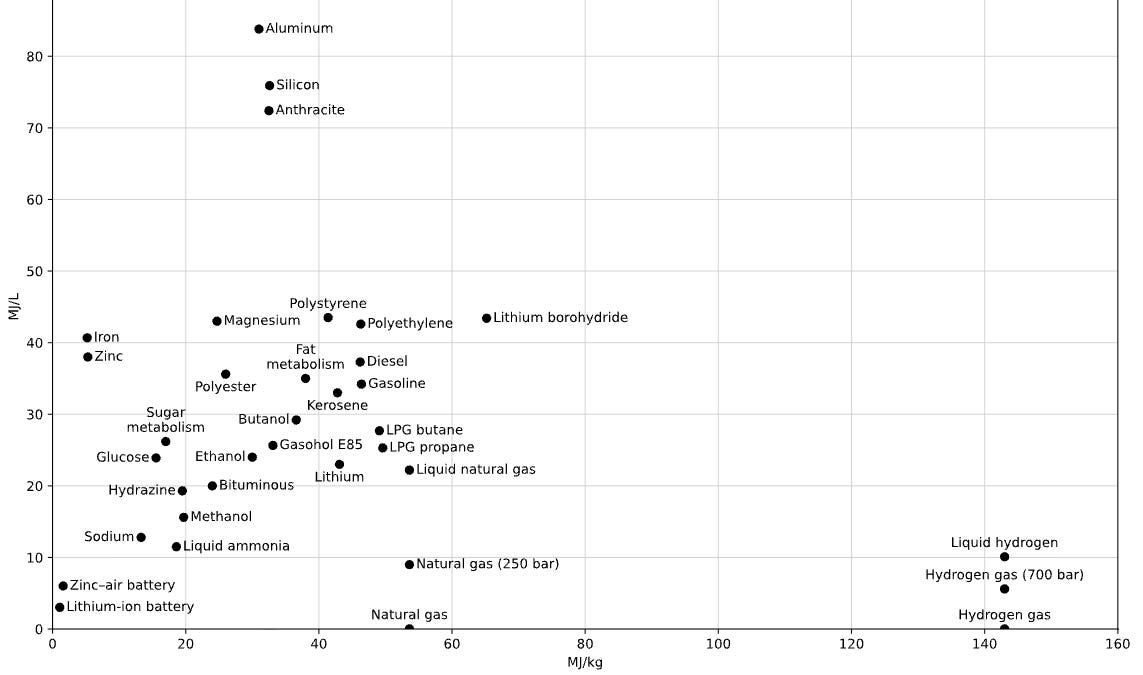
    The energy density scatter plot is physically correct but misleading and everyone makes this mistake.

    From an engineering point of view you have to use work delivered at the end of the drive train not fuel raw energy content.

    When you do that lithium ion batteries compare more favorably to liquid fuels. That’s because the conversion path is more than 90% efficient. For ICE engines you’re starting with only 20-40% Carnot efficiency (depending on how good and in good shape the engine is) and then losing in the transmission and then losing more because ICE cars have more other gears and moving parts. Power to wheel is pretty terrible. Most of the energy from gasoline heats the air around the car.

    This is also why you get outrageous sounding but accurate things like: an EV charged on 100% coal fired electricity emits less carbon than a typical gasoline car. The fact that coal is literal pure carbon fuel is made up for by the high thermal efficiency of a giant supercritical steam turbine vs a small piston engine. Coal burns real hot too (steeper thermal gradient). So more of the energy from coal ends up doing actual work vs heating the air. (Well directly heating the air I mean.)

    by api
  • Yes, electricity should be the only abstraction layer to deliver energy to end user. We can extract a lot more energy from fossil fuels in large scale plants and also continuously switch out dirtier fuels with clean energy.

    For example, no need to build natural gas infrastructure to every home. Use induction stoves (or electric coil -- already 67% of homes). Heat pump water heater instead of gas. And heat pump for HVAC.

    If all energy bills are consolidated as electricity (instead of gas, natural gas and electricity), most people would install solar on their rooftops, buy EVs, and save ~$1000/month on energy bills.

  • We need way more research on batteries. People cant ingine what is possible if we make battery 10x energy dense.
  • I think people can imagine lighter cars and laptops and things. Is there something bizarre that’s unlocked like battery powered space launches or something?
  • Generally a >10x is easily achievable if we use a chemical reaction that uses oxygen - which we do not have to carry around, that's why things like hydrogen fuel cells have a theoretical energy/mass that we can pretty much assume is best possible with a chemical reaction.

    Unfortunately the problems with hydrogen storage and the fuel cells have prevented them from really taking off.

  • I think, apart from finding better Batteries altoghether, we should build multi-tier batteries inspired by biology. Humans have bloodsugar, sugar in the Liver and then fat. All of them have their respective properties with availability and amount. This way, engineering tradeoffs could be allocated much more fine grained. For example, a while ago I read about a startup building an energy storage where they heat up large amounts of sand to store the surplus of renewables. This could serve analogous to the fat in humans.
  • Agreed, but I think people can imagine and companies are very motivated: powertools, phones, laptops, watches, backup UPS, cars, hospital equipment... there's high demand for durable, long-lasting batteries. I think the research is there, it's just complex chemistry. We'll get there. Impressive to see the progress in EV batteries and they've actually turned out to be more durable than first feared.
  • I don't think 10x density is possible without getting into nuclear, at least not with the chemistries we know of today, everything at a certain point becomes an explosive.

    Speaking of nuclear, getting tons of the material that powers mars rovers and putting them in every home would generate enough power for decades... At the cost of being able to build a nuclear bomb in a garage.

  • The past 20 years have made lithium ion 2-3x more dense, both because of some chemistry changes and because of better pack level design.

    And it's still improving at about 5% per year.

  • I can - it’s called a bomb. Some of the problems with batteries are heat dissipation (one of those problems that superconductors would mostly solve), fire safety, and end of life disposal. Higher energy density makes it even worse.

    A good place to start would be a BMS on individual cells that monitors them for general degradation, unexpected discharge, unexpected temperature changes, and can remove a failing cell from the array.

  • It should be relatively straightforward to imagine — we already have that in gasoline-powered internal combustion engines.

    The Watt-hours per kilogram of good Lithium Ion batteries is around 250-280 Wh/Kg; for Lithium Iron Phosphate it's about 180 Wh/kg, and for Sodium-Ion about 170 Wh/Kg.

    The raw energy in gasoline is about 12,300 Wh/Kg but automobile internal combustion engines get only about 20-30% efficiency yielding about 2500-3600 Wh/Kg. For aviation piston engines it is a bit better at 25-30$ so 3000-3600 Wh/kg.

    So, the batteries, instead of being 10-12X the weight of the gasoline for the same net driving/flying range, could weigh about the same as the gasoline. So, a typical car with maybe a 16 gallon tank and 30 miles per gallon fills up with 128 pounds (58 kg) of gasoline to get 480 miles of range. The Li-Ion battery for that range would weigh something like 1300 Lbs (590 kg). That is a substantial additional weight for a car that could be 2800-3800 Lbs in ICE configuration, so 35-45% added weight (a bit less because of savings on the ICE engine, etc). This requires everything else to also be heavier, from the structural frame, the suspension system, and even the wheels and tires (which is also unsprung weight, further impairing performance).

    With a 130Lb/60kg battery instead, and saving the weight of the ICE engine and fuel system, the overall car design could go much more lightweight, regaining a lot of performance and range, all while gaining the huge torque of electric motors.

    In aviation, a battery systems of that weight would enable all-electric aviation to go from small performance niches to the default for general aviation.

    So yes, it would be a HUGE benefit to achieve 10X energy density batteries, and we do have reference points for people to imagine it.

  • The article gives the technical reasons that answer the headline question (e.g. potential for better energy density)

    I am surprised they didn't point out the literal "killer app" - military drones. Energy density is king for any airborne power source. And dendrite growth during charge/discharge cycling isn't as big a deal for that application (how many times would you need to charge a disposable weapon?)

  • If the thing is going to blow up anyway, does it need to be light? Wouldn't you rather have more cheaper drones?
  • For disposable applications like that, aren't there single-use chemistries that are better already? I'm thinking by analogy to things like:

    - WW2 proximity fuzes that had batteries where the electrolyte was in a vial that got smashed by the G-forces of being shot out of a cannon providing power to the radio inside for the 10 seconds it needs to get to the incoming aircraft

    - Hearing aid Zinc-Air batteries, that are extremely energy dense because you only have to actually manufacture the anode, the cathode is the entire atmosphere of the Earth

    - Missile batteries, which are often Lithium-silicon/Iron Disulfide batteries that borrow some thermal energy from the rocket motor to get a molten salt electrolyte

  • If you know a bit about electronics, you might be a bit surprised by the term 'solid-state battery'. It's a poor analogue to the more common usage of solid-state with semiconductors, integrated circuits, etc. -- a "solid-state" cell is still a chemical cell. It's not a paradigm shift on the level of, say, replacing a relay with a MOSFET.
  • I mean the ultimate goal is still to surely have literally that. A solid state battery.

    Tbf just like computronium, I actually don't care if my battery is liquid or solid but that almost every atom or molecule that makes up the battery is used for that purpose. I guess we could call it powertronium!

  • I believe you’ve made all that up. The battery is “solid state” as in “solid state of matter”. There are no liquids, gases or plasma in the battery. It’s an elementary school physics term.
  • Non-solid-state batteries have liquid/gel electrolyte.