
Join the discussion
Write your take first — we'll ask for email only when you're ready to publish.
- Hacker News
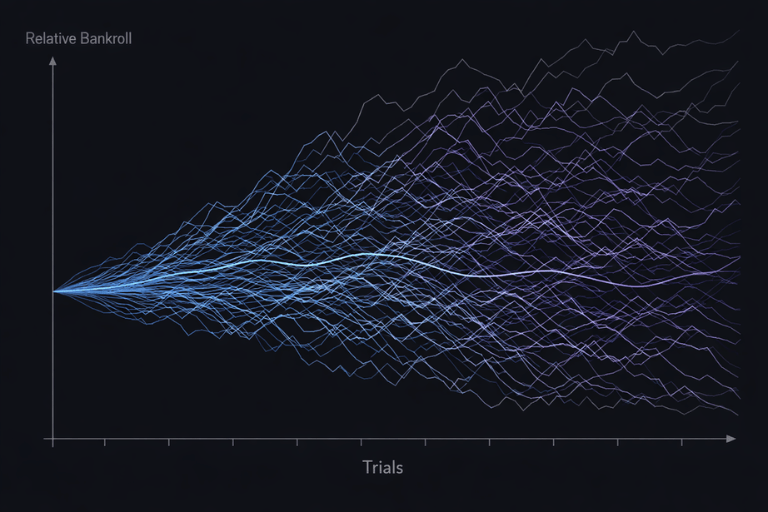
- Graph needs a log scaleby destrolas
- This woulda been helpful for Leo and the 3% of Korea that got liquidatedby hiramwen
- Their estimates: Win probability 100% -- Odds / payout 100-1.by shapefrog
- The Situational Awareness situation was the reason I wanted people to be aware of the Kelly Criterion and submitted this link.by aleyan
- Back in the day when I played HU Hyper-Turbos on Pokerstars I created one of these in Mathematica (not as fancy with Monte-Carlo)by nemesis17
- In case the author is here:
What's the difference between "win probability of win" and "odds", please? The seem the same thing to me.
And also, what are "decimal" vs. "american" odds, please?
Thanks.
- ‘Odds’ is the payout, the price of the bet, the prize you may win. And the ‘win probability’ is the probability of winning as the name suggests.by kgwgk
- Decimal odds give the total payout (including stake) if you win a bet of 1. So if I place a bet of $1 at decimal odds of 2.5 and it pays out I receive 1 x 2.5 = 2.5. So payout = stake * odds.
American odds (also sometimes called “moneyline” odds) have two presentations.
- If the odds quoted are positive it indicates the net payout (excluding stake) from a bet of $100 dollars. So I place a bet of 1 dollar at moneyline odds of 150 it pays me 1.5 plus my original stake back. 150/100 * 1 + 1 = 2.5. So payout = stake + (odds/100 * stake) . A positive moneyline odds number means an underdog.
- If the odds quoted are negative it’s how much you need to bet to win $100 (excluding stake). So if I place $1 at moneyline odds of -150 and it pays out I get 1 * 100/150 + 1 =1.667. Therefore payout = stake + (100/abs(odds) * stake). A negative moneyline odds number indicates a favourite. The higher the absolute value, the bigger the favourite as far as the house is concerned.
by seanhunter - the first lesson here is that betting is easy when you believe that you know the important variable, your edge.
the second lesson is that, no matter how poorly you perform, you are going to be able to make the case to your stakeholders that, contrary to all evidence, you do in fact have an edge and you are in fact exploiting it correctly.
the lesson not here is that, in practice, continuing to believe that you know your edge is going to be virtually impossible in the long run, partly because of volatility, but mostly because, in practice, you do not know it.
by dnnehgf - What bet you can make consistently gives you at least 51% odds? As far as I know, the best you can do in a casino is 48%. If I plug 48% into the simulation, it states there is no Kelly edge for that bet.by butlike
- The first time I ran across Kelly it was WRT card counting. There is some rare positive off the top video poker out there.by tahoemph999
- As far as casino games, you might find yourself in this situation with a half-decent poker hand or if you're counting cards in blackjack. Casinos don't hand out advantages over the house, which is why the former is coming from other players and the latter is against the rules. As the sibling comment notes, it is generally irrational to participate in casino games and the simulator is correct to tell you not to do so.
This comes up more when you have (or at least believe you have) information that the counterparty doesn't have.
- Bets with a positive edge can be found most commonly via sports betting, poker games, and the stock market. Although note that most bets you can find via such methods do not have a positive edge, and the edge is not labelled.
More generally, look for any area where bets can be made, and professionals exist who make their living winning such bets. There are professional poker players and sports gamblers; there are not professional roulette players.
by Lazare - A similar calculator created many years ago is at https://www.albionresearch.com/tools/kellyby g8oz
- Kelly is nice if you know the odds.by forinti
- and if you have a lot of bet opportunities.by tunesmith
- Interesting, I recently learned about this.
So there is a term called "Full Kelly" which is were you actually wager the amount given by the formula. This is pretty aggressive and not for the faint of heart. Usually, you do something like a "half Kelly" where you halve the suggested bet amount. Usually because you assume you might be incorrect in your estimated advantage.
What I haven't found yet is some mental math rule to apply this. Given some assumed advantage, what percentage should I "wager"?
- by T-A
- Optimal bet size is 2x the coin bias. Dérivation here: https://www.edwardothorp.com/wp-content/uploads/2016/11/TheK...by tdullien
- I made a 'game' to help me son get some intuition for bet sizing: https://tools.encona.com/investor
- Fixed number of rounds with a target should use DP for solution, not KC.
- Good game, but the fact that there is a target that you have to achieve in a fixed number of rounds changes the math.
For instance, if all I care about is satisfying your win conditions, and I am above $20,000, then I should just pass till the end. Similarly, if I have been unlucky (even with Kelly bets) for the first 14 rounds, I should go all in on the 15th round.
by zomglings