Join the discussion
Write your take first — we'll ask for email only when you're ready to publish.
- Hacker News
- Can't remember where i've read that nor even if it's a real thing or not so do take the following with caution.
I think Roman Empire garum (fish sauce) factories where one of, if not the first thing in known history to trigger lawmakers to set a minimum distance from factories to residential areas (something like 1 mile iirc).
by riabor - Where I grew up farmers "muckspreading" would occasionally foul the locality. It was gross but after a day or two it would be back to normal.
I've been to Phu Quoc. One or two of the villages had that amine smell. It was like chemical munitions.
Reading between the lines, perhaps the factory owner blamed the shutdown on locals complaining to regulators and decided to stiff them on the way out.
by t0mpr1c3 - Isn't the ocean filled with salt and already knows how to biologically degrade fish? I sort of think that you could deposit this at sea somehow, just need to spread it out sufficiently.
I am sure I am overlooking something that would lead to an unintended ecological disaster.
by bhouston - The real story here is how a corporation can just pack up and leave it's mess for the government to clean up. With public money.
Recently in my city they discovered that a laundromat had polluted the ground water. The owners are long gone. Unfortunately chemicals are forever. The municipality tried to send the bill to the current owners but that is not real justice either.
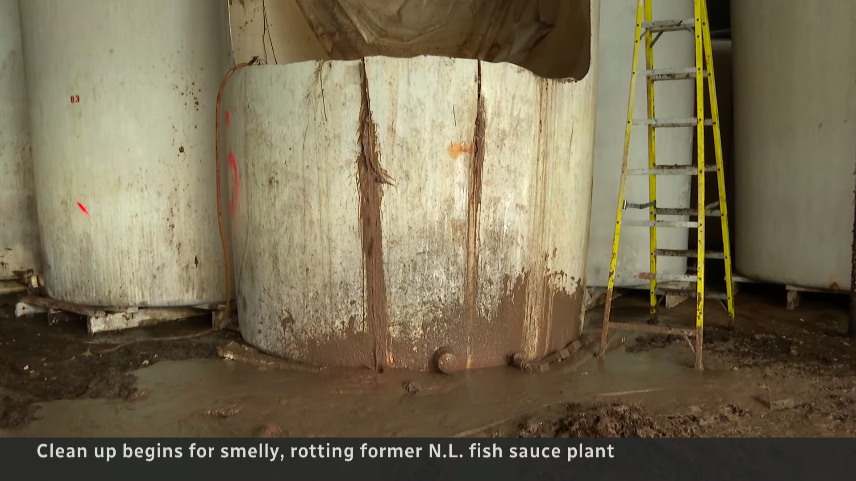
by TitaRusell - Since this is just salted, fermented fish, which the scientist in the article claims he would like to taste, why does it need to be buried in plastic? Why not slowly pour it into a sewer, over the course of several months?by Symbiote
- There's a farmers market here in Zurich where some Italians drive up and sell Italian products like cheeses, sausages, etc. but one thing I buy from them I've never seen anywhere else - they are rotten salted anchovies packed with peppercorns. Stink super bad and are falling apart but when you're making a sauce you drop one in and the anchovy dissolves and delivers tons of umami - glutamates - and you no longer smell the rotten fish smell. I'm sure professional chefs must know about these.
I keep them in baggies in the freezer so that they don't stink up the fridge.
by comrade1234 - I recall reading there were zoning laws in the classical era about where you could manufacture garum (the Roman fermented fish condiment). Here's one attributable example I could find, from the tail end of the Eastern empire. This is 2.4.22 in the Hexabiblos (1344–1345) ["–" sic] of the Byzantine jurist, Constantine Harmenopoulos of Thessalonica; it legislates a ~450–600-meter exclusion zone (three stadia).
The archive.org page I linked is in Byzantine Greek with a Latin translation. I've quoted the Greek part here, and I used Deepseek V4 Flash for OCR-cleanup and machine translation.
https://en.wikipedia.org/wiki/Constantine_Harmenopoulos
https://archive.org/details/constharmenopul00heimgoog/page/2... ("Ἐπαρχιχὸν ΠΕΡῚ ΓΑΡΕΨΩΝ" / "Edictum DE GARI COCTORIBUS")
> "22. Ἡ τέχνη τῶν γαρεψῶν καὶ ἡ τῶν τυροποιῶν οὐ τὴν τυχοῦσαν ποιεῖ τοῖς παρακειμένοις βλάβην· πολλὴ γὰρ ἡ ἀπ᾽ αὐτῆς ἀτμὶς δυσώδης τε ἀμέτρως ἐστὶ καὶ ἐπιβλαβὴς ἐπὶ πολὺ διάστημα. Ὅθεν χρὴ τοὺς τοιούτους ἅπασαν μὲν πόλιν μὴ οἰκεῖν μηδὲ κώμην. Εἰ δὲ χρεία τούτων εἴη πρὸς τὰς χρήσεις τῶν πόλεων καὶ τῶν κωμῶν, ἀφεστάναι στάδια τούτους δεῖ τρία. Εἰδέναι δὲ χρὴ ὡς ταῦτα πάντα τὰ προειρημένα ἐπὶ τῶν ἐκ νέου κατασκευαζόντων εἴρηται· εἰ δὲ χάρται εἰσὶ παλαιοὶ ἢ καὶ δουλεία τις προλαβοῦσα, κεχρῆσθαι δεῖ τοῖς ἐξ ἀρχῆς περὶ αὐτῶν συμπεφωνημένοις."
> "The craft of the salt‑fish merchants and that of the cheesemakers causes no ordinary harm to those nearby; for the vapour arising from it is exceedingly foul‑smelling and harmful over a great distance. Hence such persons ought not to dwell in any city or village. But if there should be need of them for the uses of the cities and villages, they must keep a distance of three stades [~555 m]. And it must be known that all these aforestated things have been said concerning those who set up (such establishments) anew; but if there exist old charters or some prior servitude (i.e., an established legal right or prescriptive practice), one must abide by what was originally agreed concerning them."
by peri-cl - Sounds like the Canadian Food Inspection agency screwed the town out of spite. Like they had a target on Ngo's back. Anyone have more details? From the linked Eater article:
>He suggests that a prior conflict with the CFIA over product labeling motivated them to close the factory before the inspection began. Ngo claims that he had been vocal about their interactions, and speculates “if they shut [us] down, nobody makes any complaints anymore.”
>After the government-run lab found Ngo’s product to be safe, he went on to win a court case and an appeal against the government. Even after those victories, the CFIA moved to restrict the sales of his product to the province of Newfoundland. “If I sell there, who will use my product?” Ngo says, pointing out the small population of Newfoundland and its non-existent Vietnamese community. “I could sell maybe one or two cases a month[...] we can’t survive.” The CFIA declined to comment, citing the amount of time that has passed since filing its initial complaint.
They could have stopped production in the moldy factory but allowed sale of the remaining product.
by anon84873628