Join the discussion

Write your take first — we'll ask for email only when you're ready to publish.

  • Hacker News
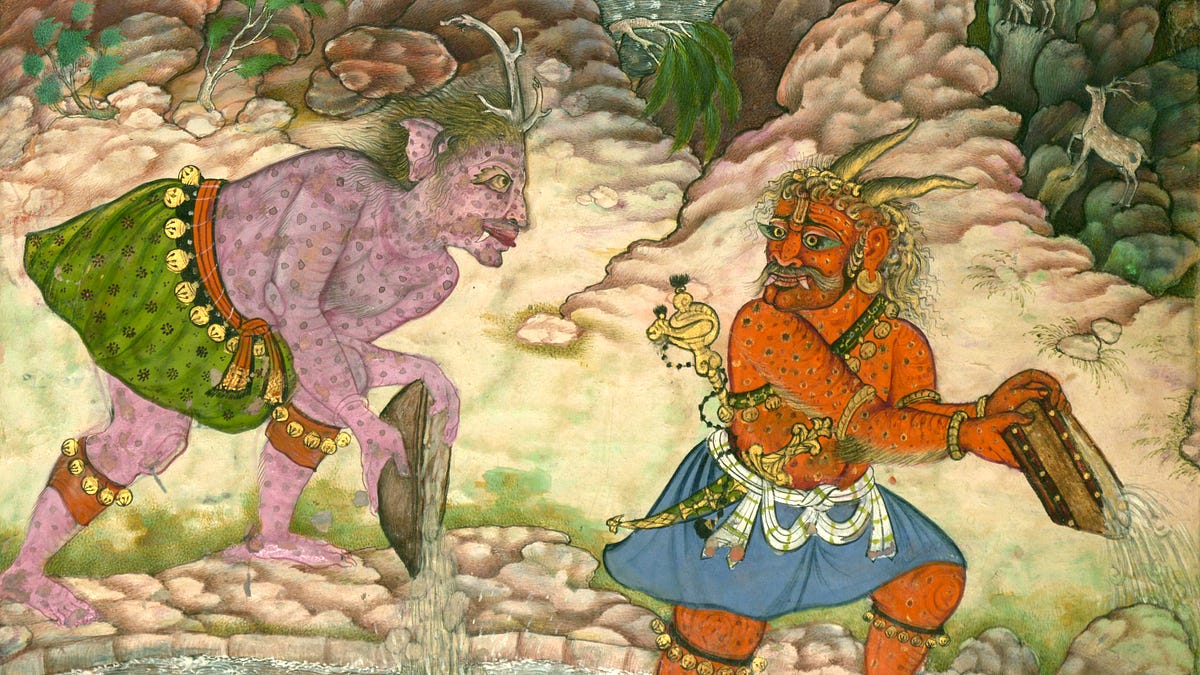
  • The Farsi word div may be related to the English word devil.
  • And then Hello became Allo in French and Alo in Spanish, which is only used as a greeting over the phone and never as a general greeting.
  • >Alo in Spanish, which is only used as a greeting over the phone and never as a general greeting

    Eh, kind of. Imagine you're in a warehouse and you can't see anyone but you think someone may be in earshot. You could get their attention with aló. It's sort of an uncertain greeting, when you don't know who or if someone is on the other side.

  • English people learning Chinese are told that goodbye is zài jiàn ('again see'), only to find that most Chinese informally say bái bái ('bye-bye').
  • And likewise became EHLO which could also be used as a greeting over the phone if you were you were talking to an email server.
  • There was a wealthy Italian who was building a villa in the US, and told the architect he wanted a "hollow statue" in it. The architect looked far and wide for a hollow statue, without success. Finally he came back to the client and told him that no one he talked to had heard of hollow statues. The client said, "Oh, it's one of those things that rings, and you pick it up and say "Halo, 'stat you kiddo?"
  • Meanwhile German independently had the word "hallo", which appears in writing since the 15th century, used to call for the ferry man or to call to your dogs on the hunt (meaning something like "fetch"). Then the telephone made "hello" popular in English, and suddenly the word "hallo" becomes popular as a greeting in German

    We just picked the closest existing German word to take the same meaning as the English word. But at the same time, the etymologies of hallo and hello cross over at various times before the invention of the telephone (One etymology of Hello is that it derives from Halloo, a call to a ferry man)

    Etymologies can be really weird at times

  • > For instance, Shakespeare’s characters call one another “cuz,”

    Calling someone 'cuz' is quite common in Aotearoa/NZ.

  • many times, even etymology does not make things intuitive: e.g. 'spendthrift'. similarly, many English words are close, but their meaning diverge a lot. e.g. condemn vs condone, or vindicate vs vindictive.
  • Thrift was formerly a word for profits, now it makes sense. But I recognize the snowclone as a popular 16th century way to form personal verb-noun descriptors like cutpurse, upstart, sawbones, spoilsport, dreadnought. This is still productive because midwit is a recent addition. (Eh, I suppose mid isn't a verb, but I think it's the same pattern.)
  • >vindicate vs vindictive

    I don't think this is a good example of cognates diverging in meaning. They're both more or less kinds of avenging or counter-attacking. When you vindicate something you are responding to some attack made against it, and when something is vindictive it responds to attacks with attacks of its own.

  • I love the etymology of the word "world" it's a combination of:

    weraz = “man” and aldiz = “age, lifetime”.

    Literally meaning “era/age of man”

  • I recently learned that most of the western zodiac constellations have names which are Mesopotamian in origin, the same as in the Sumerian star catalogs thousands of years ago. Taurus, Leo, Scorpio, Capricorn, Gemini, Cancer. Or in English: the Bull, the Lion, the Scorpion, and the Goat-Horned, the Twins, and the Crab.

    To the Akkadians and Sumerians they were, literally translated: the Bull of Heaven, the Lion, the Scorpion, the Goat-Fish, the Twins, and the Crayfish.

    There was some process of transmission there, maybe via Aramaic, now mostly lost to history. Until quite recently the extent of the Mesopotamian influence was not recognized, even though the ancient Greeks themselves grudgingly acknowledged the Persian (i.e. Babylonian) roots of their own learning; the same origin as 12 hours in their day and 360 degrees in their circles.

    A few of the traditional Arabic names of the stars are also calques from Akkadian ("heart of the scorpion", among others). This also hints at a process of transmission, which is now elusive.

  • I'm never going to look at a <div> the same
    by adzm
  • The demons come out when centering
    by tys-
  • I really love etymology, because I like to imagine words having "lives", and then tracking those lives over the centuries. It's fascinating to think that a word might have begun in China thousands of years ago, migrated to India, then the Islamic World, then Europe, and are now everyday things in English.
  • A good book on this is Proto by Laura Spinney, it covers all the branches of Proto-Indo-European and also postulates that the entire family may have started from as few as a hundred speakers who were steppe nomads, which is mindboggling if true.
  • +1 on Proto. It focuses on the tremendous amount of information revealed by DNA analysis, and it weaves this together with historical linguistics and archeology.
  • In a similar vein: "The Horse, the Wheel, and Language: How Bronze-Age Riders from the Eurasian Steppes Shaped the Modern World" by David W. Anthony

    https://press.princeton.edu/books/paperback/9780691148182/th...

  • Indeed, there is a PIE 2-branched theogony behind TFA's example

      Asura - Aesir - Olympians
    
      Devas - Vanir - Titans
    
    And the etymology of "Hormuz", allegedly, "Ahura Mazda"
  • A book I enjoyed in a similar vain is "Wordslut", it's an exploration of the etymology of various English words (mostly pejoratives today) and the difference in language use between genders. It's more sociolinguistics than linguistics, but a good read.