Join the discussion
Write your take first — we'll ask for email only when you're ready to publish.
- Hacker News
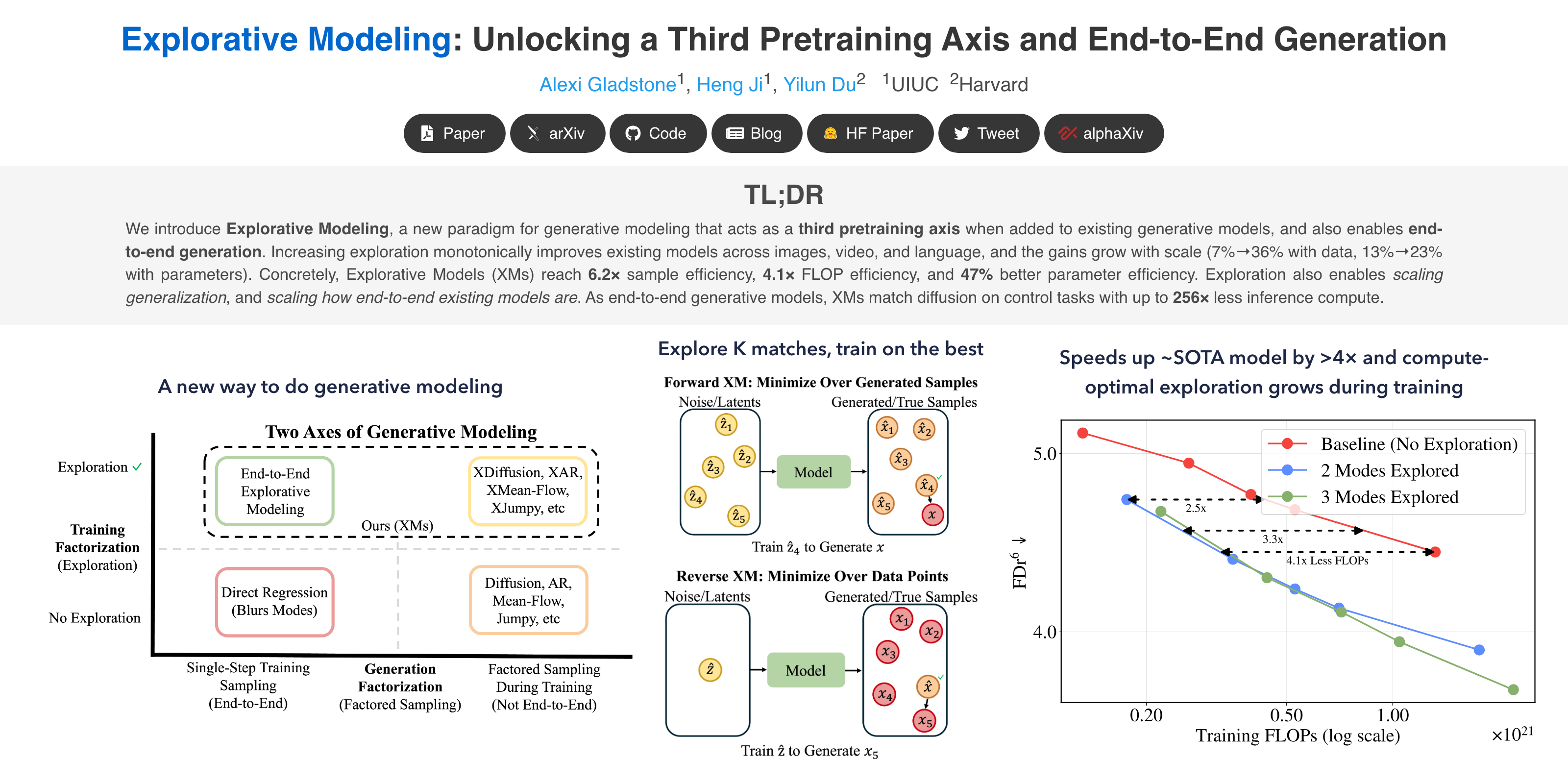
- I find the presentation of this as "factoring training" very confusing.
Factoring is something we do to distributions, which we then parameterize with our neural net.
An autoregressive model pertains to a certain factorisation of a joint distribution. And if we choose this factorisation it may have consequences for our training and sampling etc.
But to say "most models on factor generation".. I dont quite get this.
This would be better work if it didnt claim it was a new pretraining axis also. Its another way of scaling compute right?
If it were a new axis, IWAE would have an equal claim to it (as others have pointed out).
by angusturner - If their numbers are real and hold up at scale, every image model trained before this is now obsolete.
- This feels extremely close in nature to being a generalisation of discrete distribution networks.
Paper: https://arxiv.org/abs/2401.00036 Project page: https://discrete-distribution-networks.github.io/
Given that these were published at ICML 2025, at which the author was a top reviewer as per their own website https://alexiglad.github.io/, I wonder how influenced they were to pursue this avenue of the back of it. They do have a related works section in appendix E, but it somehow seems to miss this. Which is odd, as the paper made a splash at the time at the conference and even made it close to the top of hacker news due to the novelty.
Of course, DDNs are a fundamentally new architecture, whereas this is more a generaliseable training strategy, but there is a very similar core.
by ImageXav - Project page: https://explorative-modeling.github.io/by frozenseven
- The training method is very similar to Importance Weighted Autoencoders: https://arxiv.org/abs/1509.00519by in-silico
- This is amazing and I think will probably end up being a pretty important development.
I was just reading this great breakdown of how diffusion Gemma works: https://newsletter.maartengrootendorst.com/p/a-visual-guide-...
In reference to the difficulties with applying this to autoregressive LLMs - I wonder if these type of hybrids might be a good candidate for this approach.
by kamranjon - This paper shows a nice integration of older winner-take-all ideas for learning K-modal generative models (see e.g. https://arxiv.org/abs/1612.00197, https://arxiv.org/abs/2211.14286) into modern diffusion/flow pipelines. As-implemented, I think it has some downsides:
1. K-1 extra forward passes during training
2. Inaccurate sampling behavior (will sample all K modes with equal likelihood, rather than sampling them proportionally)
However, I think both of these downsides can be mitigated by adjusting the implementation a bit more (you can have the model predict K modes jointly in one forward pass, along with probabilities of each being the min-loss mode, which you can then use for properly-weighted mode sampling at inference).
That said, I'm not entirely sure if this strategy is as generally applicable as the authors are hoping. In particular:
1. For highly-conditional image generation (like modern commercial diffusion pipelines, which use a big LLM preprocessor), most of the low-frequency color/layout decisions are already made for you by the conditioning signal. The diffusion process mostly needs to generate high-frequency details, for which there are a huge number of equally-valid modes.
2. For LLMs themselves, the sequence-generation process is already factored into a discrete classification problem, and there's no mode smearing issue to fix.
by ollin - Although this is a neat idea, the author appears to be confused about how generative modelling works.
They repeatedly claim that previous approaches rely on factorization to reduce things to guessable chunks to avoid the 'blur problem'. This is a misunderstanding. Previous approaches solve this problem by modelling a distribution as output rather than a point. Factorization is one way of representing the distribution, but the key point is that even for the small chunks we predict an output distribution, not a point estimate.
Factored models have no issue producing TV static as an image. Each individual guess is impossible, and yet they don't produce a constant grey averaged image.
Normalizing flows, though not considered particularly efficient, are not factored at all, do not proceed in small steps, and yet still have no issues with blur because they predict a distribution.
Their approach appears to be a hard version of a latent variable model. It may be a good idea, but it isn't a fundamental change in the way they suggest.
by Straw