Join the discussion

Write your take first — we'll ask for email only when you're ready to publish.

  • Hacker News
  • Interesting.

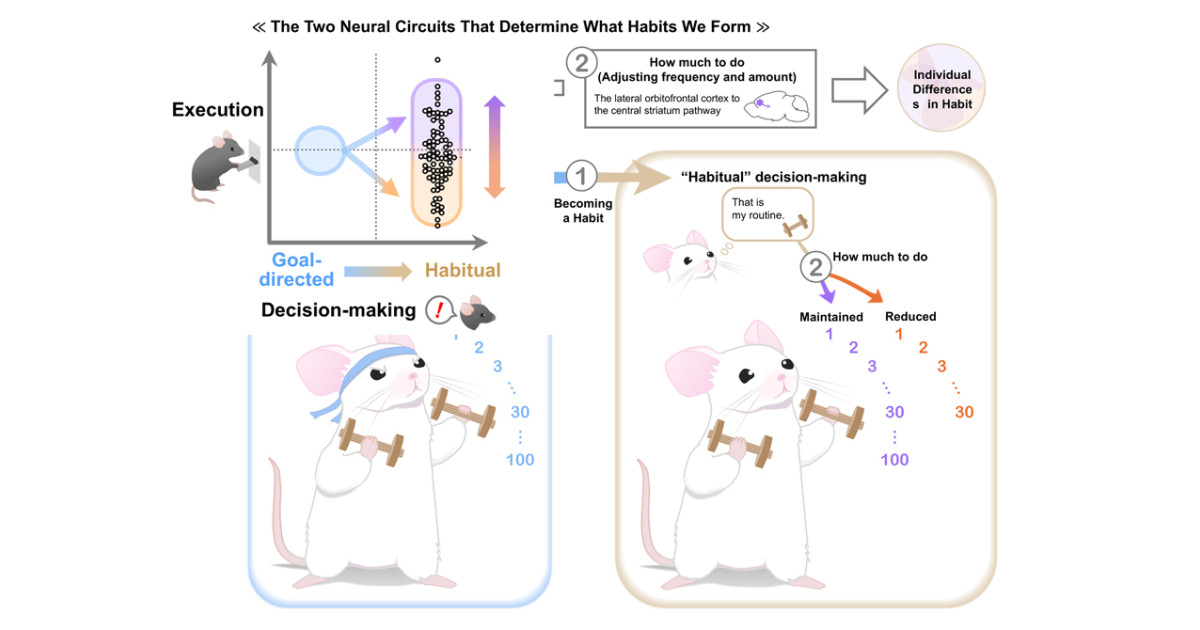
    So one circuit essentially has 2 modes: 1 I do ActionA because I want to get GoalA 2 I do ActionA because it is my routine

    What would be interesting to see is IF by activating this mechanism, mice start getting habits almost instantly for behaviors performed when this circuit was in the state#2. Correct me please.

  • As a beginner academic, is it fine to publish cute figures like this in academic journals (Im in computer science) ?
  • It's fine, though it isn't the norm, presumably because authors fear their work might be taken less seriously; but if the content of the paper is good, it's fine to add a little character, or flourish. Some amusing titles fall into a similar category.
  • What also still puzzles me about habits is the fact that once I have a routine (like going to the gym at 6am) it is super easy. But once I lost it I struggle a lot to get it back.
  • I feel like it's much the same for bad habits broken, too. If you allow yourself to fall back into a bad habit (smoking, drinking, gambling, etc for example) it feels really challenging to break it yet again. Best excuse I suppose to keep those good habits and bad ones right where you wanna keep 'em.
  • The psychologist William James described habits as like winding a string of yarn into a ball. If you drop the ball then you have to spend time rewinding it. Also, a ball that has been being wound for a long time will be easier to rewind than a newer and smaller ball.
  • The paper might explain why it is so. Routine-setting in your brain runs separately than the execution of the activity itself, meaning you need to train the two separately, at least from what I understand.
  • When I start a habit it feels like a one-way trip to a new life. If I break it, even once, I realize it’s not, it’s just a thing that I can do or not do. Now starting that habit again feels much less consequential.
  • The determined mouse with the barbells and the headband is my new spirit animal.
  • Same :D That mouse is determined. I love it.
  • (in mice)

    Needs to be as mandatory a suffix here as year, video, etc

  • Should it be? "New black hole observed" needs a mandatory "(with a radiotelescope)"? "Agentic AI is great" needs a mandatory "(according to my opinion)"?

    Lots of things we know about human physiology comes from animal studies.

    Mice are not just some random animal species. They are a model organism for humans, meaning that they are sufficiently close in many ways such that insights are transferable.

  • I was watching a Charlie Rocket interview today and I got a lot of inspiration from him. He made it a habit of staying positive, turning a loss into a win and always finding the upside. Instead of getting sucked into the despair, he takes a loss as a learning lesson. Good habits can be hard to find but once you get into the habit of something, it becomes super easy. Everything is hard to do -- if it was easy, everybody would be doing it. Once you learn to do something, and keep doing it, you understand it better and it can make your life so much easier, or happier, or better, in so many ways. There are also bad habits but those are just as easy to break as good ones.
  • Could you share a link to the interview?
  • We are easily influenced by what we say.

    Complaining is a reinforcing negative loop.

    Saying to yourself that you can do it, even when you think the opposite very quickly shapes your mind.

  • Agree with most everything and will check our that interview, that attitude is how I try and live, but the last sentence is obviously not true. Taking heroin is a habit, going to a gym is a habit, and obviously one is much easier to stop whether either willfully or not.

    I'd say the ease which you can pick up habits or drop them is extremely variable across the specific habit and person. (as a different example, someone with less social awareness will find it harder to pick up the habit of being a hospitable host than someone it comes naturally to, but once learned its probably fairly easy to maintain)

    One of my favorite quotes is, "first the man makes the habit, then the habit makes the man" , and it works both ways, good and bad. I really think this is something that should be taught much more explicitly in school to everyone, rather than leaving it only in places like sports and the military.

  • There's a fine line between what you described and toxic positivity.

    It's important not to ruminate on bad thoughts (when your proposal is a good replacement behavior), but it's also important not to bottle up natural human emotions as if they are unjustified or unreal.

    A thought exercise: if it wasn't your behavior that caused your own despair, but your spouse's behaviors that caused you irritation / grief. Do you think it's better to paint a smile on yourself and ignore the underlying problem, or spend a few minutes feeling your emotions, describe the cause to your partner, then politely suggest a substitute behavior? The former builds resentment and bottles up strong emotions for an inevitable outburst down the road. The other diffuses the emotion, potentially alleviates the offending behavior, and doesn't betray what you authentically emote.