
Join the discussion
Write your take first — we'll ask for email only when you're ready to publish.
- Hacker News
- > It’s as if the world now requires you to be more precise about everything.
This is something I've been thinking a lot about. We have trended from subjective language to objective language. Why?
Computing. Software is written with objective language. Everything is clearly unambiguously defined. Blue is no longer a category, it's #0000FF. Logic must always reduce to a binary truth value. Most of what we have to talk about is somehow relative to software. Software even structures most of what we write! We don't just talk to each other, we tweet, email, message, post, search, etc. These structures each imply a specific set of phrase structures that can make sense.
Lately, it's hard to go even a day without reading some complaint that such and such was written by "AI" (an LLM). Why is this so obvious? Well, the core advantage that LLMs provide is that they don't compute. Inside an LLM, there is no arithmetic, no logical branches, no truth values. Phrases aren't generated to define or to resolve. They are generated to continue. Sure, we can direct the story to follow the steps of logical deduction, but that isn't anything like calculation. An LLM simply isn't invested in logic, precision, correctness, etc. the way we expect modern writers to be. It's not the em-dashes or the word choice that illustrates this, it's the fundamental perspective of the system.
We are sorely missing subjectivity. Natural language never was, and never will be, computable. You can't reduce a natural story to binary truth values without choosing an arbitrary perspective that resolves its ambiguity. The more precisely abstract our language gets, the more detached from reality our stories become. The more objective our assertions about reality are, the less relevant they can be.
My answer to this is to make the arbitrary choice of perspective a first-class feature. If we can explicitly decide what meaning is relevant, we should be able to weakly solve natural language processing. It seems like a pretty simple and obvious idea, but so far is easier said than done.
- Eh, this seems somewhat right, but somewhat not right either.
Language has to do with our Monkeysphere, that humans over long periods of time in the past were limited to a very small subset of people they interacted with socially and closely. A few institutions likely had a large effect on your language like the church depending on where you were. After that it was the people you interacted with to stay alive. Because almost everything was in person or person to person transfer of information a lot of socially encoded clues were involved which lessened the need for well defined words.
Books were the first stage of homogenizing language as they could be shared over long distances and to many people, but more sequentially than latter forms of communication. After that radio and TV had a huge effect, for example the 'General American' used in broadcasts that was based heavily on a midwestern accent.
As we encroached on the 70s and 80s the previous technological advances and things like high speed interstates and trucking shrank America to something you could drive across in less than a week, and you could reach anywhere by voice nearly instantly. Suddenly people in California, Texas and New York all could be in the same meetings and local colloquialisms would need explained, so people would trend to a shared vocabulary.
It's also odd to me to say an LLM isn't subjective. Each LLM has it's own behavior, it's that there are like 20 or 30 big LLMs in all, and people are using them millions to billions of time so we're getting that one LLMs language everywhere. And that's why I disagree and will say natural language is computable, but it's also lossy and probabilistic. And for the most part it's single prompt and being ran by the user for the cheapest price possible.
by pixl97 - I don't agree with the assumed equivalence between precision and objectivity. Language can be precise when describing a subjective perspective, and it can be imprecise or ambiguous when describing objective facts. The tendency toward increasing precision is a good thing, in my opinion. If anything, precision in language allows writers to tell better, more nuanced stories about subjectivity.by fasterik
- >> We have trended from subjective language to objective language. Why?
Alternative theory: asynchronous communication.
It used to be your speech stayed with you, and if you were unprecise, or misspoke, or was caught meandering off-topic, people could just ask you and you would clarify. With exception for authors and journalists, that were explicitly taught how to write.
Now, your speech stays while you leave, so you have to construct as precise of an image as you can. If you misspoke or said something wrong, people have to engage with your speech as-is.
People can ask you to clarify online, of course. But you have to build a solid foundation, before people even start to think that they could benefit from a few clarifications.
by lesostep - I still cannot get my head around what is "lunch", "supper", and "dinner" - and how this was explained to me at school was different from reality, also depending on the country where you are in :-)
No English school teaches you this, only real practice.
by alex_akimov - Wait til you find out that in Northern England, we call the evening meal "tea", not to be confused with "tea", the delicious leaf water.by cryptopian
- Dinner originally had a meaning like "biggest meal of the day". That used to be midday, culturally shifted to the evening. In some places and some contexts the language followed but not in every case. In southern England dinner is typically in the evening but we still say "school dinners" for subsidised lunches and "dinner ladies" for the women who serve them.
Supper has always meant evening as far as I know but referring to the evening meal as supper became a marker first of the upper class and then of pretension. Hearing someone say supper is quite jarring for me.
by ccppurcell - It's changed so much I can't even parse the title.by wseqyrku
- Evidently grammar's become slackerby shh_labs
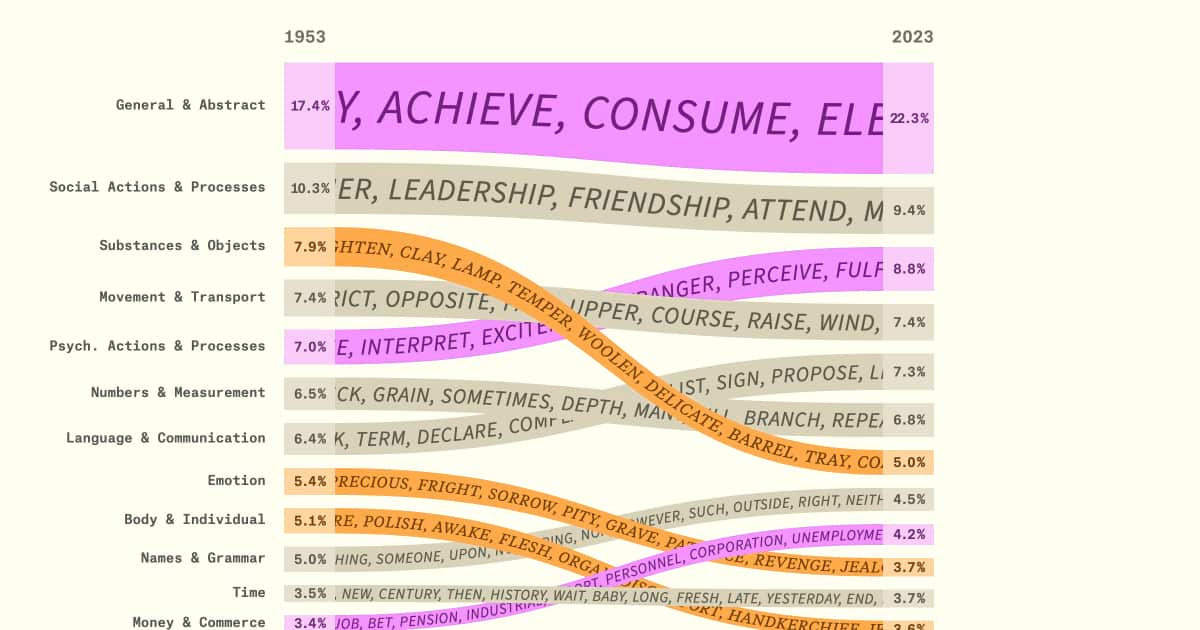
- > But also: apple didn’t make the new list. Neither did fork, soap, umbrella or leaf, for example. It’s not that these things vanished from everyday life, but many hands-on words became less central to the core vocabulary.
I do not understand what this article is about. Clearly anyone learning English needs to know the word "fork".
The article is essentially saying that the new list is more advanced than the old list. Okay? That's not interesting.
by zarzavat - always hated this style of web presentation.by Jtarii
- this is particularly badby bot41
- This is the worse I have seen.
Most of these kind of website have the animation on the centre of the screen. This one animate at the bottom
by j16sdiz - The author mentions various categories grew or shrank, but always in percentages. Since the list also grew from 2300 to 2800 words that feels like it might distort things a bit: in absolute word count, a category that shrank by 1% lost fewer words than a category that grew by 1% would have gained, no?
Having said that, the categories that shrank all did so by a big enough percentage to also shrink in absolute number of words, so at least that isn't a problem.
by vanderZwan - All that time spent programming those visuals. Which, I think, ironically, have made the article harder to read, not easier.by azangru
- But you’re more likely to remember it. It’s not trying to be easier.by kimos
- I tried to build a similar list myself for German and it's not easy as just taking a lot of content and counting frequency. I also haven't found existing curated lists of most useful vocabulary.
There are some databases but e.g. they are biased towards Wikipedia and web which makes some very obscure words at the top of popularity (like some technical words which are present on each wiki page like Datenschutz or Impressum).
by kuboble - Another commenter mentioned that enWiktionary[1] has some, and I also found a dewp article[2].
[1]: https://en.wiktionary.org/wiki/Wiktionary:Frequency_lists/Ge...
by YoshiRulz - Useless, obnoxious, absolutely frustrating Scrolljacker? Straight to jail.
- I thought the same thing.by twosdai
- When I was in high school at a private school, I was surrounded by students who were religious but didn’t have much curiosity. I got into a debate with basically my whole class about how languages shift and change over time, and everyone was saying that languages stay the same and that they were all determined at the Tower of Babel.
I used the examples of Latin to Spanish and English, or Old English to new English.
I say that to say, languages changing over time is to some people not actually something they believe happens. The facts are right there in front of you, but some people cannot have their minds changed no matter how much sense you make.
by ninjahawk1 - > I was surrounded by students who were religious but didn’t have much curiosity
That seems like a given. If you're curious, you'll soon see through any ideology you were spoon-fed as a child, religious or otherwise.
by scoot - You're talking about ignorant teenagers. Is there more proof that large groups of people don't believe languages change over time?by bot41
- Huh, English has changed perceptibly over just my lifetime.by WalterBright
- There's a very easy way out for them: Just claim that the bible is rather metaphorical than literal, and many things can be interpreted to be in line with scientific findings. That seems to be at least what protestant churches in Europe seem to do.by blauditore
- Here’s one verse from the Bible itself that shows that language changed: 1 Samuel 9:9:
> (Formerly in Israel, when a man went to inquire of God, he said, “Come, let us go to the seer”; for he who is now called a prophet was formerly called a seer.)
I love that one because it translates so well into English because we also have an older and a newer word for close enough to the same thing. Though when saying older and newer I should note that the words “prophet” and “seer” have been used consistently since the very first English translation, Wycliffe’s in ~1382. Maybe it’s more the feel of the words. (In Bible Gateway’s catalogue of English translations, only the CEV doesn’t use both of those words: <https://www.biblegateway.com/verse/en/1sam9.9>; I disqualify OJB as not English.)
That’s the only one I can think of off the top of my head that’s specifically about language, but there are plenty of others about changed customs over time, in Old and New Testaments.
by chrismorgan - > The “Social-Communicative” level barely changed in size. But nearly a quarter of the words in the 1953 list are gone, and 39% of the 2023 words are new. Humble, loyalty, fellowship, generous, polite, and companionship gave way to community, identity, organization, ethnic, gender, and narrative. ...It offers fewer words for the people directly around you, but more for belonging at a distance.
I would blame inequality on this one. In a more unequal world tribalization is a survival strategy and language follows.
When you see everybody else as your equals then focusing on describing that individual person, instead of their group, makes more sense.
Economic inequality affects deeply how we think about others.
by Frieren - I would blame it more on globalization.
In 1953 people were not exposed as much to different groups of people far away.
by kuboble - I can't quite follow your point. Are you saying there is more inequality today than in 1953?by SoftTalker
- I don't follow your reasoning at all. It's a shift and what people talk about and write about. It can't be anything more than that, by construction.
What I see is shifting from a focus on individuals and close personal relationships to a focus on the functioning of society and, well, identity.
It seems like a swing of the pendulum to me. Encouraging people to create their own identities, creating vocabulary to describe one's identity, and advocating for a restructuring around society that is relatively collectivized economically, but culturally celebrates individual diversity. I'm not a professional historian, but I think that's somewhat of a new phenomenon historically.
And it's clearly a reaction to the perception that the ideals of equality and being uniformly kind to each other we're not enough to bring about a just and equitable society, and if anything were abused in order to suppress diversity. We still have to be kind to each other at a basic level, but it's not enough anymore.
So maybe now there's too much focus on that stuff and not enough focus on the part where you should actually just be nice to your neighbors and be humble and all that. Or, maybe people are disproportionately writing about it, because it's a new thing, and a lot of people know a lot to say about it, and a lot of people want to talk about it.
I don't think it makes a shred of sense to conclude that somehow the world is now more equal than it was in the 50s. It's disappointingly far from equal, though, and I think the change in lexicon is a change in people's focus specifically because the old system clearly wasn't working, and people are eager to try something different.
by gwerbin