
Join the discussion
Write your take first — we'll ask for email only when you're ready to publish.
- Hacker News
- I love renewables, but the problem with solar is the lack of inertia (literally). Big spinning masses like steam turbines have an easier time staying on network frequency. Wind turbines better than solar of course so I hope we continue to have diversity there.by tomasphan
- Wind has the same problem, because the actual generator is not spinning at line frequency. It has a rectifier plus inverter.by pitaj
- This is interesting. They can't make AC inverters more reliable than spinning motors? I thought the problem was more about supply not matching demand quickly enough.by frollogaston
- Thankfully this is one of the easiest limitations to get around technically. Grid forming inverters and inertia markets make this pretty straightforward to solve IMO. Storage is the key thing we need to solveby klysm
- Batteries paired with the right inverters solve this fully. Buys you enough time for powering up backup power in the form of a good old steam turbine (gas or coal powered). No need to keep spinning if they aren't needed.
The good news is that batteries are deployed at almost the same scale as solar now on grids world wide. They can respond in more or less real-time to huge fluctuations in supply and demand and smooth out peaks and dips in those.
- Cheap, renewable energy offers a competitive advantage to manufacturing and AI.
This undoubtedly explains why the current US administration is openly hostile to it.
by jqpabc123 - Some good data on this topic: https://ourworldindata.org/co2-emissions
- That's because Germany doesn't need so much energy anymore. The heavy industry is disrupting, instead you get a climate anxiety and migration industries.
- Thank goodness the energy policy of the US is being dictated by a single, highly intelligent man that isn't falling for the clean energy hoax, a man who consistently puts the interests of the people over his own interests. It's sad that the rest of the world is falling for this scam. </sarcasm; gosh, i hope it was obvious>by jimt1234
- It's a good news and a milestone to celebrate but if we count all energy and not only electricity and not only developed world then the progress is not as fast unfortunately [1].
Not a long time ago I've seen a post arguing based on the data [1] that renewables are irrelevant and should not be taken seriously and fossils will the main source for the lifetime.
[1] https://ourworldindata.org/grapher/global-energy-substitutio...
by citrin_ru - Also interesting to look at the chart per country. [2] US fossil fuel is 4x entire Germany, while for China just coal is over 8x all of Germany. So good and relevant news at a local scale! But pretty irrelevant at a global one... A scale at which there is more talk than action in parts of the world, probably because it would be too economically painful if not unfeasible to e.g. limit or tax imports, outsourcing etc by emission source.
[2] https://ourworldindata.org/grapher/primary-energy-source-bar...
by afarah1 - When looking at hat kind of graphs, it's good to keep in mind that burning hydrocarbons is relatively inefficient: only ~20-30% of the energy in the fuel turns into useful work, while electricity is much, much more efficient. So, we need much less of it.
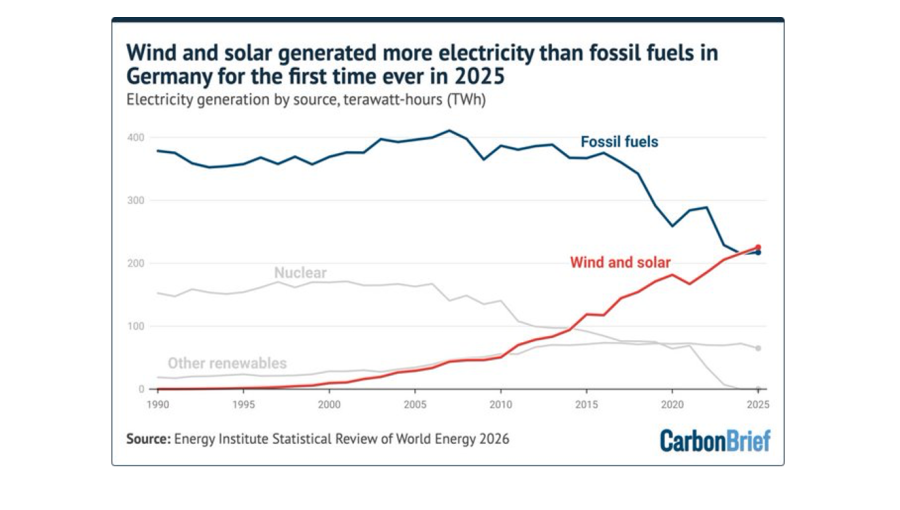
Still a long ways to go regardless, but much less bleak. And also, exponentially growing deployments of wind and solar are harder to spot on this 2-year old graph which goes only up to 2024.
by ragebol - This is such a misleading comparison. The energy used that comes from a solar panel is already in an extremely low-entropy, highly usable form. The energy used from a fossil fuel is highly inefficient and hard to harness.
For instance, if you just go by the number of joules in an electric car's battery versus the number of joules in a gasoline car's tank with the same range, you'll see that a 'normal' electric car gets around 15 kWh/100km whereas even a rather efficient gas car needs something more like 50kWh/100km. That's because gas combusion loses gigantic amounts of energy to heat and sound.
If you want to talk about 'total energy consumption' and compare solar/wind against fossil fuels, you should count the amount of energy in the sunlight that hits the surface of the solar panel, or the amount of wind energy hitting the turbine blade, rather than the amount of energy they deliver to the grid.
by eigenspace - Breaking news: "Wind and solar overtake fossil fuels in <insert_European_country> for the first time" for the 10th time this year.
Also on other unrelated news German economy is rocketing to the bottom, their industry is dying with thousands of layoffs, closing factories, and complains on energy prices and they can't even maintain their rail and road networks for the first time since forever. The signs of decline are not even signs anymore they are bright neon signs. But at least we are taxing cows farting. While china is steamrolling ahead and we are regulated to death by bureaucrats.
- Your cause/effect doesn't have all that much truth to it with regards to rail.
German rail has been an under-invested in mess since reunification, it's a long slide not a recent one. They are finally investing the kind of amounts in it they need to, to actually revive it to what it should be. It's going to be a long road to actually get there, of course.
Paywall but a decent read on that note: https://www.ft.com/content/db75e347-b13b-4753-8130-6301bb55c...
by volkl48 - What’s your point in relation to this article?by zingar
- Average German industrial electricity prices spiked in 2021, 2022, and 2023. 3 years. That's it. By 2024, they were back to the same level as 2017.
https://www.dw.com/en/high-electricity-prices-a-threat-to-ge...
In other words it's been approximately 2.5 years since prices recovered. If Germany industry can be irrecoverably damaged by 3 years of high power bills, maybe there were deeper issues.
by triceratops - The continent is literally on fire due to global warming. Europe does not produce any fossil fuels and needs energy independence. It's because politicians dragged their feet for so long on net zero that we are even in this mess in the first place. Better now than never.by alpineman
- The headline should state this is about electricity generation.
If you compare e.g. with a country like Sweden or France they have been free from fossil fuels for electricity since the build outs in the 70s-80s.
Also Germany is an importer of significant electricity (e.g nuclear power from France).
But due to a stagnant economy and no increase in electricity demand - yes, I guess this milestone is now passed...
by mikaeluman - True. Less than 40% of the world's fossil fuel energy goes to generating electricity. The rest goes to transportation, industrial processes, material feedstock, and direct heating - which are not accounted for in this metric!
"Renewable alternatives cover half of 40% of fossil fuel demand" would be more accurate. Still a win, but it's not "overtaking fossil fuels" by any definition.
by perrygeo - The next frontier will be meat consumption. Particularly red meat.
A single 1/4 beef hamburger emits 7-12 kg of carbon[1]. Compared to ~1.5kg of carbon driving your car 3 miles[2].
Not telling you to go full vegetarian, but I'm personally far less interested in a beef product unless you're going to guarantee its an extremely expert prepared steak. Most beef is mediocre.
1 - https://ourworldindata.org/environmental-impacts-of-food
2 - https://www.epa.gov/greenvehicles/greenhouse-gas-emissions-t...
by softwaredoug - There's tens of millions of well-armed Americans who'd rather die fighting then let anyone take away their right to eat red meat, so good luck trying.by logicchains
- Indeed. And also it's not healthy, compared to veggies, or even leaner meats like poultryby oulipo
- Getting people to agree to the same cultural diet is about as easy as getting people to agree to the same religion.
If we could change culture and the global diet, there are many exciting low carbon foods being promoted, especially in aquaculture. Shellfish and seaweed do not rely on artificial fertilizer, fresh water, or people burning down the rain forest.
by belorn - Wait, how does beef emit carbon? I thought the main problem with beef was methane, not carbon emissions.
Ah, I see, your graph says CO2-equivalent, not CO2. It's the methane.
by stavros - Going vegetarian would only cut it if you stayed clear of dairy. Gram for gram it's better to eat chicken than cheese for the climate.by puchatek
- Beef is already too expensive for most people. Americans are probably the exception but I can assure you that most Europeans do not have beef heavy diets. Even culturally, pork (and now chicken) were the proteins of choice.
- There was a German article comparing different traveled distances between German cities with CO2 impact of meat production.
https://www.merkur.de/reise/reduzieren-sollte-besser-reisen-...
by leonidasrup - Yeah, plus the ethical angle. It's a bit ridiculous that we have people researching the 'theoretical ethical treatment of LLMs' when we are doing such awful things to animals on a massive scale.
We have dogs and cats as pets and we eat cows and pigs (in Western countries). As if cows and pigs didn't also have personalities, memories, parental bonds, the ability to feel pain. It's a mass wilful ignorance.
What's the difference between us and animals? I would argue that it's our ability to take ethical decisions and not inflict suffering even if it goes against our base instincts.
by alpineman - Part of this is about a new way to store energy. In the Netherlands, they have started storing heat energy with sand, in Germany, they are using bricks. This has some advantages. It allows the direct use of heat for industrial processes and heating industrial and commercial facilities. They can either convert energy into electricity or use the heat directly. This technology can be used with a wide variety of energy sources. This includes nuclear because it allows thermal storage of excess heat from nuclear energy. This kind of setup is supposed to be more stable for the grid and more reliable for storing energy.by NishanStepak