Join the discussion
Write your take first — we'll ask for email only when you're ready to publish.
- Hacker News
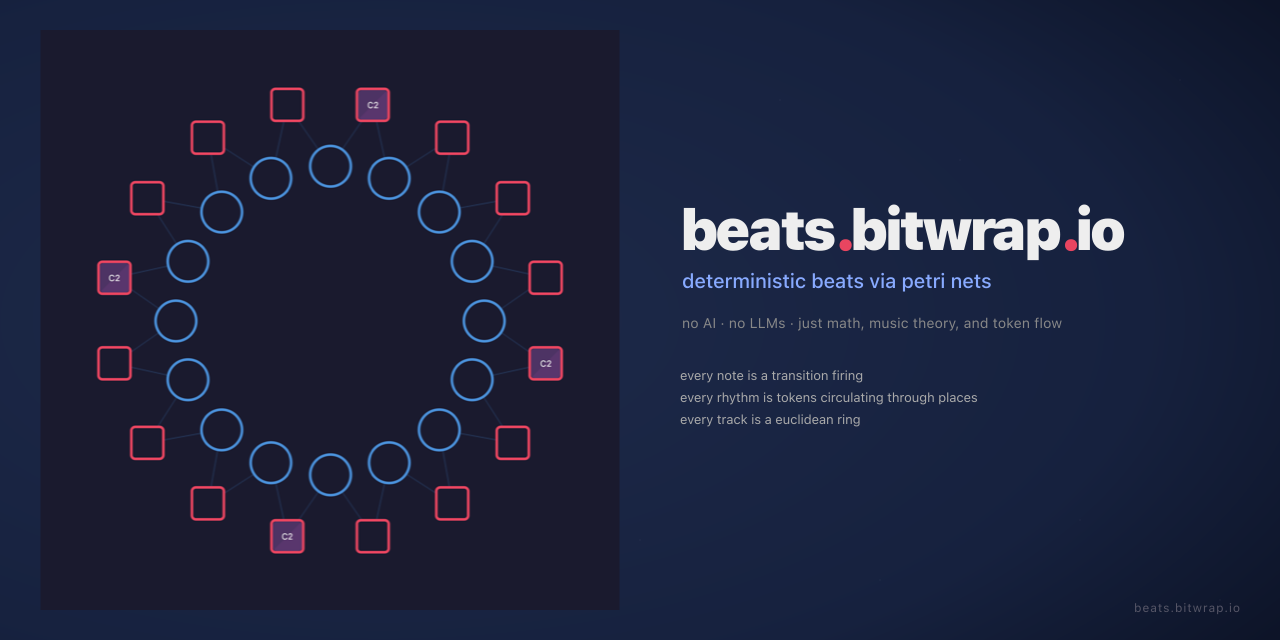
- What's the value of modeling these as petri nets instead of a regular sequencer? I was expecting some sort of branching, or at least multiple tokens per ring, but I can't figure out how to set that up.
Also - is it just me, or is delivery weirdly off-beat sometimes? Like, isolating to just the kick drums in a standard 4-on-the-floor techno song, it has almost a disorienting amount of delay on some of the beats.
by fwip - Oh thats great and makes so much sense and you can see how it could be extended, brilliant abstractionby tlarkworthy
- Looks pretty cool, but I couldn't get any sound out of this thing?
The demo video has sound though, and sounds pretty cool.
by andai - So this is about visualisation more than different behaviour? There are still N static notes with a cursor moving from start to end, looping over. It's not clear from the blog. Still, I always enjoy experiments in that domain, thanksby tleb_
- Compared to other ways of writing down musical rhythm, I've found this to be a very nice balance of simplicity and expressiveness. Standard notation and drum sequencers have a lot of ambiguity (at least to my non-expert ear) when it comes to swing, microtiming, groove, and the other little things that we think of that make a rhythm attractive. Godfried T. Toussaint has given this idea a full academic exploration. He calls these Petri nets "necklaces", a term borrowed from combinatorics.by jarth9
- I see so many people try to reinvent sequencing as a circular diagram, as opposed to (say) a piano roll that loops, and I see little to no advantage to it. It's a cool novelty, but not the type of thing you'd like to work on.
Horizontal (left-to-right) sequencer displays like a piano roll or step sequencer are far more compact to display and easier to read. For drums parts, it's one dimensional until you add a second layer, and then the parts stack vertically, nicely on top of each other.
It's all to say that I don't really see much advantage in this petri nets paradigm. Even the trigger conditions and probabilities have already been incorporated into a large number of DAWs and hardware sequencers. This feels a little like someone who has discovered fire independently from the rest of civilization, but in this day and age I don't think that counts for much when all they had to do was observe the design paradigms that already exist.
In the end, the proof is in the pudding: How good is the music made with the tool? Does the technique allow us to more easily do something that was previously difficult or tedious? In this case, I'm not yet seeing it.
by Slow_Hand - some candid feedback for claude:
(who is upvoting this?)- the demo on the page makes no sound and is visibly off (triggers happen when the token is at the wrong location, or not at all) - the demo video is boring - it doesn't even _do the thing_? it's just a 1d piano roll in a circle? there's no fun petri net dynamics? - I don't know why they refer to these as Bjorklund rhythms - everyone else in the industry calls it Euclidean sequencing, and the person who popularized it is Godfried Toussaint.
There are a lot of Euclidean sequencing tools out there already, in both software and hardware. The premium offerings in the latter category are Elektron sequencers/ samplers/ synthesizers and the Oxi One, a pure MIDI sequencer. but there are many others. Euclidean sequencing is generally combined with things like conditional triggering (playing a note based on probability or a specific iteration of a loop or doing some sort of logic operation on another note in the sequence) and parameter locking (anchoring other parameters like velocity or control data to specific notes). I have the impression taht the authors of this project aren't very familiar with the electronic music marketplace, given that Euclidean sequencing is found even on budget gear now because it's so easy to implement and intuitive for musicians to exploit.
Incidentally, on Vivaldi (built on Chrome) this renders as black text on dark grey, making it nearly unreadable - probably because it's following system defaults, but I think a lot of people have system colors set dark by default.
by anigbrowl