Join the discussion

Write your take first — we'll ask for email only when you're ready to publish.

  • Hacker News
  • I personally think a good balance between tech and employees was the late 1980s.

    You still had to hire people to do work and tech was good enough to help them out. As tech advanced, people started trusting what the systems said even if blatantly wrong and people started loosing work.

  • Agent Smith was right when he was explaining The Matrix. Human civilization peaked in the 90's.
  • To a casual reader of this thread - look at comments, this is what ideology is.
  • Marx actually has a bit about this: https://www.marxists.org/archive/marx/works/1867-c1/ch15.htm...

    The most interesting point here is relating machine speed to intensity. Plenty of tech folks are both working longer hours and overseeing more responsibilities thanks to AI. There are other factors at play though (interest rates and AI-addiction, for two).

  • There was a time when life was much simpler. We would all walk a few miles down to the 'station then have breakfast and read the 'paper while the steam smoke hung thick in the air

    Then we all had to move to cars. The fire man, stations, engineers, and conductors all lost their jobs, and the commute got 10 times more intense. Now we had to drive our own cars, follow road rules, maintain our cars, and find parking

  • This reminds me of watching JIRA go downhill over 10 years as it incorporated new technnology.

    I used to be a scrum master who helped manage the team JIRA ticket board. When running into the inevitable problem during a meeting, I would sarcastically make a comment about "JIRA's monthly downgrade". By the time I stopped using JIRA in early 2025, it had become noticeably slower and had a bunch of UI clutter that made it difficult to do basic tasks.

    I checked the homepage for Atlassian, which owns JIRA, and it has a headline saying: "Unleash your teams and their agents"

  • This one is different. It makes the quality of consumption worse too.
  • A comment by Norbert Wiener on translation machines (published 1993 but written somewhat earlier in "Invention: The Care and Feeding of Ideas"):

    "Thus the effect of the machine of this sort in intellectual work may be to decrease the number of first class brains needed but to increase, and greatly increase, the demands made on these brains."

  • idk I'm pretty glad to not be in the coal mines
  • Corey Doctorow talks about the role of technology in society as not pre-determined, and I think this is mostly right. Trends are not inevitable.

    At the same time, technology makes it easier to do one thing or another. And I think that’s the right framing for new technologies like AI: what does it make it easier to do? (It might be easier to answer that question by teasing apart the different technologies lumped together as “AI”.)

  • This seems obviously wrong as there are many counter examples. Employees in Ford's plants for instance saw huge wage increases and an additional day off. Mining mechanization made mines far less deadly and greatly reduced the human exertion required. I'd much rather harvest corn in an air conditioned combine vs. with an ox.

    Even during the early industrial revolution, notorious for poor working conditions, people overlook why there was such high demand for those shitty jobs. The reason is because people were literally starving in the countryside. A family's survival was dependent on a good harvest.

  • > Employees in Ford's plants for instance saw huge wage increases and an additional day off

    I think there was something else going on that might explain that.

  • Becuase they would quit and work anywhere else after a few days.

    In 1913 Ford had to hire over 52,000 workers just to maintain an active factory workforce of 14,000.

    https://www.forbes.com/sites/timworstall/2012/03/04/the-stor...

    > The reason is because people were literally starving in the countryside.

    Because their land was stolen during enclosure.

  • During the early industrial revolution people were not starving in the countryside because of poor harvests. They were starving in the countryside because the UK at that time siezed land that was previously held in common and granted it to the nobility through the enclosure acts. Now to survive as a peasant you could not subsist off of common land, you had to pay rent to a lord and work their land, and as agricultural productivity increased through mechanization and improved farming techniques the lords only needed so many people to work. A subsistence farmer would become unable to afford rising rents, as they did not benefit from mechanization due to not having the capital to buy machines.
  • This feels wrong. Did the vacuum make cleaning worse for employees? What about sewing machines? Modern looms?

    It is probably a safe case that most tech revolutions reduced the number of needed employees for most things. But even then, it would be great if this would provide evidence of that!

    Notably, it isn't like people strongly missed this work! Yes, there are fewer secretaries. But there aren't none, and the ones that were responsible for being a scribe to bad bosses almost certainly don't miss that work.

  • Labour saving devices do not save any labour for the employees, their workday is just as long.
  • for some lines of jobs the tooling progress might be objectively worth a lot, but then there's the less mechanical side of things, maybe teamwork, craft went down after power tools became common

    something less positive i noticed, in offices, is that technology is not there to help you, management get sold something shiny to replace the old and dusty, the supplier assembles a bad team, implement crappy network, install new web stuff that is sluggish and requires new machines, and employees are left holding the bag. the new tech is often way more limited than the old junk (feature dropped, bad ergonomics for prolonged work, no more scripting options), the integrations are lacking, the people are not trained .. it's often a slow mess full of redundant steps and missed opportunities.

  • The introduction of mechanical looms (is this what you mean by "modern"?) was famously terrible for workers. Weaving went from a high-skill, safe task to a dangerous, low-skill one and was largely responsible for the rise of factories. The original Luddites were weavers.
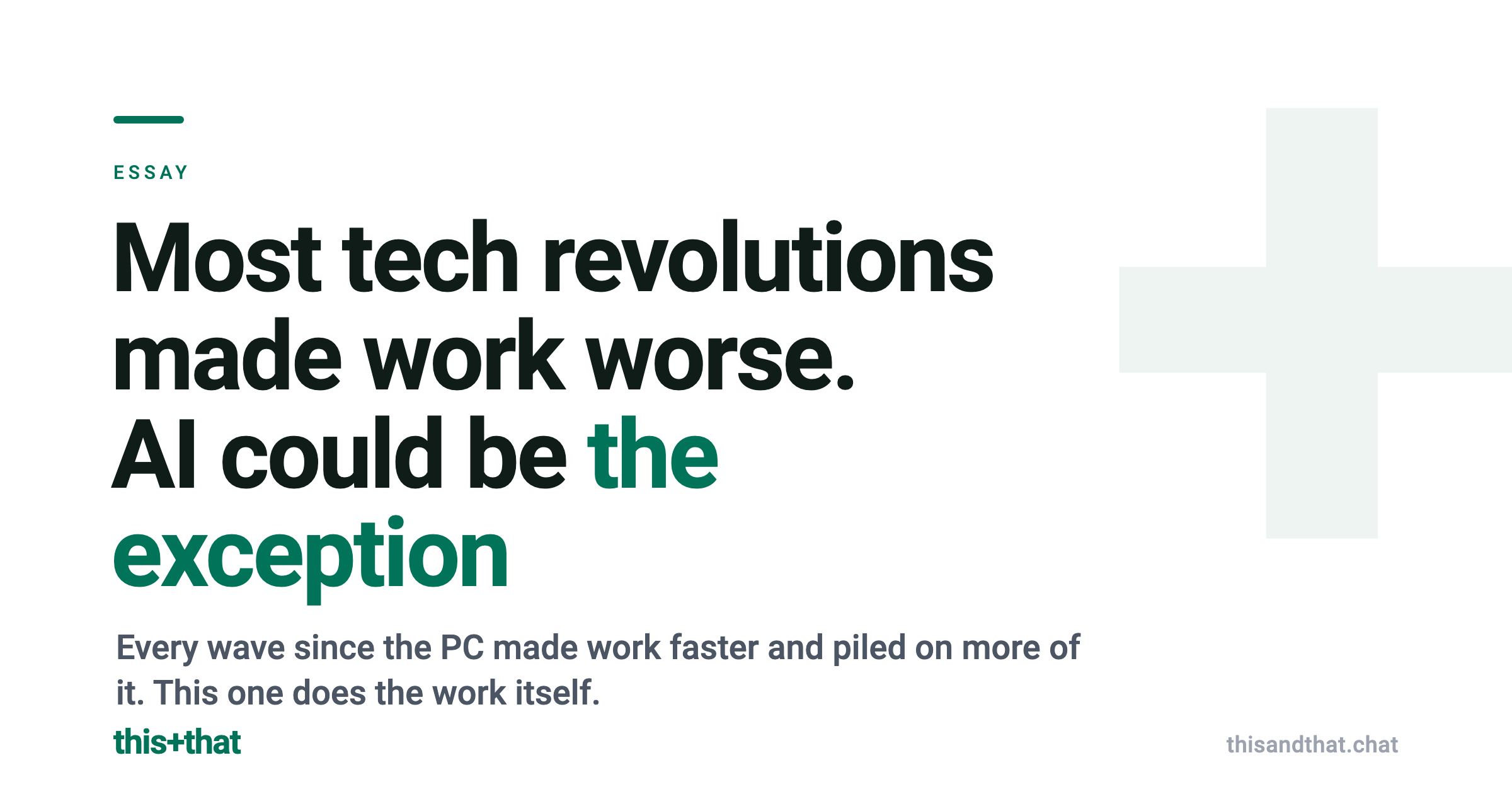
  • The claim of the article is that expectations increase at a faster rate than the work becomes easier.

    It probably feels that way to someone who got comfortable doing their job the old way wishes the world could go back to when they had it all comfortably figured out.

    If this does happen, it’s a second order effect from reducing the barrier to entry. Now that anyone can make some code with enough prompts, it’s no longer impressive to be able to make simple apps. You have to bring something different and better to the table. Good developers still do this on top of what AI can do by itself, but I also think there were a lot of relatively easy programming jobs where you didn’t have to be particularly good at anything. You had to know how to follow the rules, get easy tickets from the tracker, make enough changes that you could call it done, and then go on through the dog and pony show of getting the PR approved and getting those story points to count for your standup report. Repeat 5 days per week.

    Every mid-size and larger company I worked for had a collection of developers like this: Not really trustworthy or skilled enough to handle big tickets, but you could assign all the loose ends and easy tickets to them. They’d get done eventually while the other devs could focus on bigger efforts.

    Now, it’s hard to justify having a lot of those easy ticket solver developers around. An experienced developer can take 10 easy tickets, use their codebase knowledge to write targeted prompts with Opus or Fable, quickly review the code, and have all the easy work done in an afternoon. Then back to the hard tickets.

    If you were one of those developers coasting on the easy work, this revolution probably feels like it increased expectations unfairly. If you were one of those devs doing the hard work, you have another tool to use but you’re still grinding away at the hard problems with an extra tool to make some of the parts easier.

  • The central premise of this post is basically not true: working conditions and wages have pretty consistently improved over the past 200 years. The cases where it didn't were generally offset by the rest of society benefiting from increased automation and productivity. Where the current revolution will lead remains unclear, but if the past is any indication things will probably continue to improve for most people.
  • 2026 - 200 = 1826

    Yeah no. It's only since 1950 that conditions improved for everyone. Before then everything from sewage, to coal smoke, to chronically low wages made life worse for everyone involved. The most miserable people to live in history were the British working class in the mid/late 19th century.

  • > working conditions and wages have pretty consistently improved over the past 200 years

    They've improved, but not consistently on human timescales.

    Being a worker in the pre-labor-movement industrial revolution was by all accounts horrendous. Things have, so far, trended better over time but they can be bad for whole generations and also past results do not guarantee future results.

    > The cases where it didn't were generally offset by the rest of society benefiting from increased automation and productivity.

    I don't think we can sweep the worst parts of it under the rug because the bad impacts are only happening to "the poors". And anyway when it comes to the current tech revolution, it is likely that almost all of us are going to be "the poors".

  • > working conditions and wages have pretty consistently improved over the past 200 years

    Really depends on the group of people you are including. In the US the middle class has been eviscerated to the point where raising a family on a single income is not a realistic goal for most people.

  • Although that's true, is 200 years ago really the baseline we want to use for judging working conditions?

    Two hundred years ago meant widespread child labor, harsh factory conditions, little worker protection, and slavery or serfdom. Add to it the onset of Industrial Revolution.

    Modern studies indicate people in the dark ages worked 6 hours a day: Ironically a better baseline!

  • You're missing the trees for the forest. The Industrial Revolution was terrible for the people who were working during it. Their jobs got eliminated and they only sorta sometimes were able to retrain for the new jobs, and the working conditions in those new jobs were atrocious, exactly because they were new enough that we didn't yet have safety regulations for them.

    It was only their children who eventually saw any improvement in working/living conditions, and it was only because of all the absolutely awful things that happened to their parents. Safety regulations are written in blood. It only looks like consistent improvement if you zoom out to a level that obscures intra-generation experiences. At the level of the actual human beings subjected to the turbulence, it was awful.

  • I think you're conflating productivity growth with distribution. Technology increased wealth, but whether workers shared in those gains depended heavily on bargaining power and institutions.
  • The US Department of Labor measures wages, and adjusted for inflation the hourly wage is below what it was in 1973. It is even lower if you are only counting non-management roles then and now. Wages have not gotten better over the past half century they have gotten worse.

    Workers now work more hours pee year to try to catch up to what they made back then, so working conditions are worse now as well.

  • > pretty consistently improved

    I can accept the premise that condiitions have improved, but not that it was consistent. It seems to me that it was anything but; more like extremely spiky. great depression, postwar economic miracle. Massive labor movements rose and fell, general strikes... Plus most countries have had several wars + revolutions in the last 200 years, including two world wars. Not all of those are to do with technology, but I also dont think technology wasnt indirectly responsible for the conditions that created some of them