Join the discussion
Write your take first — we'll ask for email only when you're ready to publish.
- Hacker News
- WJW. This entire article is assuming there’s a single measure of “success” in this endeavor and the simulation isn’t remotely anything like mowing an actual lawn.
I’m usually a huge fan of Pudding, but this completely misses the mark.
by calmbonsai - Though I solved it in 49 moves (yay me), I realized when thinking about efficiency, it didn't take into consideration two important things: 1) all of the turns I was making in order to be most efficient, whereas overlapping a few times would have probably taken less time, and 2) I spent a lot of thinking on the spot, as to what was the most efficient path, rather than moving the mower.. so while I only took 49 moves, the time spent on inaction may have balanced the scales with someone who just kept moving.
There's a life lesson in there somewhere, I'm sure!
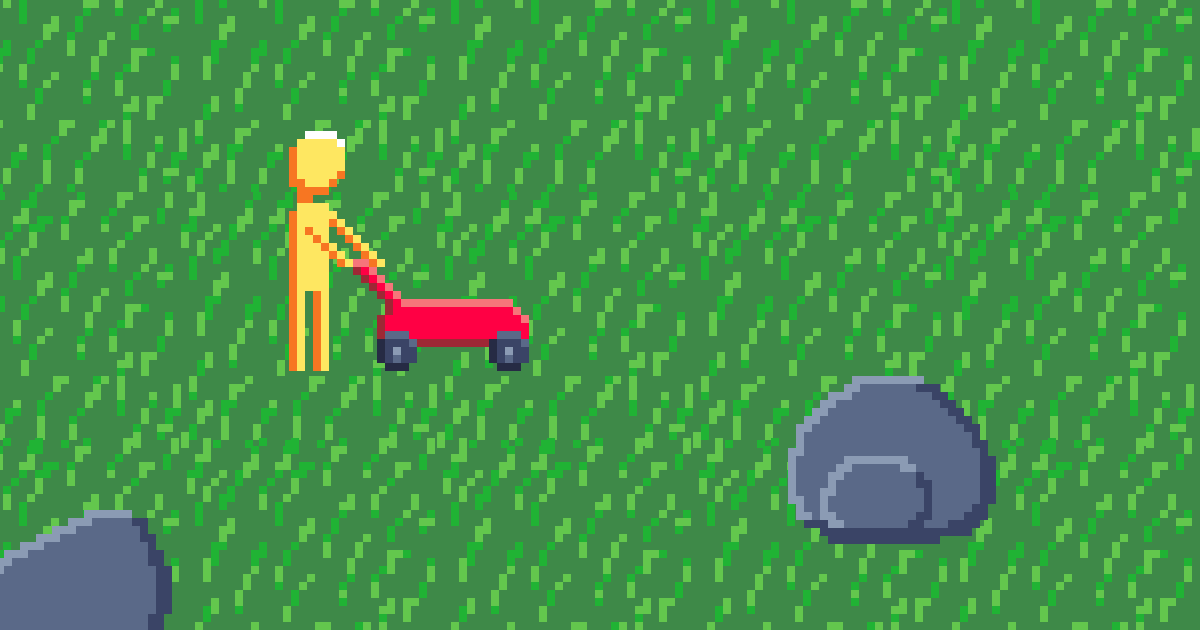
by tsizz - This is a really nice presentation of how some people play the authors' lawn-moving game better than others -- a great analysis of the gameplay. But the majority of comments on this HN thread right now are reacting to the title rather than to the article, as if it were about real-life lawn-moving.by svat
- There are a number of bad premises in this article.
For example, most people in the world (outside the USA in particular) have never mowed a lawn. I live in a city of 3.5 million and essentially no one has a lawn.
When you really mow a lawn terrain matters. Most lawns are not flat. One goes on lines of equal height not up and down a hill.
Edges are different than the interior part of the lawn, particularly if they abut flower beds, curbs, etc.
Re passing a given spot is sometimes an efficient way to mow it properly. Particularly in dead ends and odd corners. Etc.
by contubernio - I have a small yard and I'm not optimizing for the fewest moves, I'm optimizing for both the longest continuous lines (because I think they look nicest) and the shortest distance to carry the clippings at the end.
I have a different definition of optimal to this game.
by adregan - I started doing it and immediately felt like I was optimizing for minimal moves like a video game, rather than what I'd actually do which is not the same strategy. There's a handful of things different
- The direction you mow leaves a pattern that I generally try to stay parallel to, and mow alongside, and go for long strips even if I have to do a bit of running over already-mowed parts
- I may go diagonal at times
- I've never had a yard that's a maze of rocks
- If there's a small patch I need to mow around, like a garden, I'll likely do a circle around that and use the edge of that mow line as a new edge
I'd bet the vast majority of people who did the game input a series of moves that doesn't reflect that closely to what they'd do in real life.
by hbn - Semi-related: Worked as a landscaper during my youth, one of my first jobs
I used to think that the line patterns mowed into grass were a purely aesthetic thing.
It turns out, the lines are mowed in a rotation to prevent wearing out the grass and causing damage. First you mow length-wise, then width-wise, then diagonally, finally diagonally in the opposite direction, before cycling through again.
Useless information for you today.
by gavinray - This is a very different problem than actual efficiency when mowing a lawn or vacuuming a rub. Turning takes more work and time, and you miss a part of the 'square' when you are turning (the arc of the curve is not a straight line). In addition, vacuums especially have an area at the edge of the machine that is not cleaned as well, which is why you want a bit of overlap in your lines.
Plus, when mowing a lawn, you often want to leave a nice pattern, so you cant just go for pure efficiency.
by cortesoft