
Join the discussion
Write your take first — we'll ask for email only when you're ready to publish.
- Hacker News
- I used to fantasize about using computers to print stuff. I ended up at a little company that made desktop publishing software. While I was employed there, I went on vacation in Chicago and found myself in the basement of the former Donnelly printing plant where Sears-Robuck catalogs were printed. They had an exhibit of old printing presses, and at least one of them functioned. The docent told small groups how they worked. I told him my occupation, and he played off me as he lectured. He printed a souvenir for me, a little bit of paper with “Quality isn’t quick” written on it. Except there was an upside down ‘n’ where a ‘u’ belonged.
The organization used an antique letterpress to print up invitations for weddings and such.
- > I’d argue that there’s a clear line connecting the automation of typesetting and counting in the late 19th century to the rise of electrical computers a generation later, and then the early Internet and AI research a generation after that.
And I'd argue that's very generous.
by bcjdjsndon - Mark Twain himself wrote a story about a sure thing, The Celebrated Jumping Frog of Calaveras County:
https://readmeastoryink.com/wp-content/uploads/stories/the_c...
by willturman - It's interesting to see how — even in the 1880s — people were making the same mistakes as companies today: over-engineering to the point of unmanageable complexity ("complexity bad"[0]), and the less solve-all-possible-problems but simpler Linotype won out.
[0] - https://grugbrain.dev/
by sarreph - I would say it was the opposite. The machine was overdesigned and underengineered. Someone needed to stop the guy and tell him that getting 18,000 precision parts working in unison is bad design and he needed several passes of engineering out as much complexity as possible to simplify the whole thing.
It was like trying to publish the first draft of your novel without ever having an editor go over it.
by jandrese - Also treating machines as worker or job substitutes instead of amplifying tools.
I see that mistake made on literally every level from the automation of 15 minute tasks to analysis of the macroeconomic effects of robots and software.
by pydry - I thought this was going to be about Nikola Tesla's vibration machine that made Clemens shit himselfby NopIdoN
- Possibly the very first description of the "brown note"?by relwin
- That didn’t ruin his life, merely his shorts.by Mistletoe
- by Mistletoe
- When I heard that story, I couldn't help but thing of Steve Jobs "Real Artists Ship." The device was good but the inventor was a perfectionist instead of an entrepreneur.by abirch
- Classic angel investor mistake, too much allocated to one investment. Gotta diversify. More smaller checks.by edoceo
- Yeah wanna write 100k cheques? Better have a net worth of 100M or a way to pool investor money.by hahahaa
- > but his main talent appeared to have been his skill at raising money by promising the impossible — the 19th century version of Steve Job’s reality distortion field.
That’s a wild mischaracterization. Steve Job’s “reality distortion field” was coined after the ability to get people to achieve the impossible and deliver better products; quite the opposite of funneling money into dead end ideas.
by ricardobeat - > That’s a wild mischaracterization. Steve Job’s “reality distortion field” was coined after the ability to get people to achieve the impossible and deliver better products; quite the opposite of funneling money into dead end ideas.
Apple is widely successful, and their products are highly regarded so it's a good spot to be in.
I always find it strange when 'achieve the impossible' tag is attached to him or the products that came along. take iphone for example - there were ton of products that were way ahead of their time way before iphone came along - palmpilot (grafitti handwriting), handspring, hp pocketpc (a buddy of mine had a working vnc client on it during days of wifi infancy), and of course the original blackberry.
by mirmor23 - > Steve Job’s “reality distortion field” was coined after the ability to get people to achieve the impossible and deliver better products;
I was under the impression it was about Steve convincing the faithful that Apple invented the categories of products they sold, rather than simply delivering better products in existing categories.
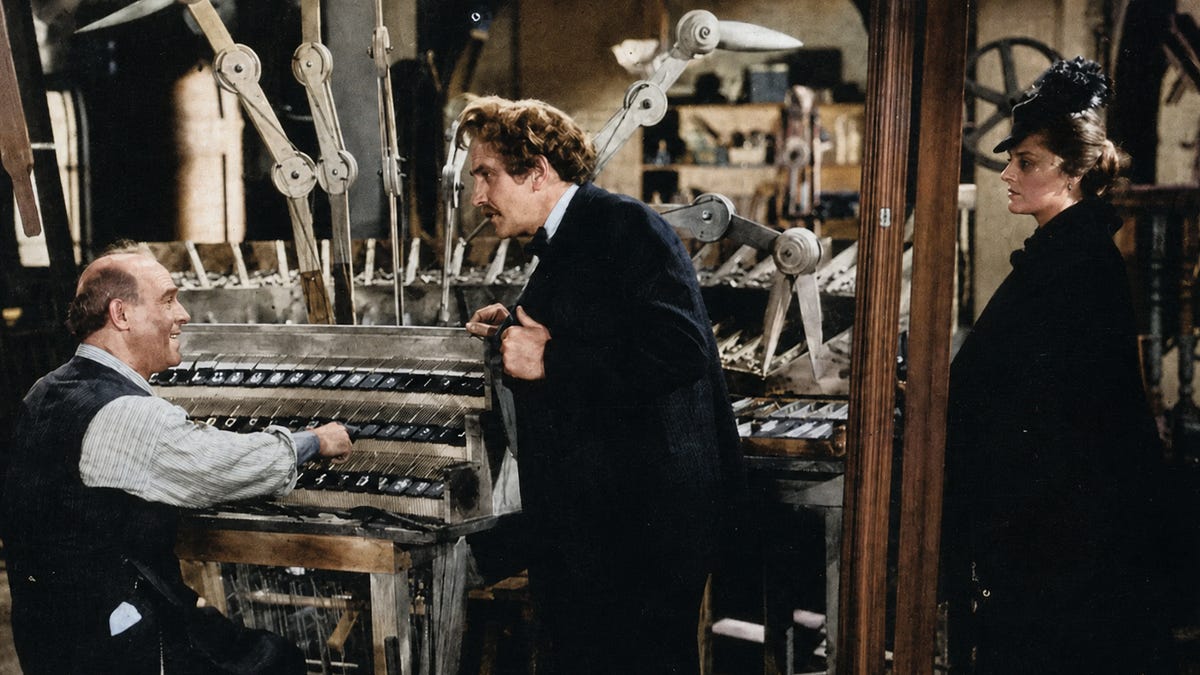
by toast0 - I wish the article talked more about how the machine actually worked. It seemed pretty simplistic and glossed over most of the details, but now I'm really curious and want answers lol.by s3p
- As linked in the article, you could read the patent application:
https://circuitousroot.com/artifice/letters/press/noncastcom...
by wvenable - Maybe: https://www.asme.org/about-asme/engineering-history/landmark...
To see a typecaster which works find a Linotype or Monotype.
by WillAdams - > 3) Transformative technologies succeed by redesigning a task, and usually not by simply trying to reproduce the existing forms of human labor. Paige built an amazingly complex mechanical imitation of the human compositor which attempted to repeat a human worker’s actual movements. By contrast, Linotype simplified the problem by doing something humans didn’t already do.
That would in fact be the main argument against humanoid robots in many (most?) applications.
The counterpoint is that what humans already do is exactly what's needed in some cases, making those cases the ideal applications for humanoids.
by arbuge - The counterpoint is that we already exploited a lot of the cases where simplifying the problem helps. We've spent approximately two centuries doing that. That leaves a lot of processes left over where that kind of specialization was either not feasible or not economically attractiveby wongarsu
- Well, LLMs are a great example of the argument for the power of doing what "humans already do": language, however imperfect for the task, so maybe humanoid robots turn out to be the most natural way to interact with a human environment (broad strokes here, I know, but hopefully you get the gist)by hnchm
- If you have a general solution like a robot that can do human tasks, i.e. copying manuscripts with a pen, that is often highly inefficient compared to a specialized solution like a printing press but the R&D effort of applying it is minimal compared to inventing a specialized machine.
It's similar with LLMs. Compared to a bespoke piece of software for the task they are incredibly inefficient, yet they are extremely useful because they can do things where developing that piece of software would require a lot of research.
by adrianN - This whole episode suggests to me that people are misjudging the future of robotics. Many companies are building robots to exactly imitate humans, perhaps with the thought that the "egocentric" training data widely available will be more useful for this form factor. Look at Tesla, Unitree, Boston Dynamics, or Figure... But humans are just barely adapted to bipedalism and hunter-gathering as it is.
The perfect kind of robot is perhaps something closer to the linotype... a AI controlled macine that has the capability to birth or re-assemble to be optimal for the task at hand. Just like the linotype automated the "casting" of lines of text.
Not necessarily a 3d printer or a nanobot universal assembler... but maybe something more akin to a modular assembly line that can rearrange itself intelligently.
by LarsDu88 - See also: the sewing machine. https://en.wikipedia.org/wiki/Sewing_machine
The 30 second version, sewing is very labor intensive and people started trying to make a sewing machine from about when manufacturing tolerances got tight enough to attempt the process. It still took about 100 years until machines that actually work well were invented, The genius bit that took so long is to not try and sew like a human does but to develop an inverted process that a machine can do. Honestly, despite being quite common at this point in time sewing machines still blow my mind when you consider the intricate process they are required to do with thread.
And a fun fact for free: Apparently patent cartels(cough MPEG LA) are not a new thing and Singer et al set one up in the 1850's to lock up the market on these marvelous machines.
by somat - Humanoids are the Turing machines of physics.
They're Mediocre at everything, and worse than a dedicated machine at almost every task, just like a CPU is worse than an ASIC. However, they adapt to new tasks quickly. This decreases ownership costs (you only need one humanoid, not one machine per task), as well as manufacturing costs, as you can make one design and spend a lot of R&D money on scaling that design.
by miki123211 - > The counterpoint is that what humans already do is exactly what's needed in some cases, making those cases the ideal applications for humanoids.
If my old textbook on control theory (printed in 80s) to be believed, there apparently were quite a lot of processes where simply recording the video of hand/arm movements of the human operators, smoothing the trajectories, and then making the mechanical manipulators simply follow them, was precisely the fastest and cheapest way to automate, compared to trying to reimagine the whole process and rebuild a whole manufacturing line with the newly invented machines.
by Joker_vD - Actually, no. Replicating the manual process was quite feasible. There were keyboard-driven typesetters that worked well. Here's the Unitype.[1] This sets type by assembling type slugs into a line. It doesn't cast hot metal. It even has an automatic distribution system; it can sort type slugs by letter, so you can reuse the type. That's the same thing the Paige machine did. The Unitype was much simpler.
The Unitype was late to market. Mergenthaler already had the Linotype out when the Unitype shipped. The Unitype was half the price of a Linotype. Unitype machines sold for about 20 years, so it wasn't a total failure. The Paige machine uses a lot more parts and space to do the same job.
Mechanism design skill is very rare. All the good Teletype machines were designed by just two people - Howard Krum and Edward Kleinschmidt. There were competing machines, and they were all much worse. William Burroughs invented the first adding machine that worked reliably, and it was better than all the competitors. Burroughs dominated banking well into the computer era.
The video claims that the big problem with the Unitype that it required not just a keyboard operator, but someone manually justifying the lines at the output end. Linotype figured out automatic justification, using expanding wedges. No need for a second worker.
Plus someone had to feed used type back into the Unitype for sorting and return to inventory. With a Linotype, the matrices with the letter forms never leave the machine; they are dispensed, set into a line, used for casting, and then immediately recycled back to the magazine for further use. As long as the supply of lead bars ready to melt holds up, you can keep setting type. With ordinary type setting, mechanized or not, you can end up with all your type tied up in pages waiting to be printed.
So the real problem with the Unitype was that it wasn't labor-saving enough. Despite that, it powered many small country newspapers for years.
by Animats - I wish school curriculum included things like "how printing actually worked through ages". Monks writing out manuscripts is somewhat relatable since we all (at least for now) still learn how to write. Everyone is taught the Gutenberg press was a big deal -- but how did it actually work? Why was it still a pain and how did later inventions fix those problems?by ekelsen
- Most of the things school curricula touch turn awful.
It's never been easier for you and interested kids to learn these things on their own.
by eru