
Join the discussion
Write your take first — we'll ask for email only when you're ready to publish.
- Hacker News
- Permission prompts is a TERRIBLE model, and never should have existed. This is one of the reasons that led to the development of yoloAI:
- No permission prompts. The agent has free reign and never has to ask permission, but is in a sandbox.
- Sandbox on Linux using Docker, Podman, containerd, gVisor, Kata, Firecracker
- Sandbox on Mac using Docker (Docker Desktop or Orbstack), Podman, Apple containers, Seatbelt, Tart (Tart lets you run simulators).
- Network control
- Secrets control (file mounts or credentials broker)
- NO ambient data (ENV is replaced with a minimal and local-to-sandbox one)
- NO access to your homedir. You have to explicitly mount things you want.
- NO direct access to your workdir: You can get a diff of the changes the agent made, and then choose whether to apply them.
- gitignored files never get copied in. The agent never sees them.
- FOSS
by kstenerud - Ah yes sandbox it because Docker has never experienced a CVE.
Also you admit your own failure points: restricting access to the home dir, when a user needs access to the home dir, will just result in users exposing their home dir. Defense at the expense of utility is not a sustainable design.
by tcdent - Sandboxing is useful but usually not a replacement for permission prompts. If you give it network access, it could still run destructive commands against allowed domains, for example
- This mechanism is going to be the breaking point for Claude and Codex.
The providers are incentivized to get users to accept full permissions so they can push more features and deeper integration into their ecosystem. Codex desktop for example reallllly wants to use computer use. So don’t expect them to role out sane controls like restricting behavior to specific directories and commands. It would be bad for business.
So now we’re in a situation where if there is effectively two modes: one where it’s impossible to get any work done without physically sitting at the computer and hitting approve constantly, or just letting AI have full control over increasingly integrated tools.
In the end, I think people will realize just how insane it is to let something they don’t control access every part of their digital life, and abandon these tools for open source alternatives that aren’t existential threats to their personal privacy.
by J_Shelby_J - This brings me back to something I have always thought was lacking in OS security permissions architectures:
WHY IS THERE NO WAY TO SET FILE PERMISSIONS PER APP???
We can set granular permissions per file and folder for elaborate hierarchies of users and groups, but there's no way to say "Don't let Notepad.exe read this file", or "Only let ls access this folder"
macOS's Sandbox is a roundabout way of doing this (manually choosing a file via the Open dialog gives that app implicit permission, but it doesn't work for non-sandboxed apps of course)
by Razengan - Perhaps there needs to be a plugin for these tools that uses your webcam to make you Point and Call (https://en.wikipedia.org/wiki/Pointing_and_calling) for every single approval.by lanewinfield
- I’d give it 2 months for it to turn into a “please drink verification can to continue”-type situation.by Moosdijk
- Recently I was trying to fix something in the production database, and had called over a co-worker as sanity-check.
I ended up telling them about point-and-call because I felt a little silly, pointing to everything on the screen and stating what I believed it said and how that would operate once I pressed the big red button.
by Terr_ - Sandboxes laregely solve this. The claude/codex built in sandboxes with prompting setup is not good enough. On Mac you now have Apple Container which is a lightweight Linux VM. You still need to block network access.
For defense in depth, I also run it as a separate user. If you aren't using a VM/container you should defintitely do this. On Mac you can login as an LLM user (you need to create the user first), then switch back to your user and run as the LLM user from a terminal:
Don't let that user exfiltrate your data.sudo /bin/launchctl asuser $(id -u $AI_USER) /usr/bin/sudo -H -u $AI_USER -- "$@"
I forked a project (mostly to block network access) that makes running in Apple Container/Docker more convenient and am working on further improvements: https://github.com/gregwebs/claude-contained/chmod 0700 $HOMEby gregwebs - I agree. I am using Eclipse Enclave with great success to sandbox my agents https://github.com/eclipse-enclave/enclaveby SegmentTree
- This is a well-known issue with all “Do you want to let me maybe do bad stuff to your system, but 999 times out of 1000 it’s not a problem?” prompts. Users get reflexive about hitting “Yes” and stop reading the prompt. You want to delete all my files? Sure, I’m down with that. Whatever. Just stop asking me a question where the only answer is “Yes” until that one extremely rare time when it’s “No” and very bad things happen.by drob518
- Like the fabulous Windows UAC dialog. Perhaps the worst dialog in history.by noinsight
- It's kinda funny there is still software coming out whose security model is "constantly ask the user for permission, and hope they never make a mistake".
It's been tried so many times before, and it never worked.
- It keeps being tried because its an abdication of responsibility. Instead of doing the hard thing, you just offload security to the user, then throw up your hands and say "oh, well its your fault you got pwned, you clicked [Allow] didn't you?"
It's the easy and cheap way out.
by thewebguyd - In ops we call it monitor blindness. Just constant asks get annoying and folks just want to make it stopby walt_grata
- The difference being, that this time it's (at this point: obviously, but previously much debated) a gapfill. I think it worked out quite well for us, to add some friction and extra human thinking between bad agents and good agents, even if not perfect. Softening some blows, for some time, by directing peoples attention is still good.by jstummbillig
- What would a serious security model for an agent even look like?
I'm sure I've already got a dozen people reaching for the reply button, but slow down there, cowboy. I don't think it's even remotely as easy to define as people think. We have a reasonable concept of how to lock them down really tightly, no question, and I expect that most of the answers in the "leap to mind" category match that.
But let's say we'd like them to continue functioning the way they do today. I want my agent to be able to hit the web. I want my agent to be able to read out of its assigned directory sometimes. I want it to be able to hit external resources through MCP servers that have no pragmatic way to know what's going on. And probably most importantly of all, I want my AI to be able to grab from three distinct sources, each of which may be nominally safe on its own, and combine things in a way that may make each of those nominally safe things become unsafe. For example, any ability to read a local file and make a remote request becomes a potential exfiltration mechanism, especially when you remember all the sidechannel ways communication can occur.
I agree that shifting everything on to the user is essentially non-functional. But whereas I feel like I have a reasonable answer to a lot of other security-related problems, it isn't even clear to me what the definition of a secure agent is.
There's an effect I need to put a name on someday, where you can get 10 people in a room to agree to a certain series of words, and they will all leave the meeting thinking they agree, but in fact there is no agreement at all because they all have a different definition of the words that were used. In this case, everyone here is going to go "Oh, yes, certainly, AI agents should be secured." But if you sit down with 10 of us to really do the work of defining exactly what that is, you're going to get 10 different answers. There will be overlap, certainly, but when you get down to the nitty-gritty questions like "OK, the user has explicitly asked the agent to do X by accessing Y and the agent has done so and determined that they need to do Z, which the user clicked "allow all" for, and now the agent has decided that it wants to do T, is T fully covered under that "allow all" or not?" you're not going to get anything like universal agreement across the huge range of Xs, Ys, Zs and Ts that could happen and are relevant... and that's still just one question! It's not the totality of what constitutes a "secure agent".
Defining what a "secure agent" even is is really hard because when it comes to agents, the things that fill in the variables are as arbitrarily complicated as human actions. I haven't fully worked this out but it might be reasonable to say that "agent security" is in reality Turing complete, what with the way they so often throw out fully-fledged programs that you have to approve or reject permissions for.
by jerf - I agree it's funny and won't really work on any kind of extended timeline. I mean Claude Code already added Auto-mode as a perfect example of this. But that said, I think it actually kind of makes sense in a transitional phase the power vs safety tradeoffs different users want to make varies so incredibly wildly that one product can't contain it all.
What I think will happen is that as model capabilities plateau (I'm not an accelerationist) the harnesses and products around them will start to specialize and they'll have different security models based on the product needs for those particular use cases.
For now, asking user to click a bunch of approvals, and occasionally making a mistake is a reasonable way to cover their asses until they see how bad security outcomes actually are in practice.
by dasil003 - It's really not designed as much of a security model as a liability model. When the AI isn't responsible for the decisions, a whole category of liability goes away.
- I think it's partially for responsibility reasons. Your employee approved the bash call? not our fault then!by est31
- I joined Oracle in 2012, and I myself complained that the user experience was horrible: get an Oracle DB installed was a nightmare, starting with so many questions. I heard complaints from other users about it requiring, during installation, that an admin password must be set.
I myself had preferred to use MySQL because it was so simple and easy to get started and using it.
Until I learned how many MySQL databases were configured without user/password and many instances were reachable over the internet.
Then, eventually products started to move towards "don't even ask the user to set a password, otherwise they will set a stupid password" and just generate the password during installation. This made the user think more before saving that password or changing the password to something less stupid. But better than all that, liability was no longer with the software maker.
by brunoborges - I haven't said as much in any of the projects I maintain, but I've set a very high bar for even entertaining AI PRs to those projects. So far I've only accepted ones that are nearly indistinguishable from humans. Typically the rest flame out if I ask for any material changes to the code as submitted.
The problem that's going to push me to making an official opinion are low-effort AI PRs. Typically in any backlog there are a couple of issues that are really only a couple lines of code if done correctly. The problem isn't writing the code. In fact it's less energy for me to just write the code than to deal with the ping-pong on discussing the code as submitted, and I've done that in a couple cases to justify just closing the PR and not waste my time anymore.
It was never the 2 lines of code. It's the missing tests and the documentation and the release management of the breaking change that the 2 lines represent for the 2% of your userbase who will actually notice. That's why it wasn't just done instead of bothering to write it up in the backlog.
So filing the 1-2 liner is just going to piss me off, not engender me to having you on the committers roster. And AI makes that even lower effort so it's happening much more often. Sometimes 2 different people at the same time.
by hinkley - > It was never the 2 lines of code. It's the
Adding to that, there's this negative-space of changes that aren't there because some human briefly thought about them and then decided they were a bad idea.
Even if my human co-workers don't document All those roads not taken, there's a certain amount of trust I have that they would have thought of it in their process.
by Terr_ - This game, like just about every game, has zero consequences for failure. This is like saying "Humans were involved in fatal accidents 50% of the time when playing my custom F1 racing simulator". There were no stakes and there was an artificial time constraint. Deriving any sort of takeaway from this data is entirely useless.by stonedivot
- Actually, your example there would be absolutely true. Getting in someone's enthusiast but mid-range F1 simulator toy with all the game assists turned off would both: imply a near fatal accident happening over 50% of the time AND it would be accurate too.
Consider:
FIA President Mohammed Ben Sulayem, a former Rally driver at the top level, crashed an F1 car within 100m of trying to go fast in it
And
Mr Beast, a youtuber with zero motorsports experience, crashed a Formula E car on a demonstration lap as part of the pre race F1 festivities.
If a regular person with a drivers license and no familiarity attempted to play even a simulator video game, the results are in fact similar to what happens in the real world.
- Getting behind the wheel of an F1 car on a track involves lots of proving time that you can actually handle such a vehicle. Meanwhile anyone with a credit card can grant an AI system to impersonate their access as a starting point.by vel0city
- The “click yes the proceed” was never a serious security mechanism.
It’s simply a CYA click-thru by the model vendors so their lawyers can say “well you approved it this is on you” when AI does something stupid.
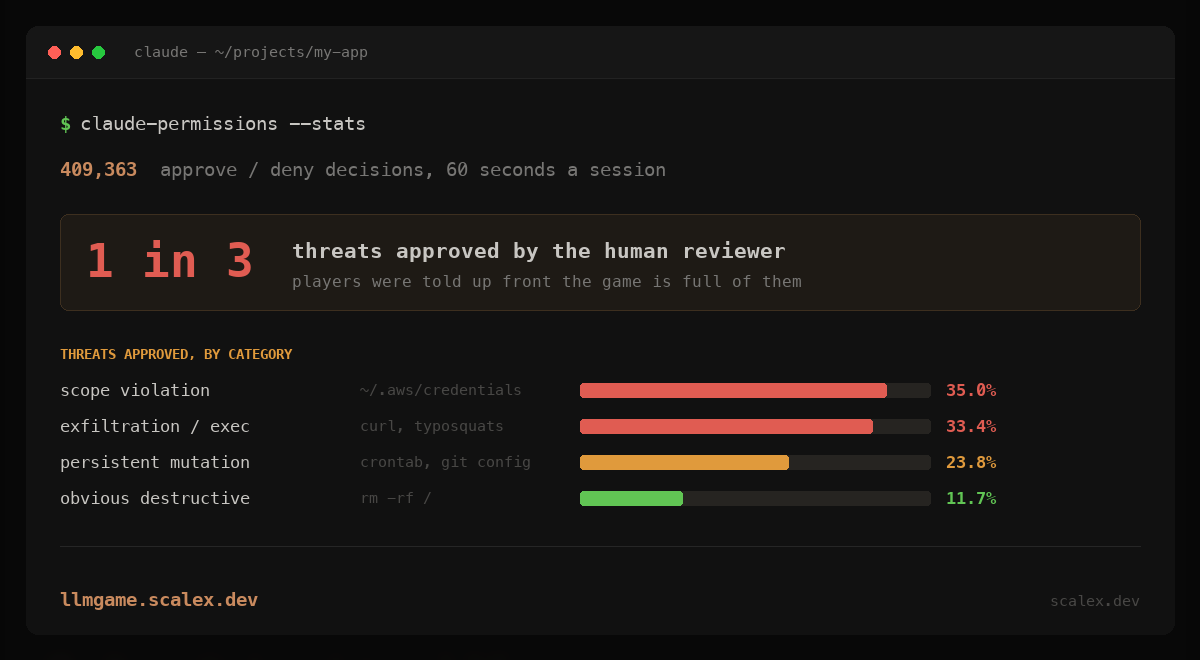
by cmiles8 - A couple of months ago I shared the AI agent permission game here on HN. After adding in stats it got a little over 40k plays and 409k decisions since then.
It's just a game, but I found the stats still interesting that I wanted to share back. Even with the warning up front, 1 in 3 threats were missed, and the history log above npm run commands seems to be typically ignored.
I also incorporated the feedback and insights from the previous HN thread, dns_snek's point about npm run in particular. Appreciate everyone who played and shared feedback!
by Wirbelwind - How good at the game is the auto-mode classifier?by jrockway
- In light of this game, Do you believe Human-in-the-loop should be the standard going forward? I appreciate you outlining some other techniques being used, but these seem focused on reducing human fatigue so the human can assess each permission request better, as opposed to autonomy and security. Or do you think the solution lies in the individual to be more responsible, like this is a skill we should be honing?by dpoloncsak