Join the discussion
Write your take first — we'll ask for email only when you're ready to publish.
- Hacker News
- What is the point of this?by lins1909
- A language model does language model things? That might actually be... an appropriate use of the technology!by sublinear
- I'm just curious why you'd put "Claud[e]" in the name of this project. Is it an Anthropic-sponsored one? If so, may you please disclose it? Additionally, I think it puts a date to a wonderful project that otherwise could be very timeless. In 5 years we'll probably be like, "what's Claude?" Anyway, really cool work and thanks for sharing!by arm32
- In 5 years we'll probably have locally run AI which could do something like this in a millisecond.by bananaflag
- It is just a domain for the project's github page. All the files, YouTube uploads, etc., are The Odyssey or Homer's Odyssey.by spinchange
- I truly doubt it will be timeless. There are already a few excellent English translations of the Odyssey.by SwellJoe
- I don't remember so many emdashes in the original.by adastra22
- They called them mudashes back then.by BigTTYGothGF
- Having recently read Wilson's translation, I was immediately put off at the introduction and leapt to the conclusion it was bad. It just doesn't sound anywhere near as good to my ear.
However, there may be more to it than I thought. No admittedly the following is ChatGPT's opinion, but I think it's valid and made me think again:
> The second is the better translation as English poetry; the first (Claude's) is the better translation if you want to see the Greek more directly.
> If I were studying Homer, I'd strongly prefer the first. It continually reminds you that you're reading an ancient poem whose concepts don't map neatly onto modern English.
by RobinL - Translation is an art form that is rapidly becoming lost, not because AI is doing it, but because there are too many translators who have apparently been trained (or likely, were never trained in it as a formal study at all) that it should be written in a way that emphasizes the translation as a standalone work more than anything else.
A good translation should attempt to communicate what the author meant, as closely as possible, even if there is no equivalent in the target language.
A good translation should be beautiful all on its own.
It's the balance of the 2 that makes a translation successful.
If you erase the author's true meaning just because you don't want to slow the reader down in having to take a moment to read an explanatory footnote if they're confused, you have failed to translate it, and have likely editorialized it.
Why do many English-speaking people know 'wabisabi' as a concept? Because someone bothered to explain it to them, and they bothered to listen. That act enriches the reader.
And don't even get me started on "localization".
by ang_cire - Probably this will be done more and more often for works which don't have translation in some language because of low interest. E.g. old manuscripts, light novels, fan fiction etc.by bananaflag
- This could allow a very opinionated and tailored translation, which I think is the appeal.
That said, I'd like to see the prompt(s) having such an effect on the subjective choices for a project like this.
by mw888 - Read this as "Claudussy" at first.by nater5000
- This is a useful marker of progress in translation, not a replacement for literary translators.
Six years ago I fed Dante's Inferno to AWS translation. It was...not good[1]. Maybe its time to try again and see how things have changed.
[1] https://github.com/ffx271/dante-inferno/blob/master/english/...
by kjellsbells - > marker of progress
Unfortunately it's just a mix of a few existing translations. Elsewhere there's an explanation showing this line by line.
by veqq - This page provides a great overview of several popular translations of The Odyssey. It lists line-by-line translations as well free translations: https://readtheodyssey.org/best-odyssey-translationby UtopiaPunk
- It's hard to take that page seriously when it doesn't include the marvellous translation by Peter Green.by squidbeak
- How does it compare to previous (human) translations, what is the regurgitation level? In any case, lots of em dashes, so mission accomplished to bring it up to contemporary standards.
- I find it to be cross between Richmond Lattimore and Ian Johnston. There are line-level annotations that discuss translation choices and a hyperlinked index w/ Latinate pronunciations was also built from scratch.by spinchange
- Emily Wilson's translation is way better, more modern and adequate to present-day readers and, probably more context aware.by ktzar
- https://theclaudyssey.com/read/book-01.html#n1
The first line is a crappy mishmash of Lattimore and Fagles.
Lattimore: >Tell me, Muse, of the man of many ways, who was driven far journeys, after he had sacked Troy's sacred citadel.
Fagles: >Sing to me of the man, Muse, the man of twists and turns driven time and again off course, once he had plundered the hallowed heights of Troy.
Claude: >Tell me the man, Muse — the man of many turnings, who was driven wandering far, once he had sacked Troy's holy citadel
Combining "man of many ways" and "man of twists and turns" into "man of many turnings" is just dreck.
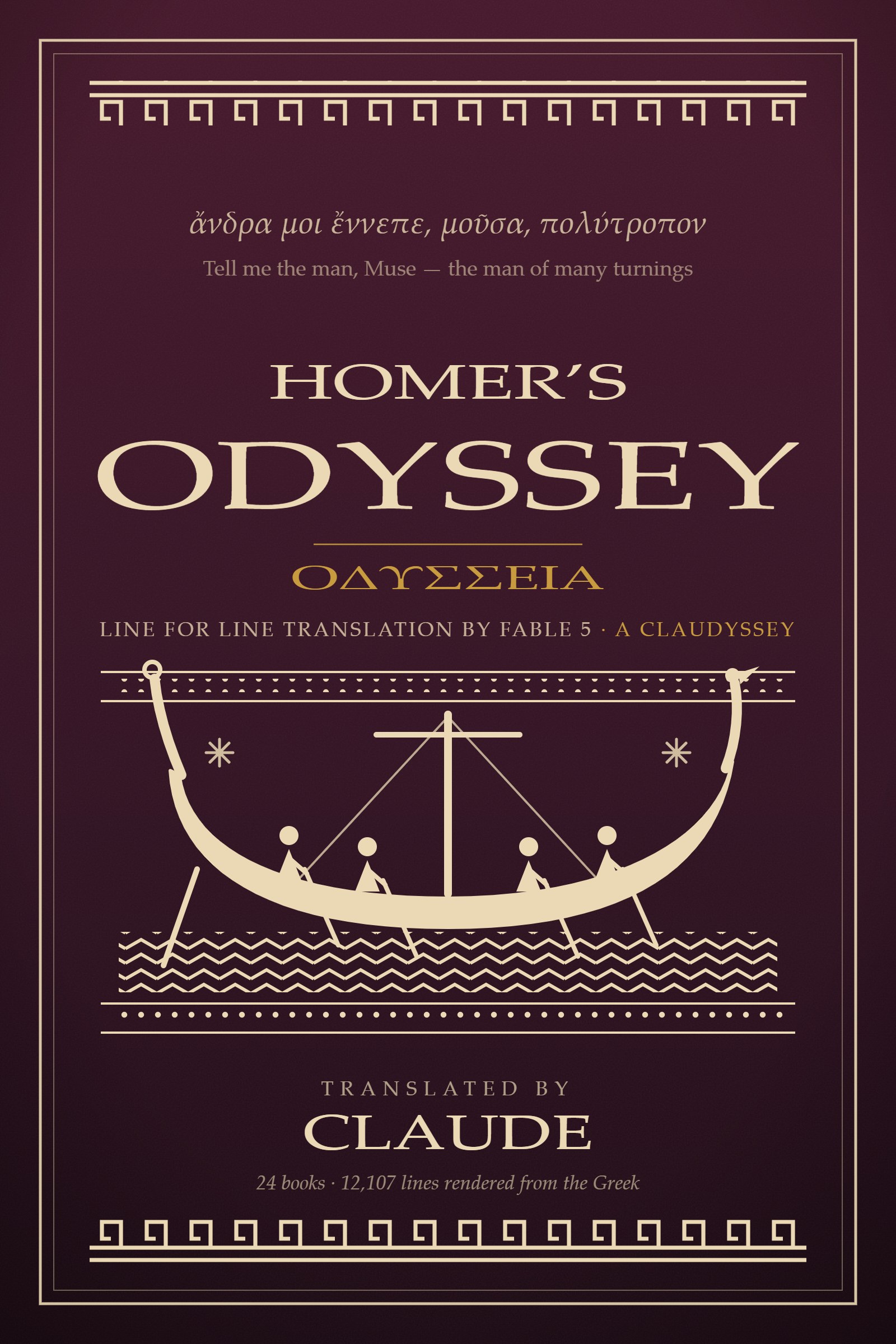
- 12,107 line-for-line translation of the A.T. Murray Greek text (Loeb, 1919) by Claude Fable. Includes line notes and an index. HTML, epub, pdf, and YouTube Audio (by gpt4o-TTS). A dual-agent review pass was done on the entire work with a third "adjudication" agent reconciling their findings. Reviewer agnets were gpt-5.6-sol high reasoning.by spinchange
- why?by 8by3
- It seems the traffic has made the site inaccessible. I'm enjoying reading the first page that's still in my browser.by axus