
Join the discussion
Write your take first — we'll ask for email only when you're ready to publish.
- Hacker News
- thirty-eight hour ping time, dang
3 AU per year ~ 300 million miles
by ck2 - What is this shitshow of a website called space.com ? There's ads, popups everywhere!
Edit: For those who think I'm too harsh: https://imgur.com/a/YkmtOZ9
by sgt - Great, but you've put it on an image host that cannot be accessed by the me, in the UK.by doublerabbit
- - stupid question: how much energy, power and what kind of systems would you need to run something for 80000 years to go all the way to proxima centauri
- how many redudancies would you need, how would it affect the payload?
- what kind of materials?
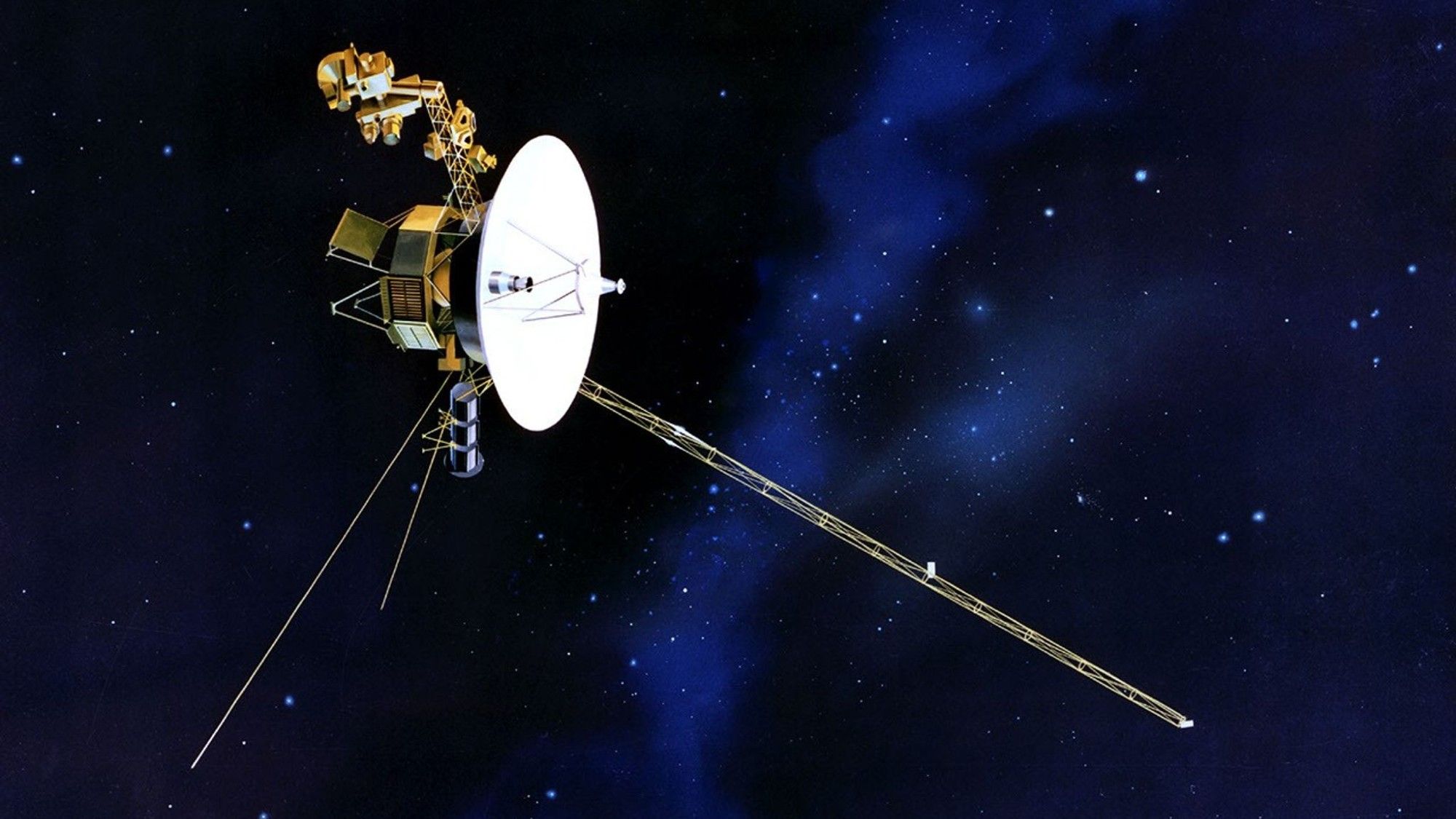
by vivzkestrel - Relevant for Voyager Iby tsoukase
- Power is possible, Thorium-230 has been pointed out as the ideal fuel for such a scenario. Very nice, long and energetic decay chain, 75ka half-life, many of the daughter products are relatively long-lived which helps to flatten out the power curve.
I don't think anyone has any clue how to build electronics that survive even a tenth of that time, though.
Also a bit of a pet peeve, if it takes you 80k years, you are not going to Proxima. The stars themselves are moving rather fast, and which is closest changes over time. The Alpha Centauri main binary becomes the closest in ~26ka with a close pass at ~3ly, Ross 248 also comes within 3ly in ~37ka. Lastly, Gliese 445 does a ~3.5ly flyby at ~45ka. After that, all the closest stars are receding, and Proxima is 5ly away.
Then eventually a million years later Gliese 710 does a 0.16ly flyby, straight through our oort cloud.
by Tuna-Fish - Move comments to source? https://news.ycombinator.com/item?id=49189895
- I wish more robotic missions like that were sent. Not necessarily the most expensive ones, just one that can use only gravity assists and plutonium power generators. They could be relatively small ones. Maybe even trying to ride some of the small rocks/asteroids, now that we have a better catalogues of such.by xvilka
- If by "ride" you mean hitch a lift to somewhere you couldn't get to otherwise, space doesn't work like that.
If you want to land on an asteroid/rock, either you match speed with it, in which case you already had enough speed to go wherever it's going, or you intercept it at a different speed, in which case you get smashed to dust if your speed was any more than a few m/s different.
Maybe you didn't mean this, but it's a common enough misconception. People even on HN were suggesting a spacecraft could hitch a ride on ʻOumuamua to get a quick way to a different solar system.
by dmurray - Even Voyager can’t retire in today's economy.
- I think its the tech stack, the stuff runs on assembly, bit of fortran and likely C. You simply cannot match that level of reliability these days, because people started to forget how to do that... Look at cars and everything else...by mawadev
- A slight tangent here is a technical deep dive on Voyager 1 fixing a memory corruption error in 2023 by hand 15 billion miles away. Blows my mind of the reverse engineering done to achieve this https://www.youtube.com/watch?v=YcUycQoz0zg
- Voyager program and the team behind it will always serve as an example for me. Over-the-space software updates, 50 years support life. Debugging and patching devices with no room for a mistake. How many of 2026 devices connected to internet will have that luxury in 2076?..by nrvn
- Not a very good title, given that the subtitle for the very same article gives the important context that "Voyager 2 would have had to shut down one of its last remaining instruments later this year, until NASA made some power changes."
(as an aside, a celebratory coffee mug for when Voyager 1 finally gets to the 1-light-day-from-earth mark would be very popular, in case anyone from the JPL store is reading this. 'Yesterday's sunrise, today!')
by nullhole - Ah, good, an opportunity to recommend It's Quieter in the Twilight (2022). Beautiful documentary.by bcraven
- Pitch perfect.by pramsey
- Just the other day I heard about the heroic effort[0] to restore communication with Voyager 2 after they inadvertently changed the antenna to point in the wrong direction due to some planned manoeuvres.
Definitely worth a listen if you get the time.
For me personally, I feel this project is the greatest engineering effort in human history bringing together the work of Newton, Kepler, the mathematics of the celestial navigation, gravitational assist techniques[1], etc. necessary to keep a little probe on its route accurately over 50 years in space.
[0] https://www.npr.org/2023/08/02/1191341035/nasa-voyager-2-spa...
by gjkood - > For me personally, I feel this project is the greatest engineering effort in human history bringing together the work of Newton, Kepler, the mathematics of the celestial navigation, gravitational assist techniques[1], etc. necessary to keep a little probe on its route accurately over 50 years in space.
All that and...
Lisp.
- I ran a few research tasks at JPL, small dollar studies. We'd often recruit part time work from engineers around the lab through informal networks, (instead of the official channels that segment by "specialization").
One year, one of the developers on my task was the apparently last person who could encode the command sequences for Voyager 2 (hoping memory serves me correctly - event though it was only 8 years ago). She would occasionally come late to meetings because they were dealing with some trouble with the old satellite.
Pretty amazing how little is set aside for these projects that most the staff keeping it alive have "day jobs". I hope she's still uploading
by jvanderbot - not to be that guy but I have faith a powerful AI could understand all the ins and outs of the voyager code no matter what languageby stringfood
- Some would call that an organizational failure. I suppose it depends on the budgets.by physicalecon
- To be fair, nearly all of the science payloads on Voyager 1 & 2 have been shut down. The probes are doing very little. The doesn't take away from the very unique science they are doing but its a far cry from what the program offices were doing in 30-40 years ago. I'd expect anyone working on a Voyager probe in 2026 to need something else to do most of the day.by wildzzz