
Join the discussion
Write your take first — we'll ask for email only when you're ready to publish.
- Hacker News
- > While you might think you need to code in Assembly or C to maximize those efficiency gains, your choice of language may not be as important as you think.
Yep, and the linked article is also kind of interesting.
by pjmlp - This is interesting but what I would love to see is Mac M4/M5 performance (speed) on an Intel laptop CPU. I know that it will be really difficult to pull off (assuming it's achievable at all) given that Intel just makes the CPU and the computer manufacturers for PCs don't do the kind of tuning that Apple is able to do, but still, I can't help but hope that maybe it can be done somehow. Maybe even while making the machines still serviceable! (Yes yes, I know, but a man can dream...)by ethin
- A more accurate title is can Intel (Linux/Windows) beat Apple?
If you don't want to run Windows, is there even a choice? My issue now with the non-Apple computers if you want to run Linux it's really hard to predict how awful Chromium/Firefox will be. My work Dell Laptop is only a 3 year old CPU with integrated GPU (and unused Nvidia GPU) but Chromium and Firefox are both slow as shit just loading pages like Slack and Outlook. Even resizing the browser windows seems 4-5x times slower than my M3 Macbook Air.
Maybe this is strictly a Linux issue but it hardly matters when the Windows ecosystem is pretty stagnant, full of junk-ware, and software development is much, much better on Linux/MacOS.
- I’m running CachyOS (based on arch) and it is blazing fast. Both with Firefox and Vivaldi. Especially compared to the windows install I used to have on the same machine. Or is your point only about windows?by spockz
- You might want to try getting the Nvidia GPU working. They're several times faster than intel integrated, and browsers are a GPU-heavy application.
Intel keeps trying to say their integrated graphics are finally decently fast, but that's only a select few special models. Their high-volume chips continue to have integrated GPUs that are barely fast enough for web browsing.
by hnuser123456 - My servers run linux, my customers run windows, but if I run Mac that only adds to my complexity. So all our dev boxes run Linux.by jgalt212
- It's long been possible (since Alder Lake at the latest) to tune Intel CPUs for task energy consumption competitive with Apple Silicon, but bone-headed OEMs including Apple always tuned them the other way, wasting a lot of power for tiny performance gains. It is inappropriate to say that you evaluated the perf per watt on a Core Ultra 7 265K because what you really evaluated was how HP, Lenovo, or Dell configured that chip. But for years it has been the case that with one of the Atom variants (Gracemont, Skymont, ___mont) tuned to non-ridiculous scaling modes (capped at 2GHz, say) the energy story is quite good. The Apple platform does not have eager scaling and this is part of their efficiency story.by jeffbee
- Max power Intel consumer chips are already losing to Apple chips in raw performance, especially ST. Tuning them for better perf/watt by turning down the Ghz would just make them even less competitive in performance.
- Performance
- Performance/watt
- Die area
These are the 3 things determine a competitive chip. You can increase perf/watt but decrease performance. You can increase performance by giving the chip a lot of cache and transistors but it's more costly to manufacture.
The problem is that Intel chips are losing in all 3 areas simultaneously against Apple chips. They are slower, less efficient, and the CPU cores are bigger physically.
by aurareturn - Nice and organised work!
My only reservation wrt the core of it is that it tests the cpus on a matrix operations task, and power efficiency in this case refers specifically to doing matrix operations. This is fine if that's the kind of task one wants to optimise for, but it does not necessarily translate to general energy efficiency for a broader spectrum of tasks that most people may do most of the time.
And thus, if one wants to optimise for matrix operations, wouldn't it make sense to use apple's accelerate framework instead of blis/openblas (I think you used blis?)? I compiled hpl to use accelerate [0] on my m1 max (macbook), and ran it with settings almost identical to the original m1 max settings [1]. I get 422 Gflops vs 264 Gflops in m1 max mac studio (docker) [2]. My average draw (using a wall power meter, but not interfaced with computer to keep a log, just me looking at it) is around 55-57W (probably less because it peaked at 57W but the last half was getting around 52W). With the most conservative estimate of 57W, this gave a 7.4 Gflops/W which is second place, just below the m4 mac mini in the benchmark table. The m1 max in the original did 4 Gflops/W (at 66W).
So tbh I do not really trust the conclusion of the benchmark page, except if I miss sth. It is quite nice, organised work anyway.
[0] https://github.com/tycho/hpl/blob/master/setup/Make.MacOSX_A...
[1] I just fixed the p:q ratio, which was prob not really meant to be 1:10 there, I assume, also judging from the settings in the other tests. I put p=2,q=4. Also I was unable to put more than 8 processes in total.
[2] The original m1 max benchmark: https://github.com/geerlingguy/top500-benchmark/issues/4
by dimask - When you test matmul these days you want bf16 max. FP64 is a niche workload 100% unused by 95%+ users.by lostmsu
- Can you please post an issue on the repo? Long on my todo list has been trying to get the Mac tests more repeatable/consistent and optimized (always easier on Linux).by geerlingguy
- This field (XPS 13 and Neo) includes the Chromebook Plus Spin 514 with Mediatek Kompanio Ultra inside, which is superior to both in performance and hardware (and default OS, IMHO) and sells for $100 less.
- In Germany the Dell XPS 13 2026 is 56% more expensive (over 1000 Euros) than the MacBook Neo (below 700). So the claim does not hold World wide, maybe only in US on local prices.by therealmarv
- Yeah, not sure why Dell has such a spread on US vs rest-of-world pricing here.
I know some have mentioned the $699/$599 price could also change a bit in the US come November. The internal assembly and parts seem like they'd cost Dell a little more than Apple's cost building the Neo, so maybe in the US they're selling them closer to at cost, and subsidizing it with the Windows exclusivity and price elsewhere? Not sure, but it stinks the price only applies here. It's a good deal at $699. Harder to justify at $1,000+.
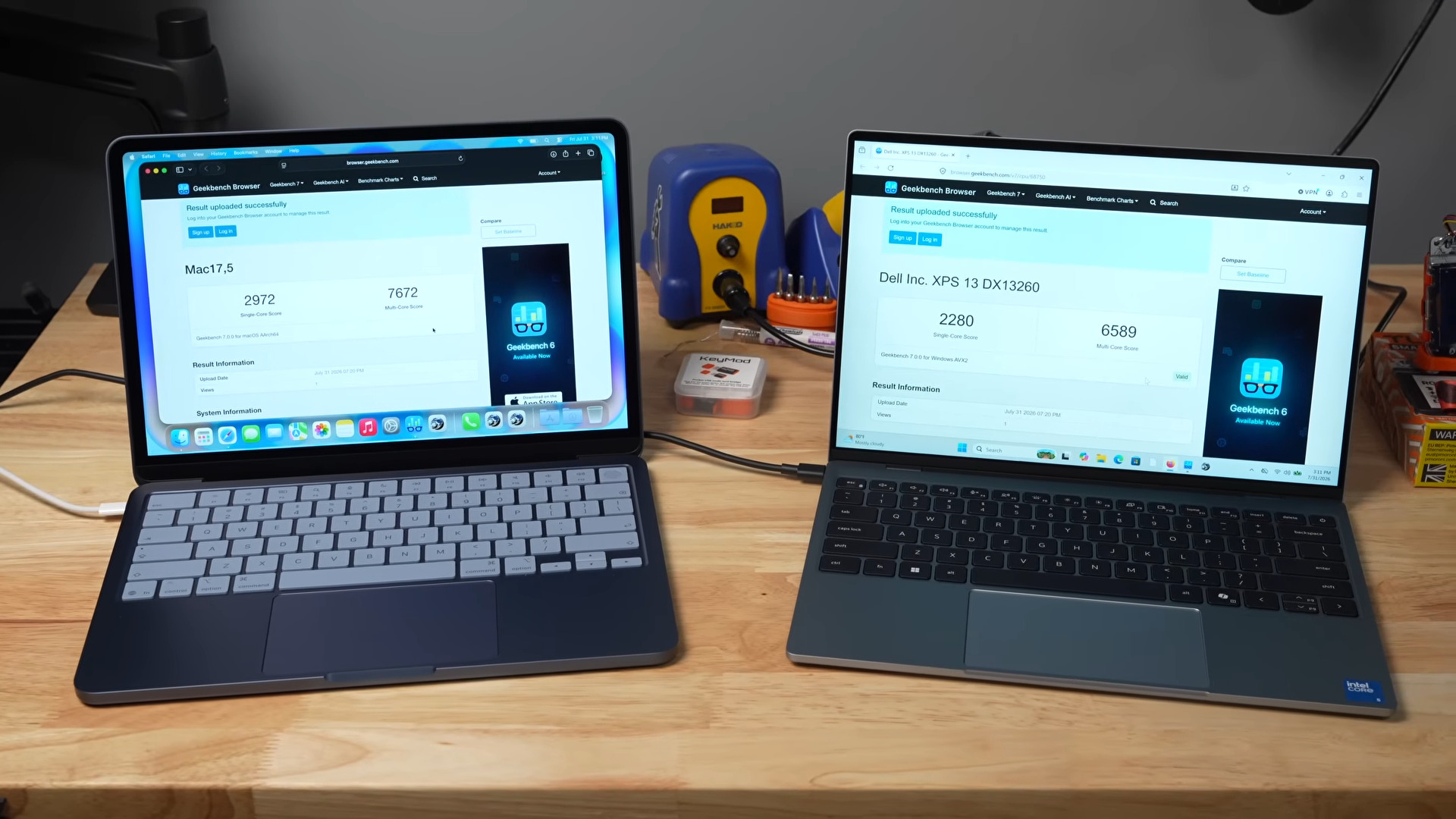
by geerlingguy - Intel wins, in HPL FP64. Its a stretch to take a single metric and apply it's outcome broadly to the chip's general functionality. Especially when by large the A18 chip with half the power requirement beats it in almost every other benchmark.
- M4's GPU does not support 64 float. So, yeah. No hardware support, so what are you expecting? The fact that it comes close is pretty impressive.by slashdave
- Yeah this is misleading cherrypicking. Also it's super slow. Not impressed with slow efficient chips. Anyone can make a chip efficient by reducing clock frequency and sacrificing performance in the process.by mmcnl
- Intel’s low end SoCs are such an undervalued gem.
A couple of years ago I got tired of dealing with OpenWRT and various Tomato based firmware or hunting down compatibility between ARM and MIPS based routers. I finally took the plunge and bought myself a mini pc with an Intel N100.
The thing has 4 cores (no SMT), a 6W TDP and boosts to 3.4 GHz and can support 16GB of ram. The mini pc I bought cost me $200, includes the processor as well 4x Intel 10Gbps Ethernet ports. At 6W, it needs no fan, and the whole chassis is metal and specifically designed to act as a heatsink, which means 0 noise and 0 moving parts.
I ran a power virus on it for a few hours to test the thermals, and on a warm day in Melbourne, after hours of having all 4 cores running full throttle, CPU temperature never exceeded 90 C and the chassis barely hit 55 C.
The best thing about it? Full upstream support for any Linux distro and FreeBSD. No more wondering if this particular Broadcom chipset needs a weird binary blob, no more being hostage to an OEM and having to run old forked kernels.
I installed OPNSense on it, VESA mounted it behind our TV, and it hasn’t been seen or heard since. Not only has it been the most reliable router I’ve ever had at home, it’s providing various other services such as DNS server, apt cache, WireGuard server and client etc for my homelab.
I’ve been waiting for ARM to get here since ARMv8 was announced in 2011, but it just hasn’t happened.
Long live x86.
by aryonoco - > bought myself a mini pc with an Intel N100
Instead of Raspi I've got a N100 uATX mainboard with N100 (120 EUR). Fortunately it does work with normal 32GB DIMM (55 EUR, those were the days!). But I'm still missing a pico-PSU, which can be powered directly from 220V (for reasonable costs).
by kvemkon - Personally have the same experience too. I am tired trying to find out if the xyzPi of the day boards can do Linux. Vendors should also try harder. There are so many boards that release with half baked implementations or proprietary blobs. x86 always just works. Devices are also almost always just pcie devices even for those mini PCs with lots of interfaces. Compare to something like bananapi R4 that I think have some oddities with a mux chip not available in vanilla linux…
It's also super easy to spec out your own devices in this regime on x86. There are mini itx boards with n100/n305 with pcie slots so you can add your own cards, and the n100 has a surprisingly number of available lanes for its small size.
There just seems to be no viable "just works" solution in the below 10 or 20W range apart from raspberry pi, and Intel n100/n305.
by podocarp - The improved efficiency is great!
The Apple Neo was still 2x faster for graphics and around 1.4x faster for single core cpu. And remember the Apple Neo is running an iPhone CPU that is much slower than the M series.
It is strange that this chip is so crazy efficient though. I would love to know the details of exactly why it is? It seems like some new tech or process?
I do want 1.5x battery life for free out of my next laptop. Who wouldn’t?
by bhouston - They have control over the OS and the design of the chip, Intel does not…by Danox
- >It is strange that this chip is so crazy efficient though.
Its only strange if you believe Apples lies.
The truth is, architecture doesn't matter. Single core performance, Apple was always on par with the best chips. Compute is compute, under the hood moving data costs energy, an you can't get away from that.
The reason for "efficiency" of Apple silicon it is because they spent a long time basically optimizing their chips for their specific hardware while running specific programs. Its like building an ASIC to specifically watch youtube vides. When it came to things that are not pipelinable (i.e a lot of branching), the efficieny/battery life statistics flew out the window.
by ActorNightly - > And remember the Apple Neo is running an iPhone CPU that is much slower than the M series.
We really need to get over generalization like "phone CPU". Times have changed. Phone or not really isn't the focus.
Per core the A series (cough phone) isn't that much slower than equivalent M series. It's literally the same family just with some extra features, more power, etc.
by re-thc - Yes, it seems to be a new process, 18A. (18 Ångström, allegedly). Manufactured in North America. If the shiny video they did didn't fool me, it's a two sided wafer process, power grid on one side, then the silicon wafer (with through-silicon vias), then transistors, then signal layers.
The processor is this one: Intel Core 5 processor 320 https://www.intel.com/content/www/us/en/products/sku/246018/... in the Wildcat Lake series.
by kzrdude - Apple has been working ruthlessly on battery efficiency for a long time because of the phones and their tendency to minimize battery sizes on Macs for thinness.
The exact design of the cores, how they’re scheduled, the way background stuff is handled on MacOS. All of it. The chips are made on a fantastic process too, but that alone isn’t it. For example they’ve been putting the ability to drop refresh rate really low when nothing changes to more and more of their machines.
It could be that the Intel chip is close, IDK.
But add in other motherboard components, the screen, the OS, the software and system libraries, all are optimized together to hit those numbers. And any of those alone or in combination could be part of the differences.
by MBCook
I am fully old man screaming at the clouds here, but what does this cost for Dell to include? I insist on a wired headset - telecommunications already barely works, I don't want to add wireless+battery problems into the mix.> no headphone jackby 3eb7988a1663- When the laptop is literally the thickness of a headphone jack? Because a USB-C port is less than 2mm, but a 3.5mm headphone jack port is more like 6mm. That becomes a problem when the actual shell it need to go in is 7.5mm.
Did it need to be that thin? Heck no. But it is, and yeah there is absolutely no room for one because of that decision.
by TheRealPomax - I have to say, I prefer dongles lately. There are many inexpensive hifi dongles that sound great with in-ears. They’re also USB class-compliant audio devices and work everywhere. Obviously a preference, but as other commenters have mentioned, 3.5 jacks do break, and I’ve personally broken plenty.by scott01
- I like a good old headphone jack, but then the USB DACs these days are also super small and portable that I just keep connected to my wired sets. I have couple nice IEMs, and because my phone doesn't have jack, I've to carry around USB DAC anyway.by truncate