
Join the discussion
Write your take first — we'll ask for email only when you're ready to publish.
- Hacker News
- I mean this is cool, it's wholly / mostly AI gen, so it takes the wow away which I think is what foklks are reacting strongly to here.
Sadly this sort of thing is much easier now - thanks to the tooling. I speak from personal experience, I'd written some stub 32bit os' myself (by hand, pre-ai) and it is very fun. But you quickly run into walls that stop further development that aren't fun. I enjoyed poking at VGA registers, the 512 byte boot sector into real mode into protected mode dance. Setting up the global descriptor tables/page tables and the PIC/8042 controller.
But...then you get into protected mode you get a prompt up some very basic memory management and then TERMIOS...boring. Boring. Defining all the posix syscalls, boring. Building test harnesses ... boring.
Oh I need a DMA controller now because PIO is slow, FUN!!!
I've taken my toy os to basically Linux 2.0 level in a few weekends by throwing tokens at boring things and when I got to the end it was a little bit empty because although the kernel of the system was all me, and it very much was built on the skeleton I arranged I didn't understand bits now that while boring were important. And the magic ... was lost.
I'm working on a new version now where my rule is I hand type every line of code and I co-plan with the AI and write from my head. It's so slow going but the fun is in the problem solving and the design and by hand writing you keep enough of it in hand it feels yours and real.
Anyway this is a cool project, I hope the author enjoyed it and learned something, but this is the new normal now, powerful tooling means things that were novel are tokens away and so they lose some of the magic accordingly.
by kar1181 - it's wholly / mostly AI gen, so it takes the wow away
No? It's the exact opposite for me. This is a great demo of how AI can do efficient software if you prompt it the right way.
by userbinator - I am not sure I will ever get this to protected mode... The goal was to have something running on slower, older hardware, and once protected mode comes into play, we're letting go many of the constraints that make this an interesting experiment.
Even though I've relied on AI to hammer out the assembly, it has been very educational iterating on it. You end up learning the techniques that other operating systems used to get applications to perform well on slow machines.
by jggonz - This is great. I had a little Flytech Carry-I 8088 back in the day that could just about run Windows 2 with dual floppies, 640K RAM, Hercules graphics and a Microsoft serial mouse.
Although it was admittedly a bit rubbish compared to Amigas, STs and Acorns of the time I still really enjoyed using.
If I'd had the chance this is exactly what I would have run.
Premptive multitasking without memory protection was still useful on the original Amigas so I think it would have been a boon for 8088 too.
by Lio - https://os8088.com/how-it-works/multitasking/
> Pre-emptive multitasking on an 8086
> Twelve task slots, 1,536 bytes of stack each, and a timer interrupt that takes the CPU away from whatever is running 18.2065 times a second. No task is asked to cooperate and no task can refuse.
If you don't have protected mode, can't any program just rewrite the interrupt handler? It's not a bad system, but it sounds easy to break.
by yjftsjthsd-h - It's a toy, easy to break is what vintage software was. A very different era with users of a very different mindset.
Not just rewrite the interrupt handler either, can rewrite the timer itself :)
Part of the fun of real-mode is the absolute god like power you have. Downside is the 20bit segmented memory model.
by kar1181 - This would be exactly like the original Mac--all processes had full heap access at all times. There was a special debugger extension that watched address zero because writing through to null was so common. (IIRC the original Mac intentionally left address zero alone for these reasons as well.)by StilesCrisis
- Yes, it's easy to break. There's no memory protection. However, building packages, drivers, and kernel modules for it has been a fun and educational exercise in memory management.by jggonz
- > If you don't have protected mode, can't any program just rewrite the interrupt handler?
Yes? It's still possible to make it safe if you ensure that all programs are written in a memory safe language. Aside from throwing out a ton of existing code it's not as bad as it sounds. The Birth and Death of JavaScript touches on it towards the end.
https://www.destroyallsoftware.com/talks/the-birth-and-death...
by Rohansi - The original MacOS lacked memory protection too. It had cooperative multi-tasking, starting at version 7. Before that, the only thing that could be launched next to the main application were "desk accessories", which were a bit of a pain to write, as they had to stay out of harm's way.by tgv
- Neat. If I was doing this though, I'd have started from a real-at-the-time system like GEM (sources are GPL) and "finish" it. By which I mean, from my experiences with the Atari ST ... GEM was in many ways a half-done project. The vision of its original designers never fully realized. We got some of that done much much later on the Atari ST, but it was never cohesive.
If I were to unleash an LLM minion on it, I guess I'd be focusing on that direction.
But, it's all rather arbitrary. We can do anything now.
- If you want to try the operating system in the browser, you can try it by visiting here: https://os8088.com/demo/by jggonz
- thanks for this, such fun!
i'm going to try an run it from free bios rom space on a NuXT similar to Basic in rom:
- Beveled-buttons Minesweeper (first appeared in Win 3.11 IIRC) running on a preemptive 8086 OS with a bootleg System 1/2/3 interface looks absolutely cursed.
- This is great -
It’s almost as impressive as the “GOS” written for Atari 8-bit running on 6502 at 1.79 MHz. Visually it’s almost identical but has a nicer font. The specs are somewhat similar with 16 task slots, calculator app and task manager, serial mouse support (ST mouse) and Atari’s hardware sprites helping with some of the graphics. The XOR window frame is the same idea. Amazingly, Atari GOS runs in 128K of RAM! One has to admire the work and inventiveness in these projects. See description and videos here:
by baud9600 - The XOR window frame was on most X11 window managers since late 80's and early 90's.by anthk
- "Author" of os8088 here. I love seeing what these early limited system could do! Someone shared a video of GOS with me after seeing what os8088 looked like.
I believe os8088 also boots now with just 128k of RAM, but it's very limited in the type of apps you can load. There's a os8088.com/hardware page where one of the contributors to the project that has been helping optimize the operating system tested it out on a bunch of different machines.
by jggonz - The graphical operating system that could have been for the IBM XT.
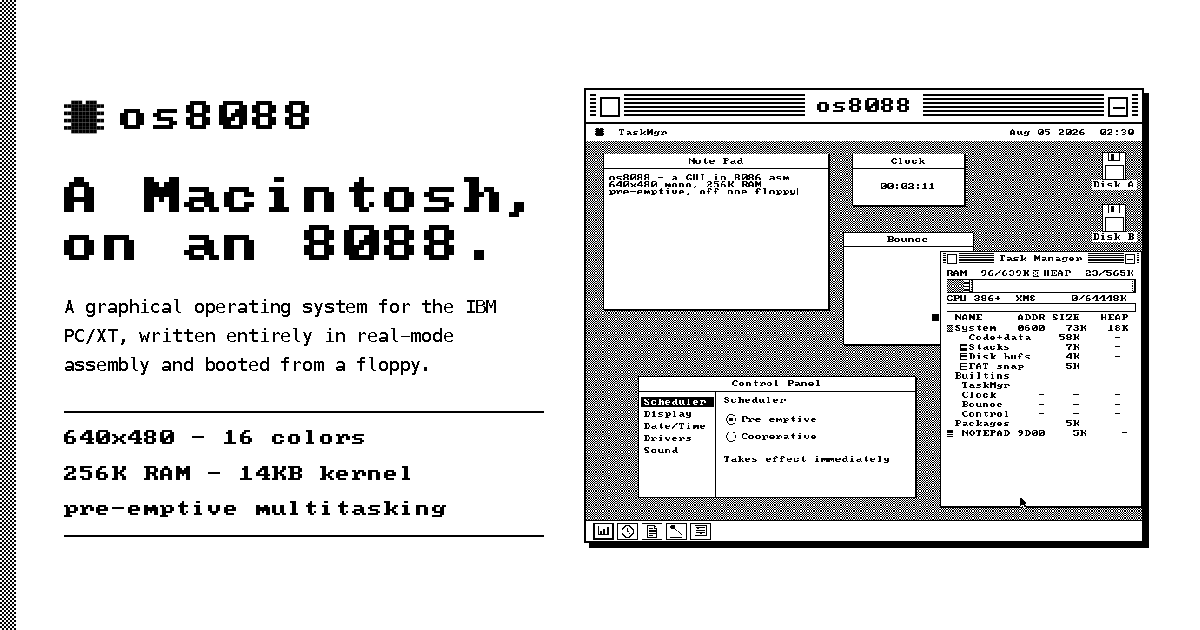
A MacOS-like desktop for the Intel 8086, written entirely in real-mode assembly (with Claude). Verified to run on real hardware, with FAT12/16 support, ported apps, games, Sound Blaster support and upcoming Hard Drive support.
by jggonz - Just discovered the videos (https://www.youtube.com/@NostalgiaPCTV) ...and the source code on github reads like a book.
Amazing.
by ozymandiax - Well there was GeoWorks (which AOL used the GUI of to their advantage):by WillAdams
- This looked great, I started reading things, and then I just kept reading and reading the voluminous description details, and it was an immediate indication to me that the whole thing was built up by Claude. Confirmed in the repo. I closed the tab.
I appreciate the topic, interest, and ambition, but if a human couldn’t be bothered to create and document it, I can’t be bothered to spend my time reading about it.
by incanus77 - Yeah if someone had spent 6 months coding this dead end from 1978 in assembly rather than getting Claude to do it in six days then I’d have given it more time too.by gizajob
- But why do you all think we should spend our time reading your empty whining about it?
This is like clicking Google reviews on an eatery and reading “1 star we went there and it was closed!!!” “1 star they don’t let dogs in so we’re never giving them our money!”
by jodrellblank - "Author" of os8088 here. That's unfortunate. This is a hobby, and yes, it's all written with Claude. I have a bunch of videos up showing the process.
I'm updating the copy of the page to make it extremely clear that it's built using AI so that we can move past that point.
by jggonz - It's funny how virtually everyone on HN is using AI to write code and simultaneously dismisses all interesting new software as written by AI.by LeoPanthera
- It’s almost like those are two different populations of people?by superb_dev
- I can pour myself a bowl of cheerios. That doesn’t mean I’m easily impressed by someone else preparing a similar bowl of cereal.
Though, I have been finding a lot of utility in programs that support otherwise deprecated hardware, now that is some good slop.
- This is a psychological phenomenon going on right now in the world around AI: gaslight your competitors into doubt and disbelief, then win.
I presume that there were similar movements during 1950-1980s who tried to gaslight the publics against using computers while using the computers to gain a competitive advantage over them.
by garganzol - Different groups, the spammers like to congratulate each other for how much hard work they must have put into their very impressive prompt engineering. Regardless, AI code is distinct from extremely blatant AI design. People dismiss things that had no actual design, just whatever fell out of the prompt they gave it. If you can't write a single human paragraph or put thought and care into how you are presenting 'your' project, it's not worth paying attention to. Why can't they present their own work honestly? Why would I spend energy looking at an OS made by someone who can't write an HTML file by themself?by 1bpp
- If you've built a large % of your personality and ego and self-worth around your ability to be a magic wizard with the machine and now it's seemingly easy to automate, how do you think that feels? Of course some people react this way. I encountered personalities of this type who decry IDEs, let alone agentic authoring. I had an asshole team lead at Google who used to smirk at people doing auto-import finding for Java or using e.g. rename refactorings, etc.
I can understand some of the viewpoint around LLMs. But I don't agree with it fully and just find it too useful to be able to get all the things I wanted to do for the last 30+ years done.
And I also think that some of the people who are threatened and angry and who have really deep systems level engineering skills and knowledge actually are in a unique position to benefit most from these tools as they will actually understand and intervene better and produce higher quality. Most of these "really neat vibe coded" projects stall at a certain point where the prompter no longer understands the beast they've created. People with deep knowledge and experience will hit that wall much later.
Anyways, I think we're at a juncture where what is worth caring about and focusing on in computers is going to have to have a radical overhaul. It's tough to separate the gatekeeping/elitism from genuine critique.