Join the discussion

Write your take first — we'll ask for email only when you're ready to publish.

  • Hacker News
  • here in Nova Scotia there are many rural comunities with NO children and where all of the adults are over 40. many small rural homes are torn down as it reduces the tax/maintenance burden on the owners who are city dwellers now, and use a travel trailer to visit. there are comunities on the map that no longer physicaly exist, except for perhaps one empty house, or literaly nothing recognisable as a town remaining, just named streets on a map, and trees where they, apairently once were. our city (singular) is booming, and the larger towns within the magic 1 hr drive from the city are also booming, but much of the rural landscape is bieng abandoned. but perversly, the final phase of twinning the trans canada hyway through New Brunswick has revealed an unknown phenominon where it is impossible for people to drive for 6 hours through scrub spruce and not stop and build a Wallmart, and so the trans Canada is slowly becoming a very long, very narrow strip mall, with sections several hundred kilometers long through ontario and quebec finnished, no homes or schools or hospitals mind you, just endless retail oportunities
  • Where do the people working the retail live? Up or down the corridor I assume?
  • Something strange happens when people get wealthy and advanced enough. Cost of living rises, workload increases, it becomes unaffordable to have kids. 30 years later, everything is empty.

    Places like Australia have plenty of land but, nah, everyone wants to live urban where housing prices are insane or inherited.

    Food costs often go down in developed countries, cheaper than developing ones. Maybe they're so low that they can't afford to become farmers anymore? Not enough people buy corn and corn price is so cheap that it gets made into HFCS. But if you can't mass produce cheap corn, you're screwed and get a desk job.

    So we have the service economy. Everyone sells services to one another, works from home, makes tons of money. Madrid has top-tier designers, chefs, doctors, moneylenders, nearly every kind of service. All the piles of money in a concentrated place like Madrid makes the whole place overpriced. If you happen to be the best tuna butcher in Western Europe, there's a limited number of places you can work, but many of these specialist jobs are also wfh.

    Is there a hack to this though? Can our top tier Spanish pixel artist sell her services to someone in suburban Canada?

  • I grew up in regional Australia. All of my friends from there moved to the city because they wanted careers. Myself included. My friend who stayed there still works in farming and lives just above the poverty line, and can't compete for a rental so he lives in a shack in a paddock. House prices there also became ridiculous after the pandemic.
  • It is my hope that increased connectivity and options to study, work, and interact with other people from anywhere will partially revert this trend, but honestly, it seems inevitable.

    Part of my family hails from a small Mountain Village which used to be quite alive thirty years ago, but now the majority of the population is above 60, and there's only a handful of children. Small towns have many positive sides, but network effects are too important for people.

  • For me towns have more perverse networks though. You meet more people but the connections are more shallow (as an adult).

    I am really torn about where to raise my kid as it really seems one has to choose between opportunities and social/family life.

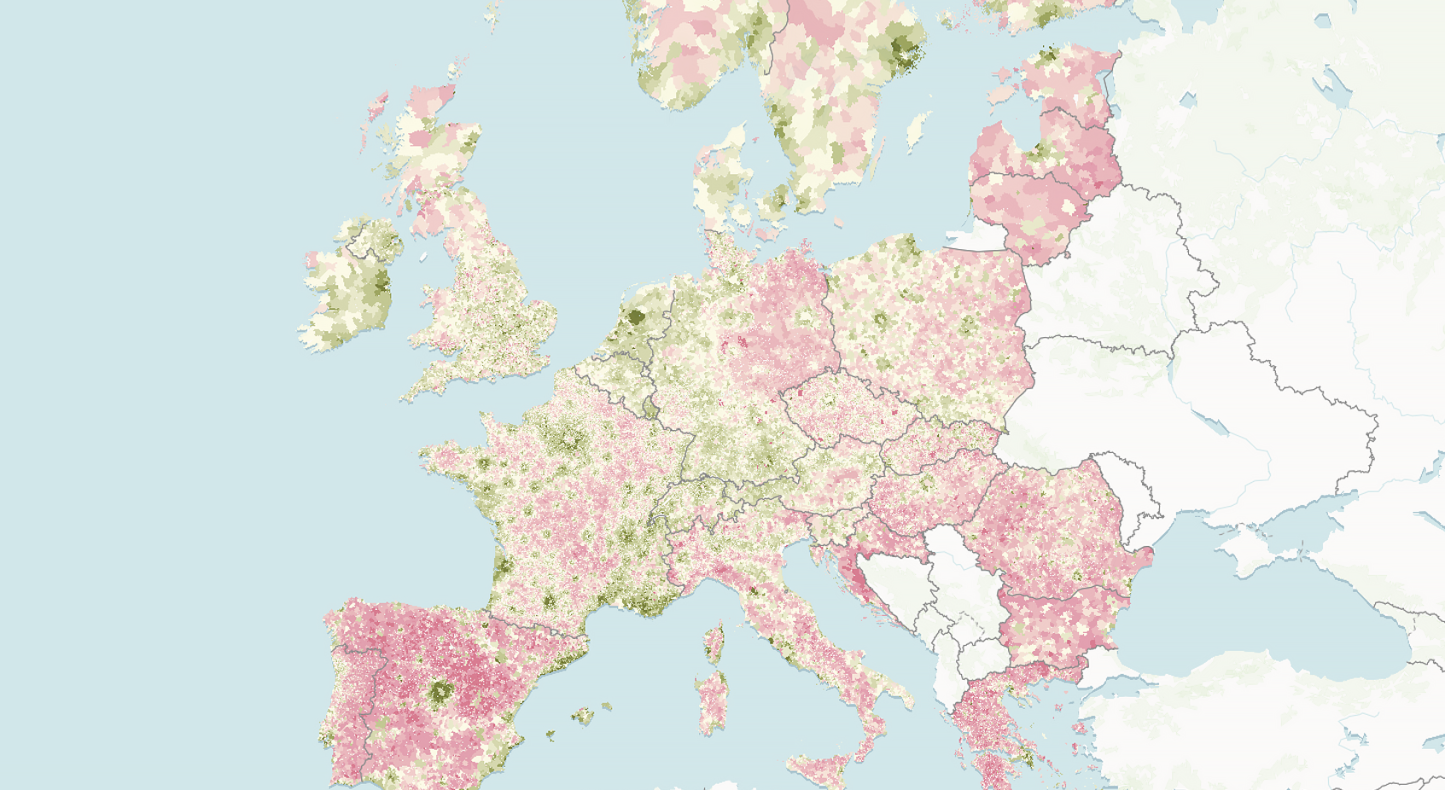
  • The area on the map that is green corresponds to the blue banana: https://en.wikipedia.org/wiki/Blue_Banana
  • Speaking as an Italian: during the pandemic and the immediate post-pandemic there was a huuuge trend of people moving back to the South because now with remote working they could effectively bring their job with them.

    Then the Government did little to nothing to encourage that, and at some point the trend essentially died.

    Needless to say, a lot of couples could have moved to their areas of origin, have the support of the extended family (grandparents) and that would have likely helped with children (particularly with couples yearning to have more children.

    It was another lost occasion to revitalise some of the smaller towns.

    by znpy
  • There are definitely some data missing, because in Czechia where I live there are some areas on the map with 100% decline in population like Libavá and Březina, which definitely have some population. I don't know about any village that would be totally de-populated. https://obyvateleceska.cz/olomouc/libava/503941
  • Classic null being replaced by 0.
  • It's a bit weird and maybe more complicated.

    I checked the area around Munich, Germany (where I live).

    - one is an actual lake (correct shape) that went down to 0 from a bogus 1

    - three are actual forests/parks which may have had some sorts, but 11/16/48 to 0 is a rounding error, but there is no filter for absolute, it technically is -100%...

    - bit further out is another lake with 14 to 0

    by wink
  • If you just want the map and not this ever scrolling cinematic experience

    https://cdn.correctiv.org/deployed-apps/CE_2026_population_m...

  • Thank you. This makes it easier to try and find somewhere quiet to live!
  • It's insane to see the UK still growing. Despite all of our problems, it's still a nice place to be
  • People move to where they can make a living. Globalization has largely killed farming as a viable livelihood (in most of the EU at least), it's simply not profitable enough unless you have a massive amount of land/cattle or have invested heavily in automation (usually both). Without that important sector, it's doubtful the trend will reverse unless cities become literally unlivable or there's some kind of miracle in transport technology.
  • > Globalization has largely killed farming as a viable livelihood (in most of the EU at least)

    Honestly that was really primarily mechanisation and industrialisation. The number of people required to farm a given area of land has _plummeted_; in Europe it is still artificially inflated with subsidies.

  • The trend will reverse once we have enough people in positions of power both able to recognise and willing to admit that remote work is, for at least 75% of office jobs, at least as good as onsite work. (Not "without tradeoffs", just "at least as good, overall".)

    Sadly, this is going to have to be at least a generational change, as the current people in power are deeply entrenched in the mindset that "managing people" means "ensuring butts are in seats", and that they are neofeudal lords overseeing their techno-serfs, which they can only feel good about if they can go aggravate them in person.

  • For Finland it seems that it is not the farming automation that kills these places. It is the deindustrialisation. Places die as the jobs die. And jobs are killed by big factories being closed leading to all other services starving. Globalisation is the killer, but via factories not farms.
  • It appears that it is turning into a problem in Italy for another reason. In mountainous regions the streams would be maintained by the people owning the land. With people leaving the area the waterways are left unmaintained leaving debris such as large trunks as branches in the water. This effect is compounded by that the land that remains “actively” owned is divided amongst many descendants that can never agree to either fix something or pay to get it fixed.

    The consequence of all this is that water flows less freely and that when there is a lot of rainfall it comes not just with water but also large amounts of trees and stones.

    I imagine this happening in many places.

  • Some countries have really high housing prices and housing scarcity right on a border with another country where this isn't the case. You can get 30-40% differences just by moving a few km on the borders of the Netherlands. The reason this isn't that popular is that by moving like that you get to deal with different jurisdictions and tax systems. Particularly the social systems different countries have are very different. So there's a cost to moving to another country. But it sure is tempting when you realize that what you paid for a small apartment buys you a large house with a garden just 10 km away.

    Here in Berlin where I currently live the population grows by a out 50K people a year. There are housing shortages and people are struggling to find a place to live.

    However the surrounding Brandenburg area has been depopulating since the wall fell. Lots of little ghost towns there. And it's not even that far. There's plenty of housing available if you can tolerate the inconvenience of a shitty commute.

    IMHO the coming revolution of autonomous driving is going to lower the cost and inconvenience of living a bit further away. It enables working or relaxing while you commute. A two hour commute is much less of a problem if you can be a bit productive. And of course you don't have to do that everyday. Lots of people work remotely some or all of the time.

    Autonomous driving could also lower the cost of public transport by eliminating the cost of drivers and fossil fuels. Most of the reason of remote villages being underserved by public transport is cost. On demand pickups/dropoffs and more flexible scheduling could further address that. And it's a lot cheaper than commuter rail extensions.

  • > the coming revolution of autonomous driving

    ...is going to take another 20-30 years, if it arrives at all.

    It's become very clear in the years since the promise of "self-driving cars in six months!" failed to materialise that the level of computer vision and processing required to operate self-driving cars on arbitrary roads (as in, not in very specific areas in the American Southwest, where the weather is very consistent) is much, much higher than we thought.

    Until we can be pretty damn well guaranteed that a self-driving tractor trailer is not going to see a road under construction and either continue going straight through—killing lots of construction workers, and possibly causing a massive explosion if it's carrying fossil fuels—or swerve off the road into someone's house, no matter how poorly the correct lane to drive in is marked...

    And that self-driving vehicles will be able to keep in lane at least as well as humans can when there's 8cm of snow on the roads...

    We're going to need to accept that the answer to "shitty commute" has to be public transport, or remote work.

  • > A two hour commute is much less of a problem if you can be a bit productive.

    A two hour commute sounds absolutely unbearable to my ears. I guess it makes sense if you are able work for 4 hours daily inside a train or something, but that's already half of the workday, i.e. you might as well just work from home.

  • > It enables working or relaxing while you commute

    If everyone is on the road, be it "autonomous" or not, then the net result will be traffic jams. It sounds so idyllic if it's only me but it won't be.

    Make public transport more attractive and it could be doable. After all, Europe has spent the last X years trying to get people to use bikes and public transport instead of clogging up roads.

    > eliminating the cost of drivers and fossil fuels

    By that time, we'll be on fission fuel ... it's just around the corner!

  • > There's plenty of housing available if you can tolerate the inconvenience of a shitty commute.

    I would rather pay for the better location than pay for the larger house. The physical size of my home isn't a large factor in my quality of life. The length of my commute is. Now I was going to write "It's really weird to me this isn't a more mainstream view", but given the data we're looking at, seems this view is absolutely the mainstream.

  • Not enough software engineers converting to farming? Shocking.

    If anything else, for me the main issue in France is the dearth of doctors in rural areas. So even the romantic idea of retiring in quaint village is predicated on not getting sick.

  • Just hire a large muscular guy from the banlieues to drive you around in your Maserati.
  • Farming continues to be automated. Farms continue to be bought up for way more than their worth (farmland in the U.K. goes for 100-200 times the rental value) as part of wealth concentration.
  • This. I'm originally from the UK, now in NL and the plan was to retire in France. Being close to a hospital is one requirement since some of these villages are over a hour away.

    With that and climate change our plans might be changing

  • > So even the romantic idea of retiring in quaint village is predicated on not getting sick.

    Grew up in a village. What you do is... drive to another village / town. There are always doctors to be found - and less queues than in big cities.

  • > Not enough software engineers converting to farming? Shocking.

    I kinda have to disagree with this. Sure, there's not a lot of software engineers grabbing a hoe and moving to a quiet rural farming village. But oh boy is there a lot of money being a software engineer working on farming.

    I'd have to say more software engineers are working in agriculture today than ever before - it's one of the reasons why the rural areas can shrink. State programs for mechanization and increasingly advanced and hyper-specific machines are allowing crops that were labour intensive just a decade ago to be done by a team of 2-4. We went apple picking last year and the field next to us was having its apples harvested by flying drones (which was a real "we're living in the future" moment for us) while a worker sat in a lawn chair nearby reading a book.

    Then there's the pushes to remove transport costs and grow closer to the cities. All of our family's lettuce, tomatoes and cucumber come year round from greenhouses on the roof Walmarts, warehouses and other big block stores, just a few blocks away - https://montreal.lufa.com/en/farms. 100% "touch-free" automated greenhouses are being built and have entered full productivity - https://www.youtube.com/watch?v=ITRts-KOkuM&t=44s. Cheap electricity and thousands of overbuilt (snow load) flat roofs are a good combination for city greenhouses. These "farms" employee directly and indirectly plenty of engineers of all kinds.