
Join the discussion
Write your take first — we'll ask for email only when you're ready to publish.
- Hacker News
- This appears to be trying to sell a system for meeting the right people, rather than giving any actionable advice about how to do so.
It also glosses over the fact that who you know is often a result of some combination of hard work and luck.
by zahlman - Studies show tall people also earn more. https://www.apa.org/monitor/julaug04/standing
Also, physically attractive people earn more. https://wol.iza.org/press-releases/does-it-pay-to-be-beautif...
- This is absolutely it, and it's something I try to impart to college students. What programming language you learn, or what you put on your resume, or even how you dress and speak at e.g. job fairs all pale in comparison to. "Who do you know, who is in your 'network?'"
And note, this can be done without being sleazy. Try to be interested in other people, try to make random friends. That will "pay off" -- both in richness of life and in just money -- more than just about anything.
(One of my personal corollaries here is "go until they stop you." This works for nightclubs, conferences, etc. etc. And even if you are stopped, hit them with a HUGE mea culpa, and back away. Which will be rarer than you expect.)
(and one more. The other thing I do in every class: Each and every one of you knows something about something WAY MORE AND BETTER than literally everyone else in this room. No promises, but that might be your good avenue.)
by jrm4 - What do you mean by "go" ? Talk ?by vinaigrette
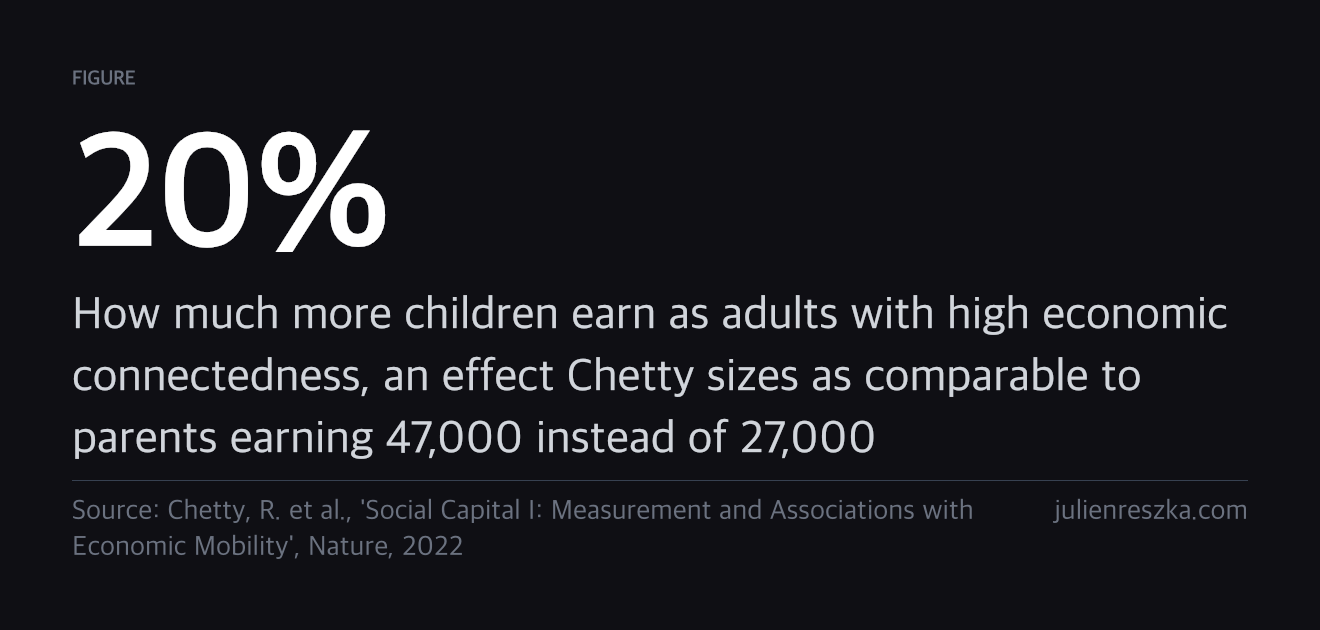
- 27000 + 20% is 32400 not 47000, so not sure what's up with that sentence.
Also, define "success". Even if it's just about being exceptional in economic terms, AIUI a bog-standard swdev salary is enough to be in the top 10% with no favoritism needed. And if it's about being able to retire and have grandkids come visit sometimes, I think that might be more common than not.
by tbrownaw - I did the same math and had the same question.
But wait, something was learned! I typed in the start of the equation and after hitting space after the equal sign it yielded the answer! The Hacker News comment box can do the math for you!
by RickJWagner - The 20 percent is the effect on the child's own adult income from growing up with more economically diverse friends. The 27,000 versus 47,000 comparison is a separate number: it's roughly the same size effect you'd see from that same child's own parents earning 47,000 instead of 27,000 while raising them, a different mechanism entirely, used only to give the 20 percent some intuitive scale. They're not the same number expressed two ways, so multiplying one by 1.2 to check the other won't line up.by julienreszka
- That sentence confused me, too, but it's clarified in the next paragraph:
> Children who grow up with high economic connectedness earn 20 percent more as adults on average than otherwise similar children who do not, a gap equal to growing up in a family making 47,000 dollars a year instead of 27,000.
ie: knowing wealthier people has as much impact on your income as growing up in a family making $47k/year instead of $27k/year
by David - The key to success is the same as it ever was: you buying my Product! Or even better, my Course about how you too can achieve success with your own Product.by glaslong
- I think it's how you appear to other people you work around.
Over a period of time, when the right person thinks you are useful/attractive/interesting, you get more opportunity/promotion.
This happens to explain the networking effect implied by the post (and related analyses).
by Supermancho - This is a game played at the level of primate politics.
If you care about epistemic accuracy more than tribal politics, you'll quickly find yourself in the outgroup.
Logical from a 'within the game' perspective, but those who believe that humans are legitimately trying to transcend their irrational nature will be very disappointed.
by rizzom5000 - This article feels like a "wet streets cause rain" kind of thing.
I think there are two factors at play beneath this:
1. Your expectations of yourself. If you grow up with studious and career oriented friends and family, you expect that of yourself. Same when you grow up around enrepreners. On the other than there are social groups that have the attitude roughly "I work a random job until I get fired" - if that's the subculture you are brought up with, that can steer your own life too.
2. You self select your friends. My highschool had a mix of poor but motivated immigrant kids, and just like "bad" kids. The two groups didn't mingle, one ended up in the 1% by and large and the other group is in jail or on welfare. So you could say we did better because we had friends who ended up better off but I think it's the other way - we associated with people who are on our trajectory.
"Who you know" is important - but the first job I got through a connection was at age 45. Everything before that came from who I am not who I knew, but who know is shaped by who I am (ie I wouldn't have had the connection that got me this job if the guy hadn't known he as a high performer to begin with)
by xyzelement - Meeting people and making friends outside my income class through civic volunteering probably had a bigger impact on my lifetime earnings to date than either of my degrees or my work history itself.
- what kind of civic volunteering did you find most rewarding?by kian
- This is probably the biggest value from going to college, or at least it was - making those connections. I got my first job from a college connection, and my second one as well. I'm not sure how useful the actual classes were, or the degree - my first job certainly didn't require one, and the second one would have likely waived the requirement for one since I was already employed as a software engineer.by pavel_lishin
- > This is probably the biggest value from going to college ...
It's a popular argument that doesn't make it's point very explicitly nor offer any support for it, but the main point is that college education itself has no value. That mode of expression is an old technique that people unintentionally use when they repeat the argument: By not being explicit about the thesis or any support for it, it's impossible to address - the thesis is invisible to many. (In college, you learn you have to explicitly write your thesis and your support for it.)
Necessary to it is the argument, again implicit, that the only value in the world is income. Once you see that explicitly written out, you know it's obviously absurd. (It's absurd for another reason too: knowledge and intellectual skill are great aids to income.)
People on HN highly value knowledge and cognitive skill. They spend significant time on gaining it, including right here. How much would they value years to dedicate to the very best of those things, learning from each of the very best humans and ideas from any time or place, guided and advised by other people who have spent their lifetime studying each person or idea, and who can introduce you to the best of it and to the most powerful counter-arguments, flaws, and alternatives. It sounds like a fantasy, but it's real.
There are powerful people who don't like those thinkers and ideas, because they undermine power. So they devalue them, ostracize them, defund them, ban them - all to stop you from reading them. Those must be powerful ideas.
by mmooss - To some degree (no pun intended), it depends on which college you attend. I went to Random Public University; my university contacts were the kind of people who go to that kind of university. If you went to Harvard/MIT/Caltech, your contacts are the kind of people who go to those places. Those are not equivalent groups.by AnimalMuppet
- I don't disagree with the result but the argument may be flawed. How do you know it's not the other way around, that richness causes having rich friends, rather than rich friends causing richness?
- That's the question that popped up into my head shortly after starting to read the article.
Correlation != Causation
by ghurtado - Because (taking the blog at face value) that would require future events causing past events, and that's relatively uncommon.by bothers
- This whole thing is silly as are many of these studies. They arbitrarily treat things as random. Consider this:
> Children who grow up with high economic connectedness earn 20 percent more as adults on average than otherwise similar children who do not.
"otherwise similar children" is doing a lot of work here.
You have high economic connectedness, which may mean you grew up in a rich neighborhood to parents that are smart and value education.
Or maybe you're connected to your Harvard classmates who are successful, which means you're likely smart and work hard.
Or you're a successful networker, so you're socially adept.
But it's almost certainly not a random characteristic like having hazel eyes. No matter how hard they try to control for other things.
by bko - I attribute 90% of my success in life to the fact that I happened to make the right childhood best friend. One thing led to another and I got a PhD and earn [unreasonable salary]/year now. Life is insanely unfair. On some level it is luck. I don’t know what the “skill issue” twitterites don’t get about it.
(Hard work doesn’t hurt, either, but that goes without saying.)
- In order to make life fair, it is necessary to hammer everyone down to the lowest common denominator.by WalterBright
- Luck is mathematical variance. Not random.
Wealth distribution is a policy issue so it's not random. It's coupled to intentional politics.
by n0rand0 - Life it not unfair. You've picked that right friend and you've earned that one friend, and you've kept that one friend for ages.
If someone does exact opposite of what you've did, than it's not unfair he's doing worse than you do.
by shuwix - Agreed.
I am not going to say that I didn’t work hard for whatever success I have, but I was very lucky to have good parents who cared about making sure their kids were successful, and friends who didn’t really peer pressure me to do anything terrible, and just sort of a natural interest in computers that ended up being profitable.
I do think I am relatively ambitious and that certainly helped, but I am not naive enough to think that things would be as good for me as they are if there weren’t a lot of positive lucky factors.
by tombert - Similarly I attribute about 70% of my quantifiable success (i.e. primarily salary) to a chain of events where the "luckiest" thing was that my OS got corrupted. If not for that I would probably be in a low level software job at 30% of my current salary. The other 2 of the top 3 luckiest in that chain are: attending a talk because it had free lunch and then getting a good job from it with no interview, and the time an inhouse recruiter reached out to me on linkedin (despite my mediocre resume) and got me into their high tier company.by hatthew
- Given only like 1% of people hold PhDs i feel like you're massively underestimating your own effort in your success.by wordpad
- My whole life would have been different if I didn’t get a new physics teacher when I was 16?
Before him, I found math and physics unintuitive, but he explained it in a way that (to me) made the whole high school physics trivial.
I studied physics at the university where I learned programming, and switched to software engineering.
by serial_dev - ~99% of my success is that I happened to make friends with the right coworker at my first job, who happened to be a genius, and happened to refer me to better places. Otherwise, I'd still probably be making 1/4th of what I'm making now - simply because I didn't go to the right schools or be born to the right family, etc.
I think Thinking Fast and Slow talks a lot about maximizing your surface area for luck.
Nothing beats luck.
Sorry to all the unlucky people. I wish you could all be lucky, too!