Join the discussion

Write your take first — we'll ask for email only when you're ready to publish.

  • Hacker News
  • I guess it’s unrelated to this particular find but is Turkey now the place where civilization first started or Gobekli Tepe and the other similar sites are not considered civilizations at this point?
  • Probably depends on definitions but there are cave paintings in France 20,000 years older and contemporary with sites in Australia. There are also much simpler Fertile Crescent sites that are older but not much more then holes in the ground.
  • There isn’t really a settled definition of “civilization” but usually one of the requirements is developing some kind of writing system without outside influence. As far as we know the people at Gobekli Tepe did not have one.

    Granted you can also argue the same about Incans and to some extent Mesoamericans, so it’s kind of debatable.

  • I think you need evidence of a system of government, agriculture, culture, laws to dispense justice predictably and a writing system to track and record aspects of the above. Hence we can have Egyptian, Indus, etc., but not prehistoric civilizations. The human organizations just didn’t have enough progress to be considered civilized. Thats not to say they were not advanced vis a vis their other contemporaries but rather didn’t meet certain milestones that mark a civilization.
    by mc32
  • > site in Turkey

    Didn’t the country rename / rebrand to Türkiye?

  • the turkish name may be now Türkiye, but not the name in other languages
  • yea but still most people use Turkey, instead of Türkiye.
  • Yes.

    They don't have authority over a language, however, so English-speakers continue to spell it as they see fit.

  • Yes.

    https://en.wikipedia.org/wiki/Name_of_Turkey#Presidential_ci...

    Türkiye has expressed the desire that their exonym be uniform. The United Nations has complied in their policies and materials. The United States switched for diplomatic contexts, but in terms of mapping and geography, decided to retain the traditional English spelling.

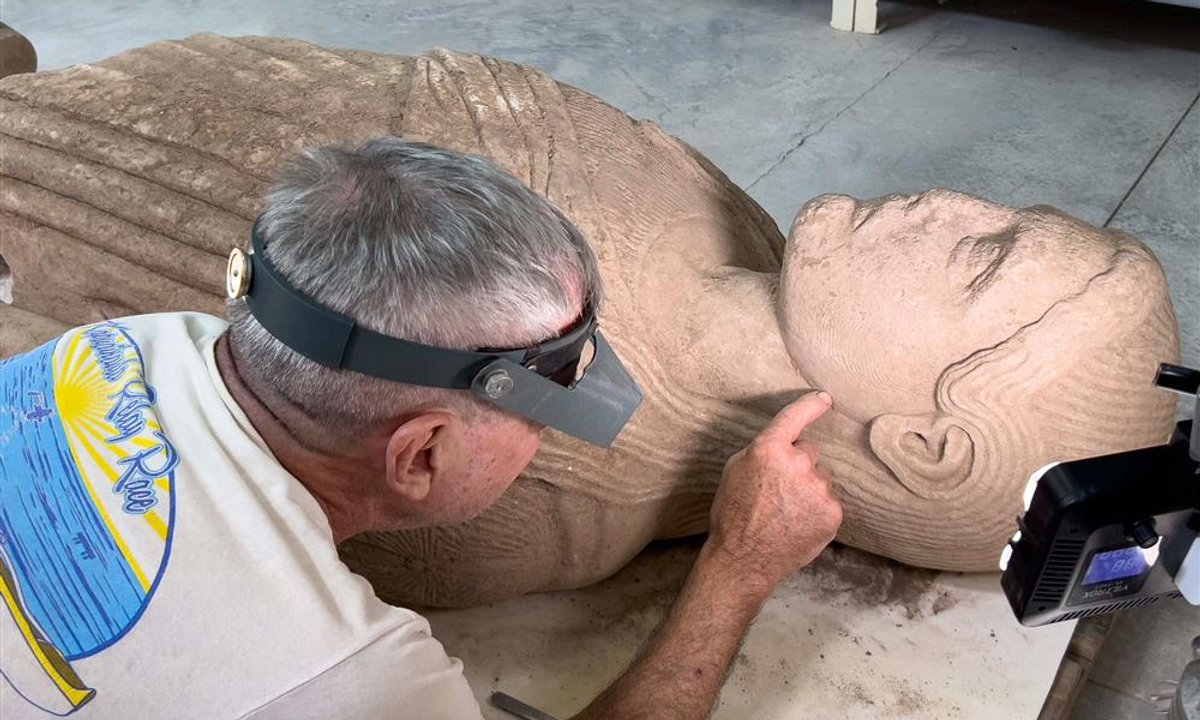
  • > It has been exceptionally well preserved because it was reused as a Roman-era paving stone on a colonnaded street

    The sculpture is very 3-dimensional. I don't get how it made a good paving stone, or how being used as a paving stone didn't end up conflicting with the "well preserved" part more.

  • > The statue was discovered in two parts

    So maybe it was about one of those parts and the lower one looks like it could be a decent paving stone.

  • The back side of it looks pretty flat - perhaps it was buried face down, in two pieces. The Romans were pretty crafty about re-using things.

    Besides which, ever been to/seen the streets of Pompeii? Flat, level surfaces for road construction only seemed important to the Romans as a side quest. They would fill the gaps with stone and mortar - perhaps that is the case here.

  • This must have been during or near the reign of Croesus, a very interesting king who was the last to rule Lydia, as recorded by Herodotus.