Join the discussion
Write your take first — we'll ask for email only when you're ready to publish.
- Hacker News
- I’ve been told the Legacy Standard Bible is one where the translators tried to not use the same English word when the original Greek or Hebrew words are different.by whitten
- This is a solid collection, one that shows real intellectual curiosity. Something that would be interesting to add would be something that falls entirely out of the canon of Western philosophy - you have what is by all measures a diverse sampling of the various permutations of the intellectual procession of western thinking, but nothing reflecting traditions from outside that procession, eg Chinese, Islamic, Indian, or even Mayan or others from the Americas. It’d be interesting to pull from something entirely outside the intellectual tradition you’re well steeped in, to take a play horizontally instead of vertically.
(Note this isn’t a knock on the author for staying within western tradition, which is both deep and interesting and also diverse in a way which provides a wide breadth of ways of thinking about the world; rather, getting outside the tradition entirely would provide yet another perspective on that tradition, eg its bounds and the lines it doesn’t realize its prescribing itself within even as it changes dramatically over different eras.)
by roughly - > I have trouble connecting with the thinkers of the Middle Ages. Their thinking seems to me to be frightened, so overcautious, so cramped and circumscribed, I can't read it without sadness for the way that medieval Christianity strangled the human spirit for so long.
As I understand it, particularly for the bizarre natural sciences stuff, a lot of this is actually _Aristotle's_ fault, not Christianity's.
Adding the Pseudodoxia Epidemica to my list of things to read if I ever have infinite time.
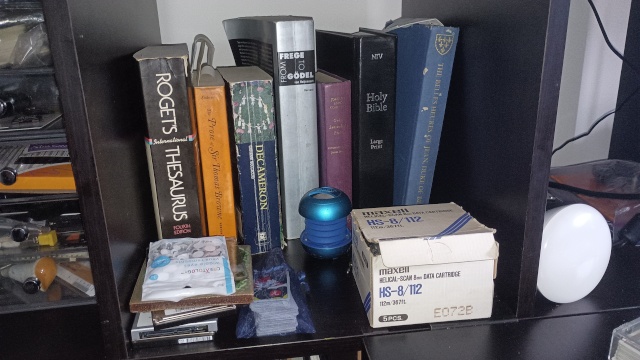
by rsynnott - Pleased to see Roget's thesaurus here. It's a fantastic resource without a great digital equivalent. I've found LLMs helpful in a pinch (and it's certainly better than a standard thesaurus), but Roget's is still the book I turn to for tricky word-picking problems.by euthymiclabs
- Speaking of “witty, and learned, and wise, and humane”, this post is all of the above. The kind of writing that, before you’re even done reading, makes you eager to look up everything else the author has written.by bdr
- > After several repetitions of this, Samson decides that being shaved, blinded and crushed will be less exasperating than listening to any more of Delilah's nagging.
A very off-tangent note, but I recently learned that Samson's last words, "ἀποθανέτω ἡ ψυχή μου μετὰ τῶν ἀλλοφύλων"/"moriatur anima mea cum Philisthiim", pretty much have never been translated into English literally; it's always "Let me die with the Philistines" for some reason.
by Joker_vD - > knowing full well that [Delilah] will betray [Samson]
It is not clear from the text that Samson is aware of the presence of Philistines the first three times. We are told they are lying in ambush in an inner chamber. We are not told that they make themselves known, attempt to subdue Samson, or interact with him in any way. Instead, we are told that Delilah announces their imminent presence, with no follow-through. (And why, after all, would they dare come in until Delilah has established that he is weak and harmless, given his reputation for strength and bloodthirst?)
I don't believe Samson understands Delilah is betraying him. Not until the end when he's told her the real secret. Until that point, he may only receive her behavior as, at worst, a taunt and, at best, an attempt to pursue a kind of relational intimacy in which he makes himself vulnerable to her. And indeed, that's exactly where the story goes. He eventually makes himself vulnerable to her, both emotionally and physically.
A shallow reading that concludes the characters must be dumb and naive to explain the ridiculousness of the plot is rarely the most appropriate reading. Frequently, the characters and nuances run much deeper, and a more careful and thoughtful reading is required. Ancient literature is stylistically terse compared to modern literature. Space on the manuscript is precious and not given over to things that the reader is meant to infer by reflection. And whenever a phrase or pattern is repeated, that means it is very, very significant. In this case, Samson's interaction with Delilah is not a one-off inexplicable behavior. It is one episode in a series of episodes, both preceding and following, where consistent patterns of behavior develop and escalate (e.g., his vengefulness, his vulnerability to women).
by cvoss - The New International Version (NIV) translation of the Bible is by far the worst translation on almost any metric you can think of, except maybe understanding how evangelical Christians read the Bible in the 90s and 2000s.
The NIV has so many inexcusable translations that reinforce a theological worldview that matched the conversation on atonement and justification that was happening in the 90s and 2000s. There's a great catalog out there of the most egregious translations in the NIV [1]. One such example:
> Romans 7:18 — The NIV here translates σάρξ (sarx) as “sinful nature” even though this implies later Augustinian doctrine on original sin that is not intended by the original writer. In contrast, the NRSV correctly chooses to translate this tricky Pauline term more literally as “flesh”.
Are you interested in a readable Bible that flows well to modern English ears? The New Living Translation (NLT) is fantastic and very underrated. I recommend reading the Psalms in the NLT since much of the language of the Psalms being in a higher register in the NIV and other translations doesn't land as well, but reading the Psalms in NLT makes it much more relatable and human. I find the way it reads refreshing, and it's based on more modern scholarship.
Are you interested in latest scholarly understanding of the Bible? The NRSV is the consensus version (as much as there could be one).
Are you interested in understanding the Bible as American Evangelical Christians read it today? That's currently the English Standard Version (ESV), which many churches have switched to as the NIV has lost favor in Reformed circles.
[1]: https://isthatinthebible.wordpress.com/articles-and-resource...
by ntdef