Join the discussion

Write your take first — we'll ask for email only when you're ready to publish.

  • Hacker News
  • I long for the days when voting for outsiders was a fun way to fill out a ballot, back when election outcomes didn’t matter very much because the probable winners were all qualified to hold office.
  • Bumper sticker with a picture of Count Binface: "Don't blame me, I voted for the other guy!"
  • Seems funnier if it was a picture of Farage...
  • The contributed proposition by the 10 year old kid to make fossil fuel companies pay for solar panels is perhaps the best policy proposal I’ve ever seen.

    The second one is to make water companies CEOs swim in the Thames.

    That is a program.

  • I can't believe people chose the joke candidate over Count Binface!
  • Best response yet!
  • Be careful with joke parties. It may seem fun and may seem like they are obvious "good guys", but you really can't know. It's easy to hide behind irony. In Hungary, we had the Two-Tailed Dog party which essentially turned into the personal enrichment of the couple leading it, and political background deals and embezzlement of state funds. A lot of times, the regular old human affairs poison these joke parties too, as anywhere else, except they may have lots of naive people around them who are even easier to fool and exploit.
  • I mean, you've got to imagine that even if Binface somehow won, he'd at least be a better MP than Farage. Like, it would not be hard. Turning up for work occasionally would do it.
  • This whole debacle was kicked off by Farage accepting and not declaring a £5m gift from a crypto billionaire living in Thailand, with Farage having engaged in meetings with the Bank of England over cryptocurrencies, and specifically promoting the coin the crypto billionaire invested in. Really, I'm not sure you can get worse.
  • The real question: is this behavior any worse than the "super serious" parties? That just sounds like normal behavior.
  • Treating joke parties like one bloc with similar motivations is a mistake. The person behind Binface strikes me as intelligent, quick-witted and knowledgeable on modern issues. I have little doubt that he'd rule well had he actually been elected.
  • Reminds me of the Black Mirror episode in which a blue animated bear named Waldo nearly wins a by-election:

    https://en.wikipedia.org/wiki/The_Waldo_Moment

    Reality these days sometimes feels as strange as fiction.

  • I mean that one came true in 2016.
  • Yes!
  • Can someone in the UK explained how the country has fared with multiple PMs since Borris Johnson? My read as an outsider is it would take another brexit exit (a singular, definable political question that can cleanly classified in a binary label) to create a unifier but I also have no idea what that could be (ai, immigration, climate change, etc are too load bearing and multifaceted to see such a clean binary moment).
  • > another brexit exit (a singular, definable political question that can cleanly classified in a binary label)

    Yes, the referendum was a binary choice, but I think it was flawed in that Brexit covered many different, incompatible options (e.g. soft, hard, in-between). If the referendum had depicted the situation more accurately, then we wouldn't have wasted so much time and money going through the whole charade (mainly because "remain" would have won).

    I like to think of an analogy where people are asked what they want to eat for dinner and they're given a choice of "meat" or "vegetarian". If 40% want vegetarian, 30% want beef and 30% want pork, then the "meat" option will win, but then someone has to choose whether it's beef or pork. That ends up with a choice that only suits 30% of the voters.

    Also, it makes sense for a referendum to specify the required margin for whether the choice is carried through and I think the vote was too close to lead to such a destructive change.

  • Brexit essentially created the short-term PM thing in the first place. Thatcher was 11 years, Major was 7, Blair was 10, Cameron was 6, even Brown managed 3. The new-PM-every-five-minutes thing is mostly a Brexit phenomenon.
  • It's the natural state of the UK political system. The PM has a (figurative) gun on his head constantly, and has to fight and defend his actions in parliament almost every day of the week. Keeps him on his toes and ensures that he gets replaced if things go down.

    The stability of the US presidency comes at a cost. It allowed a senile president to stay in office when it was clear to everyone that he was incapable of assuming his function. Or with the current presidency, it enables a president to renege on pretty much all of his electoral program with impunity. Both would have been replaced 6 months into their term in the UK.

  • IMHO it comes down to the Housing Theory of Everything [1].

    The UK doesn't produce anything anymore. The best returns on investment aren't in productive output. They're in hoarding land. This is exacerbated by an anachronistic system whereby artistocrats are still significant landowners (eg the Duke of Westminster). The UK badly needs land reform but the system is designed to protect landowners through the House of Lords. Up until only fairly recently, the House of Lords still had hereditary peers.

    This relaly started in Thatcher's time but was made significantly worse in the aftermath of 2008. The UK government chose to bail out the banks at the expensive of taxpayers and then pay for it by crippling the economy with 15+ years of austerity measures.

    So there's been a revolving door of British PMs because literally none of them have been interested in addressing these core issues. What we really need is another Oliver Cromwell.

    [1]: https://papers.ssrn.com/sol3/papers.cfm?abstract_id=6571818

  • It’s very difficult for anyone person to say because we all see our slice.

    If you got an education in an area that’s in demand and you are a good communicator, made sensible choices and were lucky to not have any major misfortune hit you directly then more than likely you have a pretty nice life that has been getting better and unaffected but the political circus.

    If you were unlucky with your starting point in life, didn’t get an education in an in demand area, or did but really struggle to communicate, or got hit by some bad luck then life could feel very stalled at the moment and frustrating.

    There’s a lot of negative news around the UK at the moment and I think a lot of it is taking real aspects of life here and massively blowing it up or extrapolating across the whole country. I suspect by a certain political party funding negative news on a mass scale.

    Crime is up in some places, but still generally not very high. Pot holes are up in many areas, but roads are still good in the main. Some industries are declining but even within things like manufacturing there is a lot of growth and jobs.

    It’s the fifth largest economy in the world and most things works pretty well. So swings and roundabouts.

  • The UK has no constitutional method to remove a PM.

    The USA does have a constitutional method to remove a President.

    Nevertheless, in living memory all Presidents have survived their impeachments. Whereas (with the exceptions of Major, Brown, and Sunak) all UK Primes Minister have been removed while in office.

    It makes an interesting study in the effectiveness of a written and inflexible constitution.

  • Brexit divided and continues to cause paralysis. Soft, hard, or no-deal? Simplistic binary vote specified no mechanism, destination, or future relationship. Leave and remain have completely incompatible visions for post-Brexit Britain.

    Along with (IMHO) a polycrisis of far-right immigration agitation, post-COVID stagnation, high energy costs, NHS/social care strain, housing/planning hell, lack of infrastructure investment.

    We're not in a great place and, to your point, there is no clear way out.

  • I'm not an UK citizen but as someone who lived in the UK for a while, my assessment would be that the issues that we're seeing in the UK (low trust in the politicians, ineffective of the government to address real issues, economic stagnation, etc) are actually not unique to the UK. We're seeing similar trends in The Netherlands, Germany and the Nordic countries.

    If I had to take a guess, I would say that the western European political systems seems to work well in a homogenous population where you mostly need "alignment" (e.g between companies and labour unions) but seems seems to struggle with major reforms. Too many stakeholders, too many vetos and too many processes.

    To give an concrete example. The Netherlands has a severe housing crisis. Despite being a relatively rich country it's not uncommon for people (sometimes even couples) to live with their parents untill they're well in their 30ies.

    Yet a single guy was able to block the building of almost a hundred houses on the chance that there might be some rare(?) frogs living at the building site. While I'm all for nature conservation, surely the needs of a hundred families should go above the concerns of some hypothetical frogs.

    Everyone agrees that this is crazy, seemingly very little changes.

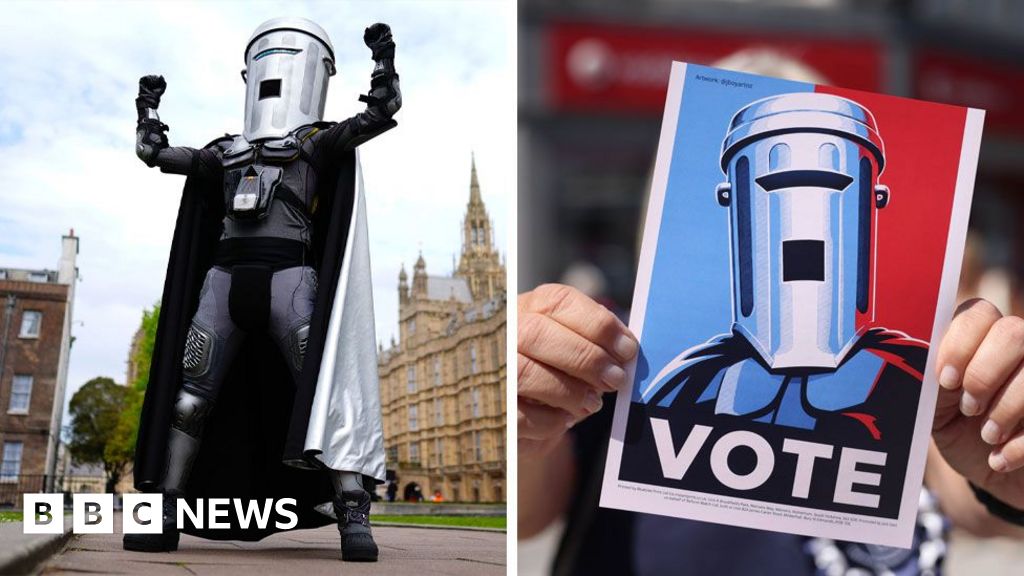
  • Really appreciate the pictures showing the evolution of the costume over the years. He's put some real solid work into it.

    Also, Monty Python's own take on the phenomenon, for those who haven't seen it: https://www.youtube.com/watch?v=dVI5ZOT5QEM

    by jerf
  • Never thought I’d see my home town being discussed here. I no longer live there but regularly go back.

    It’s not a great town but it’s also not truly awful. It’s a reasonably deprived town that harks back to its former grand past with an older demographic constantly topped up by people retiring there from east London.

    There’s a lot of very nice people who are mortified that Farage is the MP and that the town has become a political joke. I struggle to see how people can vote for Farage but if you walk around the town center (which is perfectly safe like all of the UK is regardless of what social media and US news outlets say) you can understand why people want some change.

    In reality there’s no well paid jobs and, with the aging demographic and no reason for anything to be based there, no reason for there to ever be any sadly.

    Also Farage is in the district a lot more than the media makes out, I hear enough second and third hand sightings of him that he must be there more than once a month.

  • Has he held a surgery, though?

    Photo ops are all vey well.

  • Far right is not a change toward more or better jobs. The economic or "just change" arguments are rationalizations, not explanations.
  • The interesting question is not how Farage could win. He chose that town for his high rate of supporters.

    The interesting question is: would a “real” candidate have beaten him?

  • Britain has a first-past-the-post election system so the candidate with the most votes wins in each constituency.

    As Farage didn’t get an absolute majority last time, and as a majority of voters didn’t even vote last time, I was extrapolating that Count Binface had a real chance. Not just as a protest vote, but a magnet for everyone not supporting Farage as well as everyone wanting a laugh (in a British boaty-mcboatface way).

    Perhaps a serious clean-up-politics neutral candidate would have done better, like Martin Bell - a very well known war correspondent - who stood on an anti corruption ticket against the scandal riddled Conservative Neil Hamilton in Tatton in 1997.

  • I think people voted Binface in protest but knowing that he would lose.

    Because what if he had won (apart from Farage's utter humiliation, of course)? Would he sit in Parliament in costume? Need to know when to stop so that the joke does not turn into a farce.

    Regarding first-past-the-post, the system plays heavily against Reform UK / Farage, actually. They currently have 5 MPs (well, 4...) with more votes nationally than the Lib Dems who have 71 MPs.