Join the discussion

Write your take first — we'll ask for email only when you're ready to publish.

  • Hacker News
  • > "it's difficult to research something if you don't know the name of it"

    > - Tom Scott, 8 years ago

    Ah, research in the pre-LLM era was quite different. You actually had to know which questions to ask.

    Going one level down further, it's really hard to imagine what it was like doing research into something you have zero clue about in the pre-Google era. I guess you just asked a librarian and hoped they'd point you roughly towards the right section and then just started to read random books?

  • In general, yes, you'd probably start at a library's reference desk. (which are still a thing!) Some serial publications have indices where you can find key words (and there are also similar indices published by subject area). If you're looking at academic works, most of them will have a bibliography for you to look through, and those works can have their own bibliographies. This includes subject specific encyclopaedias etc which are usually a good place to start.
  • With Tom Scott in particular, there’s a number of his videos that are kinda eerie to watch now with today’s LLM context

    eg. https://youtu.be/CcZdwX4noCE

  • Ah, research in the pre-LLM era was quite different. You actually had to know which questions to ask.

    You get a much better response if you ask the right questions in the right language though. Expertise still has value.

    I guess you just asked a librarian and hoped they'd point you roughly towards the right section and then just started to read random books?

    You looked it up in an encyclopedia first, which gave you the basics. That gave you enough to find it in a library using the Dewey Decimal code. From there you could generally trust the book because they tended to be trusted if they were in a library. For newer topics you swapped books for journals.

    Researching a niche topic as someone outside of the academic community with no journal access was basically impossible.

  • When I first joined the university I went to a guided tour of the library. The librarian said that this was the most important tour of my entire stay. She said that the key for finding knowledge was not about the answers but the questions.

    It's about finding the questions to ask. About learning to learn. The tour guided us through actually using the library and how to learn the library which is a way to find the questions first and then find the answers afterwards. The librarian then outlined their role in helping the student in how to learn, and how to use the various facilities too.

    Learning the question is something that is most fundamental to learning but is kind of overlooked.

    A good knowledge system should probe initial enquiries to identify what the users actual desires, gaps and questions are. No one wants a sycophantic doctor, they want one that can ask probing detailed questions to learn whats really going on.

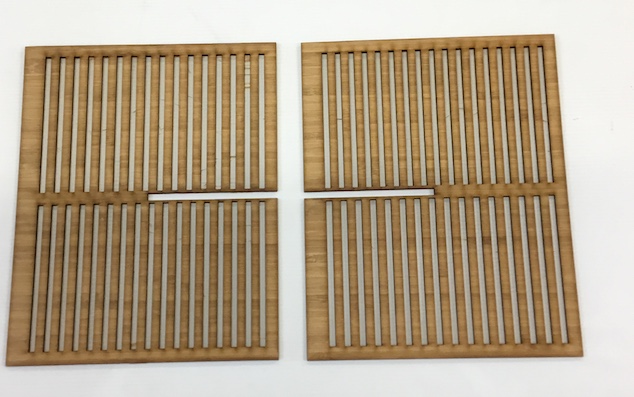
  • Moire patterns can also be used as a magnification device, similar to microscope. For example, when two screens having microscopic hexagonal holes are made to slids past each other as a slight angle, one can see large hexagons.
  • Love this. I often think of these applications when I see it in building windows where the screen and it's own reflection. I am tinkering virtually:

    https://www.ouruboroi.com/moire

    https://www.ouruboroi.com/moire2

    https://www.ouruboroi.com/moire3

  • > Typically a harbour doesn’t have one razor-thin path of traversable water. Instead there’s a clear pathway that you shouldn’t stray too far away from. The Moire system will give steering advice even if you’re in a safe area, but slightly off the main ‘beam’.

    You could fix this issue by just having a second lamp (or two grills in front of the same lamp). If the two arrows point in opposite directions, you're safe. If they point the same direction, you're not.

  • If you tune two strings together, listening for beats, you are also guided by a moiré pattern. The whistle you hear when tuning an old AM radio is also moiré beats caused by the overlap of the local oscillator frequency and the incoming carrier.

    Another example of moiré for accurate indication: optical flats:

    https://en.wikipedia.org/wiki/Optical_flat

    This application shows how an optical flat resting on a gauge block indicates a tilt: showing that the adjacent object being tested is taller or shorter than the block by a minute amount. https://commons.wikimedia.org/wiki/File:Optical_flats_in_use...

    Interference patterns are basically moiré. Anything using interference for fine calibration is using moiré.

  • > The whistle you hear when tuning an old AM radio is also moiré beats caused by the overlap of the local oscillator frequency and the incoming carrier.

    Also when you receive Morse code on a radio using a Beat Frequency Oscillator, which is tuned close to but a little off from the IF frequency.

    It's also how a Theremin works, using the capacitance between your hand and the pitch and volume antennas to pull the frequency of an oscillator. If you'd like to play with a Theremin I might be selling mine - I haven't touched it for months...

  • I don't think optical flats operate based on moiré gratings. The former is an interference/diffraction effect while the latter, is you underpinned earlier, is a sort of spatial heterodyning effect. For instance, you can generate moiré rulings (which effectively an optical illusion) with two angularly misaligned combs, but the comb spacing is order of magnitude larger than optical wavelengths, leading one to conclude it's not a wave interference phenomenon.
  • For anybody who wants to dig into the theory behind all this, these are examples of aliasing (the same word you see in "anti-aliasing" regarding fonts, computer graphics, etc.). I've been fascinated by moire patterns since I was a kid 45+ years ago. Here's one of my dabblings that required a bunch of browser-specific hacks to turn anti-aliasing off so the aliasing would show (if you change window size, you'll notice different effects after it redraws): http://www.nukacourt.com/moire.html
  • I've used an INOGON entering a marina in the UK, and it really did have a very narrow dredged channel, not a wider safe area.

    One problem with lights or marks is that they can be very hard to see. At night, there are lots of other lights to confuse things, and it can be easy to mistake on light for another.

  • This reminds me of pre-GPS systems like LORAN [0], where it also involves ship navigation by demarcating everything into patterned regions.

    [0] https://en.wikipedia.org/wiki/LORAN

  • The three-lamp triangle system is clever and reminds me of the Eye Reference Indicator in an aircraft cockpit. You adjust your seat so that the three balls are aligned in a specified way. [1]

    This is important in providing the correct visual reference out the window, as that in turn affects the pilot's perspective of other external cues.

    [1] https://safetyfirst.airbus.com/are-you-properly-seated/

  • So... seat position memory has been a thing in cars for many years now.

    Given the importance of eye position, the standardization of Airbus cockpits, the near-universal use of EFBs and Airbus's penchant for automating absolutely everything... I'm kind of surprised that a reference seat position for each pilot isn't measured when pilots go in for sim time, saved in each pilot's EFB and then automatically applied when they sit down.

    Airlines are always looking for ways to reduce ground time, and it seems like that would be an easy way to save a minute at every turn.

  • A relatively simple system of lights is used at Portsmouth Harbour to help the aircraft carriers navigate the narrow channel in and out of port.

    This looks to be similar to the 3-light system that the author talks about.

    https://insidedio.blog.gov.uk/2016/08/22/safe-approach-to-po...

        To provide navigational certainty the vessel’s navigator visually aligns one set of three up with the other (i.e. they act as a pair) and because each of the three lights is a different colour the navigator can be certain he’s lining up the correct lights.
  • It's really neat that the author took the time to fabricate their own light.

    I've been looking for something similar in concept for when I back into my garage from a side street with basically no driveway. It's a very narrow single-car garage. I can consistently back in well enough for myself, but if I'm not dead-on and I have passengers, passengers on one side of the car are going to have to squeeze to get out.

    Essentially it can be hard to tell if I'm perfectly parallel with the garage walls and whether I'm off center, or rather if I'm within tolerance to back in even if the angle isn't perfect.

    I've looked into building something like range lights [1], but I don't think the math scales down to short distances. Plus if I'm looking in the rearview mirror or my backup camera, neither of which are perfectly aligned with the direction of travel, that might mess with optical navigation aids.

    I might have to dig into this moire approach to see if it would be more feasible.

    Yes, obviously this is a minor inconvenience that I'm able to deal with on a regular basis, but it's fun to theorycraft.

    1: https://en.wikipedia.org/wiki/Leading_lights

  • Low-tech solution in my driveway: Put the car into the desired position, then hang up a couple of old tennis balls on strings to just touch it.
  • Could you maybe arrange some hints for yourself in the surrounding landscaping?

    I have done similar in the past with what I call "taking mental snapshots", but it's always easier if there are things you can change to simplify the process. i.e. make sure to align the side mirrors with the flower pots when I'm backed up enough to begin straightening out (direction of the misalignment tells which way to adjust).

    The extreme end of this would, of course, be putting lines down for the rear tires. I'm just curious if there's a better way using what you already have so it doesn't look dorky.

    Ultimately the only trick to backing up perfectly is the distance to each side being equal as you reverse in as straight of a line as you can, so I'm not sure it takes more than two surrounding reference points being compared to another two points on the car. Distance to each side is comparing the lower corners of the rear window to the lower corners of the garage opening. Flower pots or something else further away gives you better "angular resolution" when you're straightening up (no idea what else to call it).

  • You can probably get better angular resolution with lenticular sheets. You see one image if you're dead on, and the other images if you're off to the left or right.

    Some napkin math says a couple inches of precision should be achievable at reasonable distances?

  • Many runways have something called PAPI (precision approach path indicator) which does something similar. Basically you have four (or two sometimes for less precise version) lights which appear either red or white depending on whether you are high or low on the glidepath and you aim to get two reds and two whites - more whites means too high, more reds too low.

    I can see that this would be not very intuitive for left/right guidance but are similar systems used in ship navigation?

  • It is used and I guess it works largely the same way as in author’s first picture: you get arrows pointing towards where you should correct your course to. Tom Scott has made a video on those: https://wew.youtube.com/watch?v=d99_h30swtM
  • Yes - sector lights. When you are on a channel / in safe water they’re white, red in the port sector, or green when you are too far starboard. Some will combine this with an angle dependant flash to alert you how far into a port or starboard sector you may be.

    The other common mark you’ll see are leads which are two lights, one behind the other. The front is lower and the rear is higher. When they’re aligned you’re on the channel. These also have day shapes attached that provide an upwards and downwards facing triangle to align.

    by _kb