Join the discussion
Write your take first — we'll ask for email only when you're ready to publish.
- Hacker News
- Alcohol is a carcinogen, famous for causing various upper gastrointestinal cancers. It also isn't great for brain cells. Why are these reasons not enough to quit it?
If you want something to drink in the evenings, how about a cup of mild bancha green tea andor rooibos tea andor hibiscus tea? If you do, please get the loose leaf product only, never the bagged product, as the latter infuses microplastics.
by OutOfHere - I am a teetotaler with a vow to abstain for life. I never enjoyed getting drunk, but I did love the taste of various kinds of alcohol. I took the vow not for myself, but because I've endured friends, acquaintances, and strangers who were drunk, violent, unreasonable, and abusive, and that all needs to stop.
That being said, when I researched my family I found out about the Whisky Rebellion in post-Revolution Pennsylvania. And I learned some very interesting things about alcohol and distilling.
Alcohol production solves two very, very big problems for pragmatic farmers. If we look past the industrial-complex production of alcohol today, we can see that grain farmers sometimes ended up with surplus crops that couldn't be sold as grain. They also had massive volume that was difficult to both store and transport. When you have a distillery apparatus nearby, and you can send your crop surplus into this distillery, the problems of surplus, storage, and transportation are suddenly turned into liquid gold.
And these are the chief reasons that alcohol production has grown up alongside agriculture, and these are reasons why it isn't a simple thing to just tell everyone that "drinking is bad and everyone must quit". Because you're just giving a huge slap in the face to grain farmers (or potato farmers of Russia or whatever they may be contributing.)
That is why today, I have nothing against drinking in moderation and drinking for pleasure or enjoyment; it is a venerable part of any economy, and it is really something that needs to be cherished and preserved.
- Just for the 'sugar is much more addictive/obesity kills more' crowd, I am an ex-obese.
Stopping alcohol as a precursor to my diet, to limit hormonal imbalance and reduce hunger pain helped more than anything else (even stopping sugar, which I already tried. I did both during my constant, 3 year calorie deficit, but only restarted one habit). We don't fully understand alcohol long term effect on leptin and ghrelin sensitivity, but we do understand their short term effect on leptin and ghrelin production, and alcohol is ten times worse than sugar for food cravings and hormonal balance.
So please stop. You don't know shit, and stop using obesity to make cheap, dumb internet point that are ultimately false.
by orwin - I am inclined to take Nassim's position as true, since it agrees with my desired beliefs: that moderate drinking is quite harmless, or if there are harms, they are outweighed by the benefits.
Modern medicine often gives us access to amazing drugs which have, in small print, a long list of associated, known, proven harms to our organs and health. The logic, as I understand it, is that the benefits of the drugs outweigh the harms.
The logic is not "that these drugs are harmless and possess only benefits".
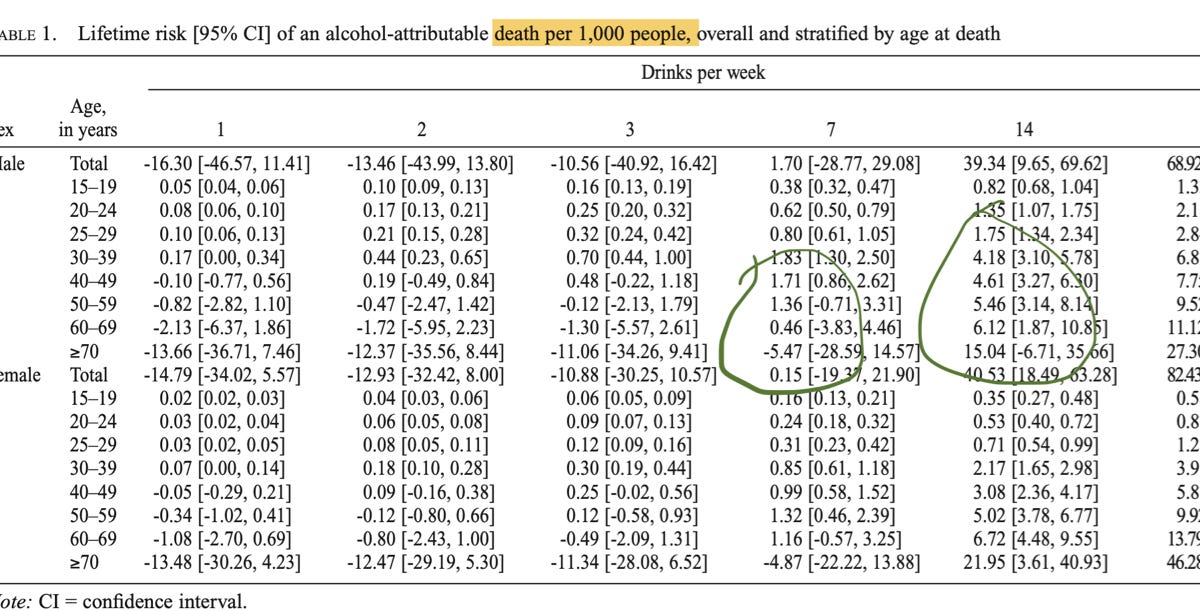
by newsomix9xl - If there's no explanation of why the 70+ bucket has so much larger CI band, having that dominate the totals seems like very fair critique. At the very least, they should have presented another totals with the outlier removed to show the impact.
- <drug> consumers every time: it's actually not bad in moderate consumption/I can quit any time/medication is always a question of dosage
Looks to me like even taking meds for a prolonged amount of time shows you that to any problem you try to fix with externally administered chemistry always has a downside to deal with, too.
Please stop trying to frame your drug habit as a good thing, be it caffeine, weed or worse things like alcohol and beyond. Another one of those things where your mental health depends on you not understanding the problems you cause yourself.
by rf15 - Setting aside my bias about whether my large glass of wine last night was one drink or two, I find the claims in this post odd. None of the issues noted seem inherently problematic, and indeed several are as I would expect. Disclaimer: not an epidemiologist, although I do fit models to data and have seen more than a few epidemiology talks.
1: Asymmetric CIs aren't mysterious. Any parameter fit to anything beyond the simplest model and data will have asymmetric CIs. We often neglect this and assume a symmetric (normal) approximation, but in complex data you really should calculate the proper CIs.
2: The data in the age groups wouldn't be expected to be either fully dependent or independent. Looking at the data and assumptions that goes in, some affects all age groups, some only one, and there's model effects between groups (if you die due to alcohol at 30, you can't also die due to alcohol at 50). The CI size lying somewhere between independent and fully correlated is exactly what you'd expect there.
3. The last complaint is a more fair, but also common: most people who die are old, and most causes of death go up when you get old, so CIs get big when you have to subtract large numbers. More data is always welcome there, but also famously hard to get.
So, none of these seem like show stoppers to me, and the way some of them are presented in the post ("mysterious asymmetric CIs") seems to speak to a motivation to knock this study down.
I agree the stats methods in the paper are a bit thin, but I'm not sure how much of that is standard practice in the field. But I think that's a case for asking more detail, rather than denying the results out of hand.
by sjmcmahon - Even the best people seem to go out of their way to rationalise (their own?) alcohol consumption. As a nowadays leading cause of cancer in many regions, and associated with dependency and other secondary negative outcomes, perhaps it is time to stop rationalising it?
And maybe also let off the rhetoric of "government sponsored" science, which is actually most science in many places. Written for views/clicks obviously. So tiering.
// Master of Science in Public Health
by nialse