Join the discussion
Write your take first — we'll ask for email only when you're ready to publish.
- Hacker News
- Amazing and super detailed.
Worth to read
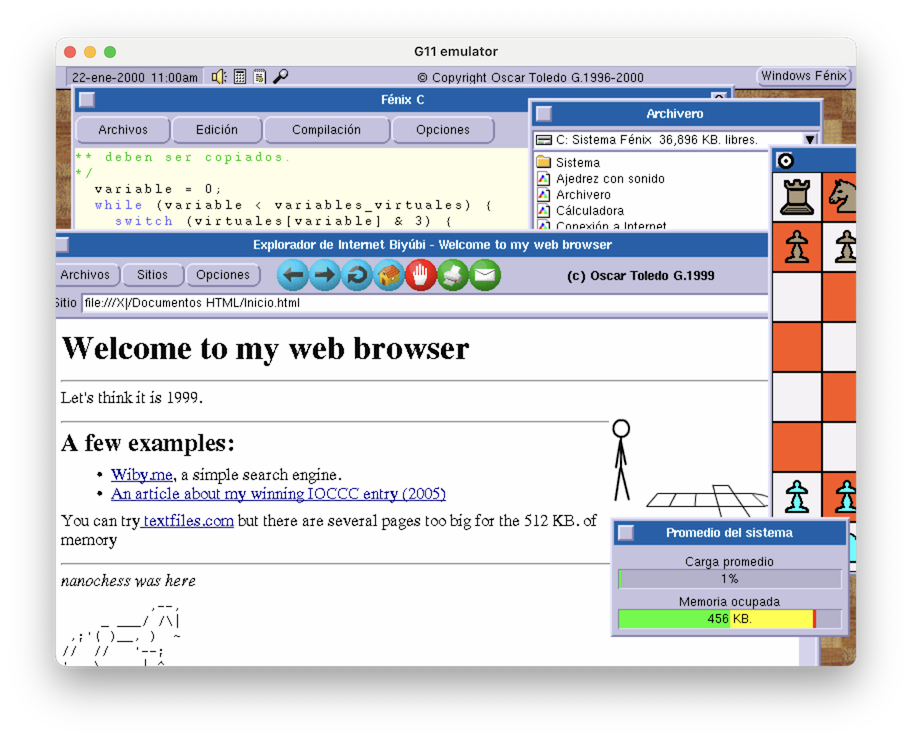
by iberator - Amazing, you can play chess on an emulated system built in the '90s from technological "mud and straw".
It's an amazing feat of teenage engineering.
I hope you have a job working with code somewhere!
Gracias!
by kreelman - >Ciega, sordomuda", "Amor de papel", “Laura no esta” and “Barbie girl”.
Oh poor soul...
https://github.com/nanochess/Am29000
This is cool, it's very Motif like.
by anthk - Oscar Toledo, you are simply insane (in a good day). I bow my head in respect at the completely pointless and insanely impressive result.by dmitrygr
- This part brought back memories from an even older time:
"Worst, it required two more programs: Flex and Bison."
In the early 80s I had the idea to port a C compiler to a new machine (I forget if this was K&R or pcc, but those were the only two C compilers you could get the source for at the time, legal issues aside...). At some point I had that same realization: uhh...this thing needs two other pretty big things: yacc and lex. The "first catch your fish" of compilers: "first port the parser-generators".
by dboreham - "Can't you just ship the generated .h/.c files with the source distribution?!"
"Those take less space than lex/yacc so of course not".
by Joker_vD - How closely related is this CPU to SPARC?
https://en.wikipedia.org/wiki/AMD_Am29000
"Based on the seminal Berkeley RISC, the 29k added a number of significant improvements... One design element used in some of the Berkeley RISC-derived designs is the concept of register windows, a technique used to speed up procedure calls significantly."
by chasil - They're from roughly the same era (and the same as 68020s/396s/88ks/mips) - 29ks came out of AMD and sadly didn't fly as high as we hoped at the time - their unique stack management may have been part of thatby Taniwha
- Well done. I agree with the credits to DJ Delorie (and to Stallman, for the original GCC!).
The code of the O.P. is actually not so bad for a teenager; however, the variables in Spanish do not help: "[isq]" and "[der]" probably stood for "isqierda" and "derecha", so the index of the left and right subtree of an expression.
Speaking of Transputers, Dr. Tim King, founder of Perihelion, was another big name of the Transputer times; he sadly passed away last month (he also wrote Tripos, which turned into AmigaDOS).
by jll29 - Fascinating. DJ Delorie rates a mention, I wonder how he's doing, I owe him a good chunk of my career.
This reads very much like the same journey I made recently when reviving my old OS, only Oscar went much further than I did and wrote a working browser as well, which - even though the browsers back then were much simpler - is extremely impressive. I still have a stack of disks from those days, I should probably find a way to read them to see what's on there.
edit: I sent DJ Delorie a short note, I should have done that years ago, without him I would have never managed.
by jacquesm - DJGPP was a revelation. Suddenly I had real build tools, for free, and I was linking to Glide libraries and thinking I was going to be the next John Carmack.by nsxwolf
- I remember being probably 13-14 in my bedroom late at night with nothing but the glow of a CRT while poking around with Allegro and DJGPP. I could boot into Mandrake Linux and compile the same code I wrote in Windows. It felt like anything was possible! It is one of those core memories that sticks with me.
I love the website still looks exactly like I remember it (even though I'm sure it isn't) https://www.delorie.com/djgpp/
by nazgulsenpai