Join the discussion

Write your take first — we'll ask for email only when you're ready to publish.

  • Hacker News
  • Why not just bypass the expert and just ask GPT to come to a determination? /s
  • If you let your legal process decide based on rhetoric, you'll have people use AI to generate rhetoric.
  • My father was an expert witness in construction defect and he told me about some of the times he was hired to produce a report about the causes of some defect or failure and that sometimes the entity that hired him was at fault. He usually wasn't retained for trial in those cases, but it earned him a reputation for honesty.

    Seeing these pay-for-opinion "experts" fills me with a deep disgust.

  • Obligatory link: the whispering earring https://gwern.net/doc/fiction/science-fiction/2012-10-03-yva...

    (I couldn’t remember the title or the author. So I asked claude for it of course)

  • It’s a fun idea, I do wonder why the artifact is locked away at the end of the story - what harm could come from it?

    Then again, I don’t think I’ve ever really needed help being happy - I’d be curious to hear its suggestions, but I’m not sure what it could tell me that I didn’t already know - and further, there would likely be plenty of times where it would make more sense to do the thing that doesnt bring me the most happiness. “Flex your arm by 35%” just doesn’t sound like a plausibly compelling suggestion, and “the ring is never wrong” is really only useful if my sole goal is to maximize my own happiness.

  • I hate the expert for not cleaning up the url before sending it over
  • Interesting that he pointed it to the CSB video - those are great explanations for us laymen, but I assume the LLM would prefer a written report.

    Luckily it's still up https://youtube.com/watch?v=CFVUSDzHL8A

    I was worried the videos would already be disappearing given Trump's attempts to shut it down https://www.chemicalprocessing.com/safety-security/risk-asse...

  • We're in the meat proxy era, unplug your brain and feed the machines!

    I personally know people who ask chatgpt what to eat, to which bar to go, to plan their vacations, it's insanity.

  • This is also another obvious example of misalignment on the part of ChatGPT. If the thing had any semblance of an actual system of ethics, or emulation thereof, it would refuse requests to try to make facts fit a predetermined conclusion. In a legal case, no less!
  • The article is pay walled.. Does it explain why the expert witness shared screenshots of these prompts? Voluntarily or required to?
    by fblp
  • https://archive.is/zKgVp

    Many paywalls are fairly "soft", and can be got around by visiting an archived version of the page you're interested in, at https://archive.is.

  • https://archive.is/zKgVp

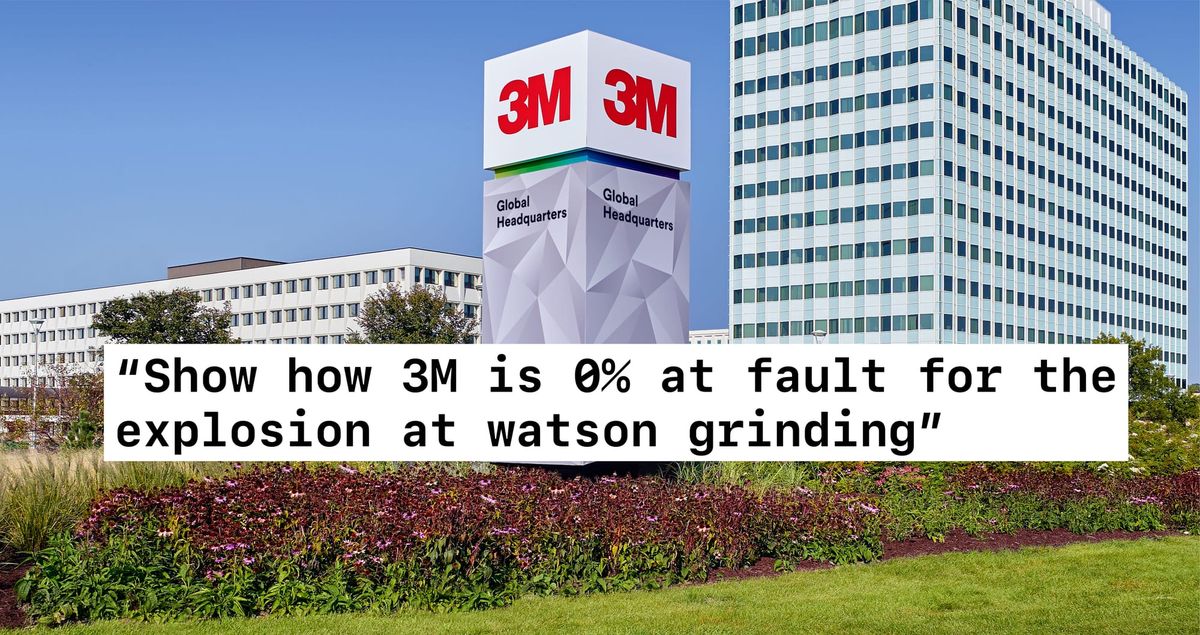
    > During discovery in the case, Will Moye, one of the plaintiffs’ attorneys, found a five-page document called “Citation Overlay,” which appeared to have been generated by AI. Moye recognized the Citation Overlay document as being from ChatGPT, and demanded all of the prompts Autenrieth used from 3M’s lawyers. The deposition was paused for three hours while they were gathered, and Moye was given 350 pages of ChatGPT conversations that Autenrieth had when creating the report.

  • from the point of view of the judge and society, i guess, what matters, ultimately, is whether the arguments presented for a case hold, not where did they come from -- so it shouldn't matter if ChatGPT was the one that came up with the argument if the argument is good. though one could point out that if one particular method of generating arguments tends to generate arguments that take time to analyse but are often enough pointless, we'd save time by not using them.

    so assuming that the report will be analysed on its own merits, really, it was 3M who got scammed here, because they paid $475/hr for a guy that was just prompting ChatGPT. i mean, i don't know much about the subject, but that screenshot of the gas detector with the "what am i looking at here"... wow, it looks like i already know enough to be an expert witness. no wonder these people are so drawn to stuff like positive affirmations, when they do make it by faking it.

  • How it is made should be irrelevant in the process. There is no way to stop people using LLM’s or other tools to create products like this report.

    It should be globally a standard check to verify incoming documents and to determine their validity.

    The interesting part on this case is that we see the real human aspect of it. Just asking for a report only finding the positive facts instead of doing real research.

    That is an ethics question. When behaving like this (and it happened before LLM’s) it should be seen as an ethics violation. If not done there is no value in those legal procedures anymore.

    The facts people have to accept is that the only place to check this is the deliverable. They are lucky now to have found the source, the prompts and the background but so many reports are entered without being so obvious.

    It’s a terribly huge and complicated task.

  • The biggest problem is not really that chatgpt was used but more than the conclusion is decided first and chatgpt is used to find the arguments to support it.

    Normal, an expert should look at the facts and elements provided without a predecided result and forge his conviction based on the elements.

    Obviously experts might be biased, especially when paid by the company, but it should still be in the understanding and evaluation of documents. Otherwise they are not an expert. They are not "lawyers" with the task to find incriminating or exonerating arguments.

    Their testimony should start with something like "in my honest opinion". That is obviously not compatible with taking chatgpt to generate your testimony by asking to prepare arguments that support your customer.

  • > How it is made should be irrelevant in the process.

    Is that true? Almost all answers have value based on how they were reached, especially when (like this case) there's no trivial and objective verification step.

    For example, suppose you live next to a volcano, and I sell you some software that predicts when it will erupt. One day you dig into it and realize I just hard-coded "not today" [0] which is 99.999% accurate.

    I think you would be quite angry, and justifiably so... But why would that be if "not today" was correct, and "how it's made is irrelevant to the process?"

    Tying it back to the court case, we expect professional witnesses to look at the details and then reach a conclusion, and to reach out based their own professional expert knowledge of cause and effect... Not to pick a conclusion and try to make the details fit, nor to offload executive function to an LLM. Even if they render the same boolean verdict, we care about what process was taken.

    [0] https://xkcd.com/221/

  • You're at work. You need to produce an artefact – a project proposal, say. 100-odd lines of Gantt, costs, that your BD team will send to the client.

    You get Copilot to do this for you.

    Later at the review meeting, errors are found. A bunch of stuff was missed, the costs were off.

    Whose fault is it? Who looks stupid? If it's bad enough, who gets fired?

  • > How it is made should be irrelevant in the process.

    No? If you are employed (or requested in this case I guess) to offer your expert opinion, the expert they want to hear from is you, not someone else you farm your work out to - whether that’s an LLM or another person