Join the discussion
Write your take first — we'll ask for email only when you're ready to publish.
- Hacker News
- Recently, I had bizarre situation: I wanted to play a game from my childhood on Windows 11, but, without changing two booleans in the settings, I could not reliably move my in-game cursor. The catch is that to change those values in the settings, I needed to move my in-game cursor. So I was stuck.
After digging around, I found a file that looked like it could be the settings file, but it was not plaintext.
Naturally, I told Claude all the options I knew existed in the settings and told it what I needed it to change.
After about 10 minutes poking around my system and the file, it correctly identified the bits (not bytes!) that corresponded to the two settings, and flipped them on. It. Just. Worked!
(Well, then I found out I actually needed to do quite a lot more than flipping those bits, but I still found it worth sharing).
I have many more experiences similar to these. LLMs are an amazing superpower.
by jorl17 - by JKCalhoun
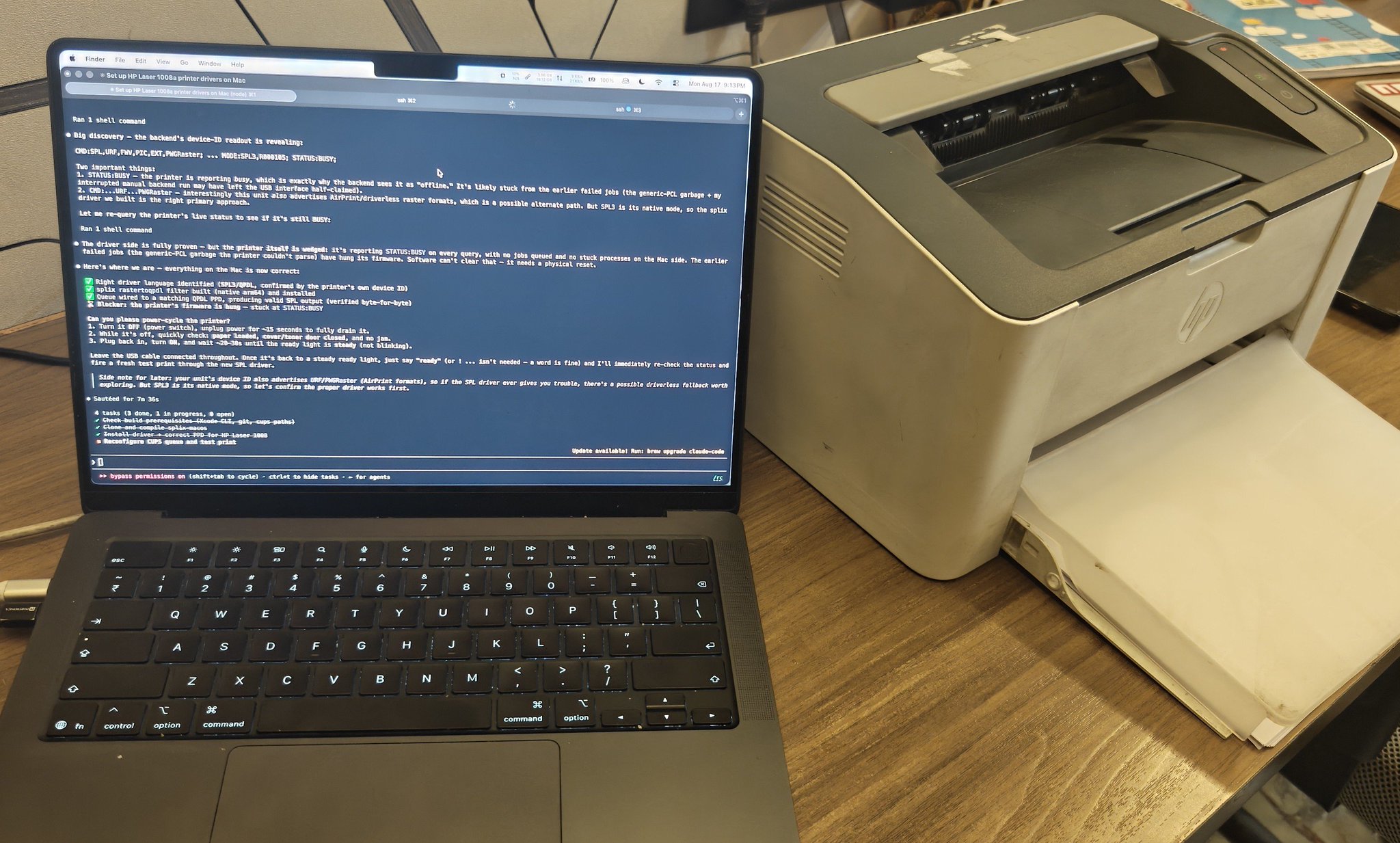
- So the critique from the other story holds true - it really is just running the Linux driver inside docker, and (perhaps) dressing it up as something more - though I note the claim on this page is walked back from the original 'writing the driver'. On the other hand, it really did get him printing from his Mac, so in this new LLM results based world we live in it did its job admirably.by feintruled
- Somehow, I'm not exactly sure why, I got creeped out by Claude's finishing line:
> Thanks for being such a game debugging partner through all the test pages. Enjoy printing, you and the family.
Maybe it's because my own LLM usage is very "Question > Answer" or "Do this > Agent does that" and I never say "Wow, that's crazy it works, thank you!" at the end or such, so I don't see that sort of things, but if I saw that regularly I'd turn me off so badly from using LLMs. I'm not exactly sure where this feeling is coming from though, it's relatively innocent but just feels so inauthentic, I'm guessing because it's simply a machine.
- Wouldn't it have made more sense for Claude to suggest using the existing Linux-Airprint-VM project/product that already does this exact thing?
There's even a zero-install method via https://printervention.app where it runs that Linux VM isolated inside a WebUSB-capable browser. That website itself was posted right here on HN not too long ago.
I get that the LLM code assistant software prefers writing stuff, but constantly re-writing the same solution seems a bit inefficient.
by oneplane - On a similar experience, I use moonlight on my Android TV to stream video games from my computer in another room. I use my own fork from an unmerged PR which enables me to use an Xbox One Wireless adapter so I can play with my pad wirelessly. These pads have a 3.5mm jack on them which on Windows and Linux enables me to route audio from the game to headphones connected to the pad. Moonlight and the xow driver it bundled, was nowhere near being able to provide this as a feature.
After about 5 hours, feeding it the GIP spec, an export of sniffed usb traffic from Windows, prior art (xone driver for linux), and giving Claude connectivity to my Shield via adb, I had it working. This continuously blows my mind that I dont have to beg a developer on Github to do it for me.
Claude could do it for me for $20.
by nullify88 - Unfortunately this is a very misleading article and headline. I don't doubt the end result - it's useful that it works, but it's not "natively" and, unlike what some people assume, Claude didn't write a driver. It basically used HP's existing proprietary driver in a Linux VM on macOS, and just bridged that to macOS.
It also requires a root launcher that runs code from the user ~/.hp1008 dir, so security is weakened.
by Tiberium - I was able to (through heavy Claude use) successfully reverse engineer a golf cart motor controller that is programmable over USB, but only was supported by a Windows application. Claude walked me through using ILSpy on the .NET assembly, using Wireshark to capture the protocol over USB, and to completely map out all of the functionality in the Windows application. The output was a portable C library and CLI program which, so far, has worked well.
I consider myself kind of an AI detractor but even I'll admit that the tool allowed me to do something it would have taken weeks-to-months to learn to do the hard way.
by ryandrake