Join the discussion

Write your take first — we'll ask for email only when you're ready to publish.

  • Hacker News
  • I use air purifiers mounted on my windows, running continuously except in the deep summer and deep winter. This makes my air contain 50-100x fewer particulates than the outdoor air. In contrast, the best I can achieve with floor air purifiers as people have them is a 5-10x reduction. The window purifiers also keep excess CO2 and VOCs out.
  • You have activated carbon to filter out the VOCs?
  • Health improvements are not measurable any more if you go below 5 mcg/m2 average level of PM2.5 particulates. For 50x reduction to be beneficial, you need to live in an area where the pollution is 250 mcg/m2, which is an extreme level found only in a few unfortunate places on Earth. 5-10x reduction is reasonable almost everywhere.
  • > The window purifiers also keep excess CO2 and VOCs out.

    I assume you mean that the increased air-exchange (purified or not) helps CO2 that originates inside the house to leave promptly? (Equalizing it with the outdoors.)

    Literally "keeping CO2 out" is a much trickier and more-expensive proposition.

  • My anecdata: I have a Japanese friend who was born in 1964. She grew up in Yokohama for the first ten years. Japan didn't pass its first (serious) environmental protection law until 1967. She said many, many of her friends had asthma. Fast forward 50 years, very few children have asthma in Yokohama.

    I will never forget watching this documentary about a Canadian man, Doug Rogers, who went to Japan in 1964 to train martial arts at a dojo. This YouTube video[1], watch it from 1:00 to 1:10. The air pollution is simply stunning. It shows you just how terrible the air pollution was in Tokyo in 1964. Today, it is night and day. The same is true for most large cities in highly industrialised nations.

    [1] https://www.youtube.com/watch?v=CBFx1a4L2ig

  • completely anecdotal. my earliest childhood memories in india were of asthma, sinusitis and constant cold. this was consistent until i was 26 and since then I've moved to the US and lived in New York with 0 days of sinusitis or breathing trouble. and i fallback to trouble breathing when i go home again.

    even New York is so much more better than Bangalore or my small village in the middle of coffee farms

  • Yes, pollution has both acute and chronic effects. What you describe here is an acute effect.
  • During my childhood, I lived across the street from a brewery. I suffered from chronic sinusitis for years, and no one understood the cause. When I moved to a different part of town, the problem immediately stopped. The same thing happened to one of my classmates who lived in the apartments next to me.
  • I just made a comment about having good air quality but with summer fires we were getting smoke for weeks at a time so I got an air purifier. My kid wasn't struggling horribly but I did notice right away after putting one in his room that he slept better and his breathing seemed so much more relaxed at night and it just felt like it made a noticeable improvement to me.
    by 14
  • Bangalore has historically (over decades) been known to have a high incidence of asthma due to the high pollen in the air. It's been made worse in recent years due to pollution. The pollen is present for a significant portion of the year while other pollen regions in the world tend to have it for a smaller duration.
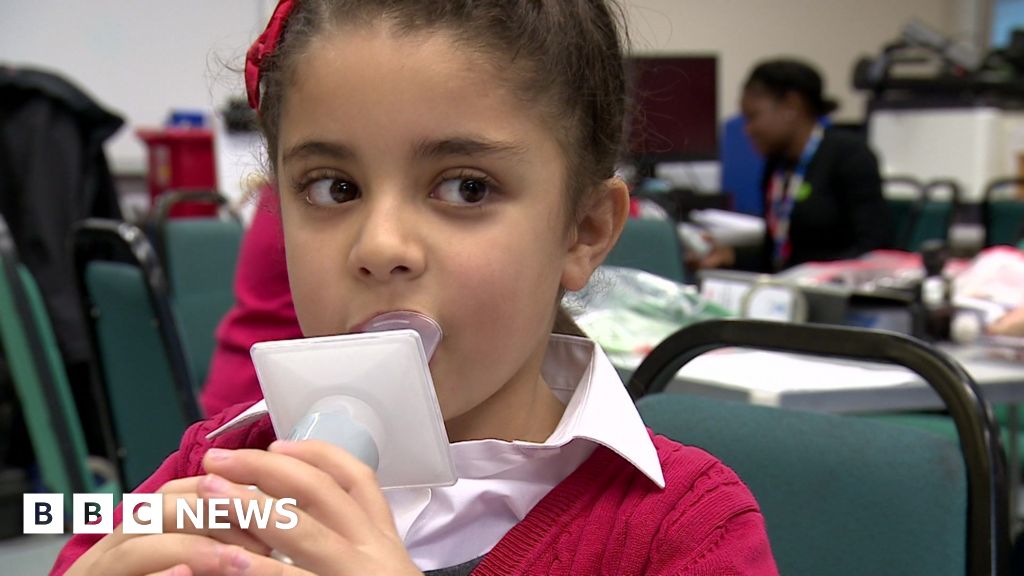
  • Link to the original study below, free to access [0]. The key data appear to be this:

    >At baseline, 184 (14%) of 1280 children with successful FEV1 measurement in London had a clinically low FEV1 (pre-bronchodilator FEV1 <80% of predicted value) compared with 126 (9%) of 1339 children in Luton (appendix p 8). At the end of the study, these values had dropped to 51 (9%) of 585 children in London and 41 (7%) of 606 children in Luton (appendix p 8).

    So the proportion of children with low lung function dropped from 14% to 9% in London, and from 9% to 7% at the comparator site in Luton. It's not that much different, though any improvement is obviously welcome.

    https://www.thelancet.com/journals/lanpub/article/PIIS2468-2...

    by pcrh
  • I'm not really sure the thing they were trying to measure was measurable with the study design and level of funding they had. To be fair, the paper is fairly clear on the limitations and much better than the press release.

    The study is supposed to measure how clearing up pollution in London improved children's lung function. The decrease in London was meaningful — NO2 fell about 22%. But particulates fell faster in Luton and NO2 in London is still roughly double Luton's. The gap is larger than the decrease.

    By 2022 both cohorts get the same results on blow tests. But how does this happen if we believe that the study's dose-response model is true?

    Put another way, if the change in London NO2 is so crucial, how come it doesn't matter that the absolute value is still double Luton's?

  • There is a chap in London who does some great work with researching and spreading awareness of air pollution:

    https://clara.southlondonscientific.com/

    He also runs this repo:

    https://github.com/southlondonscientific/aeolus

  • I've needed my inhaler way less since the ULEZ came in.

    Visiting London used to mean blowing your nose to black snot for a week afterwards, these days living in London it's pretty good.

  • People don't fire their chimneys or have garden bonfires much any more, either.
  • Pretty sure that's due to the tube.
  • More anecdata: I've been using my inhaler more since moving to a city with worse air quality than my previous location.
  • Anecdotal, but similar situation here for me (I don't need an inhaler, but visiting London around 2015 meant blowing my nose to black snot for a week, and then back in 2024 it was completely fine)!
  • I've not lived in London for more than a decade. I always thought the black snot was from the Tube. Is it not?
  • ULEZ massively reduced the amount of NO2, which is a trigger for asthma. It also seems to have reduced the hospital admissions for heart related emergencies.

    Sources:

    https://www.bbc.com/news/articles/c75q9d2pqyeo https://www.theguardian.com/environment/2026/jun/12/emergenc...

  • Using scientists being "stunned" should take the same amount of relevance as someone being "slammed" in article titles.
  • I'd like to imagine the stunned scientist is a scientist from another field, they show some medical findings to a guy who looks at snail butts all day and he's the one "stunned" by the findings
  • I'm obviously supportive of less pollution etc etc but looking at the actual graph results I wouldn't describe them as 'stunning', the needle barely moved. But of course, they have to have something to make headlines after spending so many million on the study and who knows how many billion on ulez. I'm not one of these anti ulez people I think it's good. But you can imagine the pressure to spin tepid results into headlines.
  • Sounds like an announcement of the latest AI news from Wes Roth. I'm surprised the Professor wasn't "shocked"
  • To be fair, BBC is aimed at the normies, not the scientifically literate. (No hate on BBC!) Stunned probably gets more clicks than surprised.
  • Smokers don't magically undo the damage they did to their lungs after they stop smoking. Stunned might be hyperbole, but it is at least a little bit surprising.
  • Yes, and I really don't care if they've got a direct quote from a scientist. Far too likely that word was coaxed out of the scientist by a reporter or PR hack. Or he thought he needed to use that word to get enough attention to keep his research funding. Or he was a relatively closed-minded scientist.

    HN needs a 's/^scientists stunned by/Scientists notice/i' filter for Titles.

  • Scientists are only allowed to be stunned when results exceed 5 sigma of deviation
  • It's a direct quote from one of the scientists:

    '"I was absolutely stunned when I first saw the results," Prof Chris Griffiths, a senior author on the study, at Queen Mary University of London, told the BBC."'

  • > strongest evidence yet that local clean air zones could help reduce some of the harm caused by pollution during childhood.

    It's incredible this is even in debate. It's one of those intuitive things well known since the reduction of coal burning and smog during the industrial revolution in London?