Join the discussion
Write your take first — we'll ask for email only when you're ready to publish.
- Hacker News
- Back in the day I supported Aldus Persuasion which was a competitor to Microsoft PowerPoint along with Harvard Graphics. The industry was moving from having service bureaus rasterize slides onto film slides to using computer screens.
When Microsoft started bundling Word, Excel and PowerPoint on the Mac platform where we dominated we realized we couldn't compete against a product that was basically being given away for free. The experience with slide and text animation lead to the purchase of Cosa After Effects which is still around and took full advantage of animating Photoshop and Illustrator files after the Adobe merger.
by sinoue - A lot of of the library-as-a-service startups doing excel/PowerPoint/PDF editing libs are gonna die with how ubiquitous and powerful modern LLMs are. I expect a lot of such companies to write sob blog posts similar to what the tailwind founder did about having to lay off most of their team and reinvent themselves for the agentic era. It's a sad time to be a dev right now.by Onavo
- Don’t know if anyone else here has mentioned it, but there is a JavaScript object model that you can call against https://learn.microsoft.com/en-us/office/dev/add-ins/powerpo... And a reference for that https://learn.microsoft.com/en-us/javascript/api/powerpoint?... I was involved in a project where we were trying to use all of this to build PowerPoints and Word documents programmatically and in the end we moved to a simpler approach (this was before LLM times). But knowing how the PPTX is constructed is a useful starting point for anyone.by grumblepeet
- I had to build a diffing engine for PowerPoint files in my first start-up. I initially tried to do this at the OOXML level, and one the weirdest things I found about the format is that the GUIDs are mutated by PowerPoint even if there have been no changes. The serialized OOXML is not really canonical and constantly changes as clients open and save it.
The simplest solution ended up being rendering images of the slides (not easy) and doing it with a slider.
by pea - The complication of PPT led me, with the assistance of LLMs, to design a simple but powerful enough alternative editor of slides based on a markdown format that uses reveal.js as presentation engine https://github.com/juanjosegarciaripoll/quarkfoil
Good enough for my work as scientist and also as science communicator. Some slide decks from a recent course can be seen here https://juanjose.garciaripoll.com/cern-lectures/
The markdown format is very useful because I can edit the human readable content easily enough and it is easy to get assistance from the LLM in tasks such as designing diagrams, finding typos, completing bibliography, adding paper crops, etc.
by postdoc74 - I’ve done a lot of work with the Office file formats over the years, flipping to .zip and messing with the format manually. Lately, because I’ve made courses with 500+ PowerPoint slides with lots of morph transitions, I iterated to find an approach that generally worked with Claude but is never perfect (using the Claude for PowerPoint plugin).
I switched to https://bento.page/ when it showed up here on HN and that’s been much more accurate I think because HTML and CSS is even more represented in training data.
by TonyAlicea10 - OOXML is incredibly complicated, but LLMs can write it well enough. One of my colleagues was using an LLM to generate PNG slides for a presentation. They looked pretty, but changing anything was a pain. I fed the images to free ChatGPT and asked for a PPTX with every text box, frame and image split into its own object, and it spat out a real, editable presentation.by orthoxerox
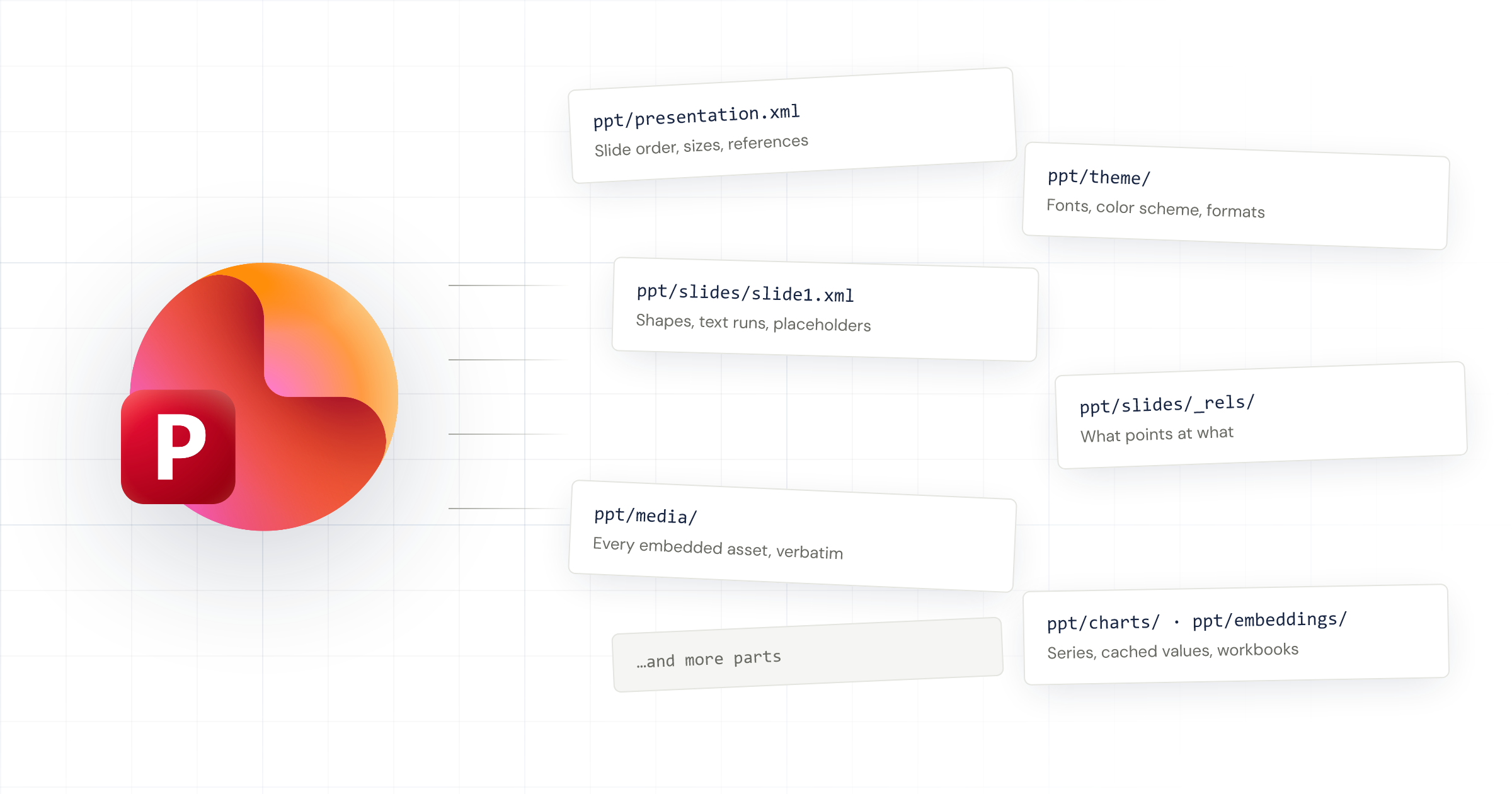
- > A PowerPoint file is a ZIP package containing XML files and binary assets.
> It stores all the properties you set in a PowerPoint presentation, and tries to organize them into separate files to avoid repetition and make things easier to locate.
Very informative read overall.
by aghuang