Join the discussion

Write your take first — we'll ask for email only when you're ready to publish.

  • Hacker News
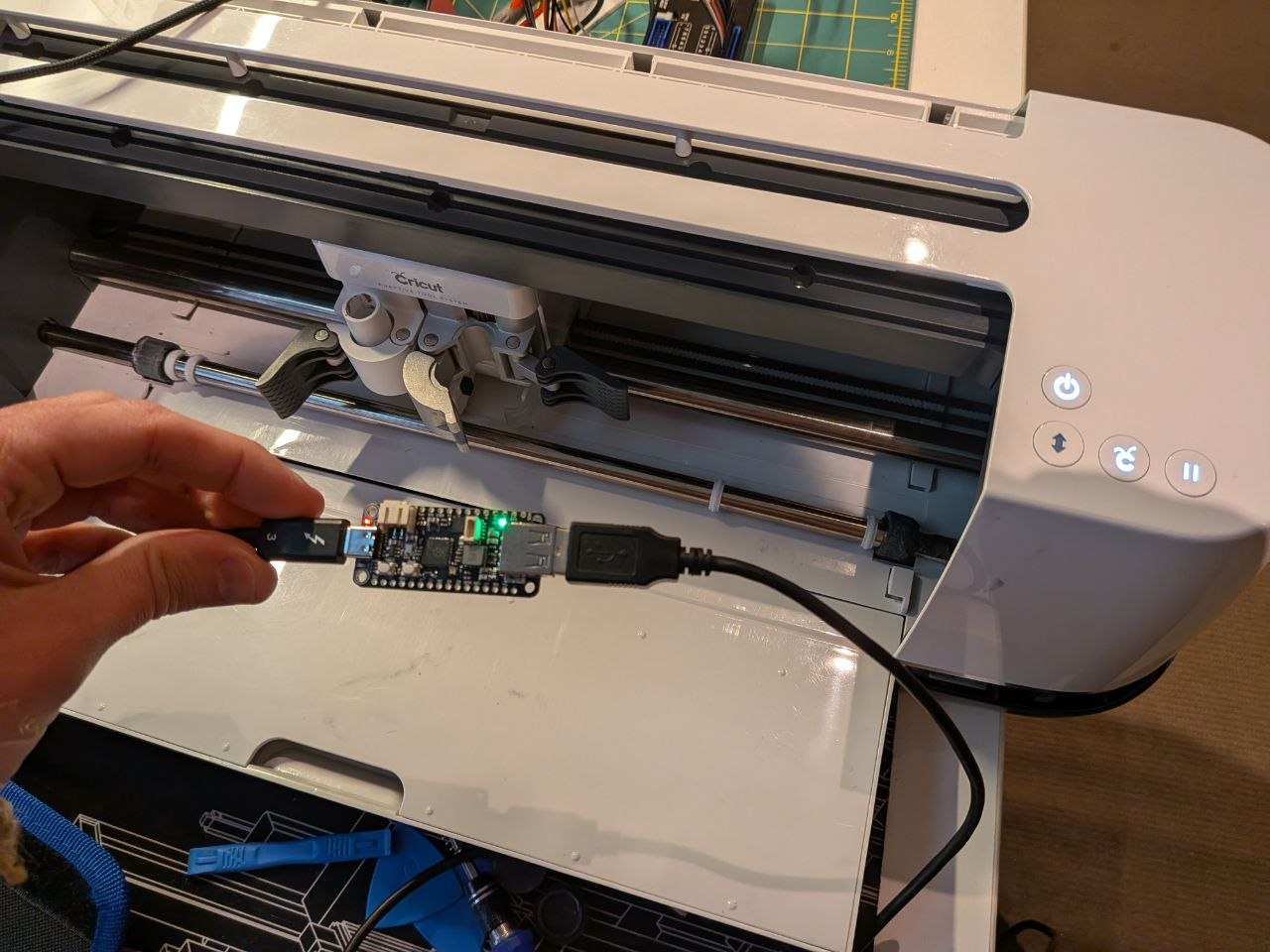
  • No checksumming on the serial number packet makes this kind of proxy trivial. Using an RP2040 as a USB man-in-the-middle is a clever and cheap fix.
  • https://en.wikipedia.org/wiki/Cricut#Controversies

    Also, it's a very fun article to read.

  • I am very surprised that the ceo backpaddled on the limit of cloud usage that was going to force users into subscription...
  • “Provo Craft contended that in order to understand and replicate this obscured protocol, Craft Edge had disassembled the DesignStudio program, contrary to the terms of its end-user license agreement, thereby (the company asserted) breaching copyright law.”

    I wonder if the wireshark USB intercepts discussed in this thread would classify as ‘disassembly’?

  • Just a PSA to anybody considering buying a new cricut:

    They are cool machines mechanically, but the software is an absolute nightmare, DO NOT BUY.

    Source: i bought one. Regret sunk in the moment i tried to do anything even slightly interesting. This isn’t a bambulabs situation where it’s mostly a philosophical objection to a closed ecosystem. It’s bad software that makes it hard or impossible to use the machine except in a very narrow set of ways.

    I’ve not firsthand used any of the competing machines (silhoutte, et al) but i hear they are a bit better - and i don’t know how they could be worse.

  • The last time I checked, bambu was clawing back functionality from purchased devices, with things like timebomb lockouts and blacklisting TPU.

    Sure, it's a matter of degree, but I'm perfectly happy with my Elegoo. If you live in California, I suggest buying one before Sacramento's open firmware ban goes into effect.

  • It's a vinyl cutter. I've used those. TechShop used to have them. Theirs seem to be repurposed large-format HP plotter designs.

    Vinyl cutters are good at doing one thing - cutting out patterns in vinyl or similar materials. You can make signs, stickers, and similar stuff. Some also be used as plotters. They're rather limited devices, though. At TechShop, they were not used much.

  • silhouette has a much better open source reputation if you want this type of machine. Everybody in the crafting world seems to have the circut though, and you can buy their machines (parts, supplies) all over, while I've never seen silhouette in a local store.
  • Could you just hook new motor controllers to the motors / puncher and add an Arduino to control it?
  • Siser machines are as consumer as you can get but still get control over them. They are more like the commercial grade ones. I have a Juliet and love it.
  • Maybe it's just me and I haven't used it much, but my fairly non-technical wife has a Cricut and the few times I've wanted to use it I had absolutely no problem creating a vector in whatever program (Illustrator or Affinity Designer, IIRC) and getting it to separate the color layers and cut at the desired size.

    The Electron app felt a bit weird, but I was able to accomplish the goal of cutting out my design at a desired size, so I didn't think any more about it. <shrug>

    It seemed more to me that their app leans hard into getting people to buy vector designs through them, and making it easy for those who might not even understand what a "vector" graphic is, but it didn't seem to preclude me from cutting out my own stuff.

  • I see so many of these at resale stores for next to nothing. What a shame.
  • He got it working, so there’s hope.
  • If anyone has an old Silhouette vinyl cutter sitting around gathering dust, there's an actively maintained open source Inkscape plugin that lets you "print" your design straight to the cutter: https://github.com/fablabnbg/inkscape-silhouette

    I wrote about it a couple years ago: https://blog.bityard.net/articles/2022/June/diy-vinyl-cut-mo...

  • Nice write-up! I was also a Suzuki fan (1980s) and always liked the stylized S logo. Now to go find a vinyl cutter.....
  • Thanks. I DO have an old Silhouette vinyl cutter sitting around... gathering dust! I picked it up at a thrift store many years ago and just waiting for you comment I guess!
  • I have a silhouette cameo pro 4 (and love it), and have been wondering around similar things. The Cameo can only be controlled via the provided software, or a couple proprietary plugins for popular design software.

    The provided software is clunky, and the plugins suck. I’ve been building an app for designing stickers, and what I really want is to either be able to drive the Cameo from the app directly, or output a design file in a format that can be loaded straight into the software to start cutting.

    The thing I’m stuck on is… how do people reverse engineer these devices protocols, without fear of bricking the device? My understanding is that reverse engineering like this is a lot of “try shit and see if it works”. It seems to me that a few wrong commands could get the cameo in some irrecoverable state. Obviously that’s not a risk I’m willing to take on a machine I use very regularly.

  • I always used to export from inkscape to the silhouette software.
  • I mostly deal with the possibility of bricking a device by not caring too much :) That said, I usually start by reverse-engineering the software at one of the ends, so I don't blindly "fuzz" the device. There's still some risk, but not that much.
  • Cameo -> inkscape plugin => https://github.com/fablabnbg/inkscape-silhouette

    """Run sendto_silhouette.py --help for information on CLI usage."""

    I've used it before (from the inkscape-plugin gui, not tried the CLI version). Typical open-source "slighly janky" (at least ~5 years ago...), but very serviceable and convenient to work with, hopefully only getting better over time!

  • You disassemble and analyze any software you have access to, and then you put Wireshark in between the software and the device. You watch the bytes being sent to the device and trace their path backwards through the software. Eventually patterns become visible and you can start making guesses about how things work.
  • I don't have a Cameo Pro 4 to test, but I have reverse engineered software to control some of their other devices. It's a little janky but if you want to help I'd appreciate it!

    https://robocut.org/

    I believe there is (or once was) also an Inkscape plugin somewhere but I never tried it.

    As for how I reverse engineered it, I just used a USB sniffer and wireshark. I don't think there's a big risk of bricking these devices - I don't think they even have non-volatile storage, so worst case you turn it off and on again.

    I would like to reverse engineer my solar power inverter too, but that is definitely brickable (the first one they shipped me came pre-bricked!) and is a lot more expensive so I've had to resist. :/

  • I was hoping this would be a hack that repurposed the unit to work standalone.

    Getting the unit to work again in the Cricut "ecosystem" just means Cricut can disable it later when they catch on.

    Companies that "lock" or otherwise brick viable hardware as part of the business model (I'm thinking about Sonos here, too) are really terrible. People shouldn't be rewarding them by buying their garbage to begin with.

  • >are really terrible.

    They are not as terrible as people who commit fraud by lying about throwing away the "bad" unit and selling it, nor are they as bad as people stealing them and then also reselling them.

  • I’d expect a certain YouTuber to pick it up in due course
  • I'm just imagining the amount of damage some determined people can do to the Cricut ecosystem because the serial numbers are guessable...