Join the discussion

Write your take first — we'll ask for email only when you're ready to publish.

  • Hacker News
  • Thank you for doing this. So cool. Its a form of time travel, getting to live the past.
  • Also, Tristam Island for the Z-Machine:

    https://github.com/hlabrand/tristam-island

    You can just transcript the feeliest to plain text. If you have an Inform6 compiler nearby, just compile the game with the 'big' flags to get the "complete" Z3 version. It has the same text as the v5 one, and it will run much faster under a 8088/8086.

    For a Zorkian adventure, just get Spiritwrak.

  • A gopher client would be easier and no AI needed as the protocol it's trivial to parse. You have sites from gopher://magical.fish to gopher://floodgap.org and gopher://sdf.org (and, as a plus, you can read finger services).
  • Any working gopher to www proxy?

    Using gopher client to load http data.

  • It seems Like projects like this (that include basic productivity tools) could potentially enable a small resurgence in sovereign computing. A 5 dollar esp32 is powerfulll enough to emulate 8086 architecture while running a tcp/ip stack, DVP display, and usb input peripherals.

    With a simple OS like CP/M or others, a low cost computer you can actually trust to only run trusted code is possible again.

  • Default esp32 still comes with built-in binary blobs for the radio though iirc
  • My take is that "sovereign computing" will go from something 0.001% of the population cares about to over 1% in the coming three decades, i.e. three orders of magnitude. It will depend on how long we continue in the current survtech course. There is also the question of if we will see mandatory backdoors in hardware. For example, Country X could legislate that all CPUs sold in their territory need to have a latent command-and-control area for law enforcement to use. If that happens, I'll start converting my savings into a physical stash of old reliable CPUs.

    In any case, it seems that CPUs have a very long shelf life; it's still possible to buy 8086 processors[^1].

    [^1]: https://www.digikey.com/en/products/detail/rochester-electro...

  • Someone test Action Retro's http://frogfind.com/ with it :)
  • It took me a moment to realise it's actually word 1.1a, since the source was related.
  • "Vibe-porting" has now officially become a thing, and I look forward to what other weird and fun ideas people will get to making because of AI.
  • Yay, I guess? It's impressive that AI can build something like this, but do you really understand how all the components work?

    AI is really good an taking what we already know and producing something that works, but what about new innovations?

    With all that said, this is still pretty cool.

  • AI code increases productivity and reduces understanding.

    If it is a project like this, that's cool. If you are deploying the safety control system on a power plant, you had better have a damn good understanding!

  • Yes, I'm old now and have learned all the foundational computer and hardware engineering topics the hard way over 30 years. I've earned my AI tokens of freedom. :)
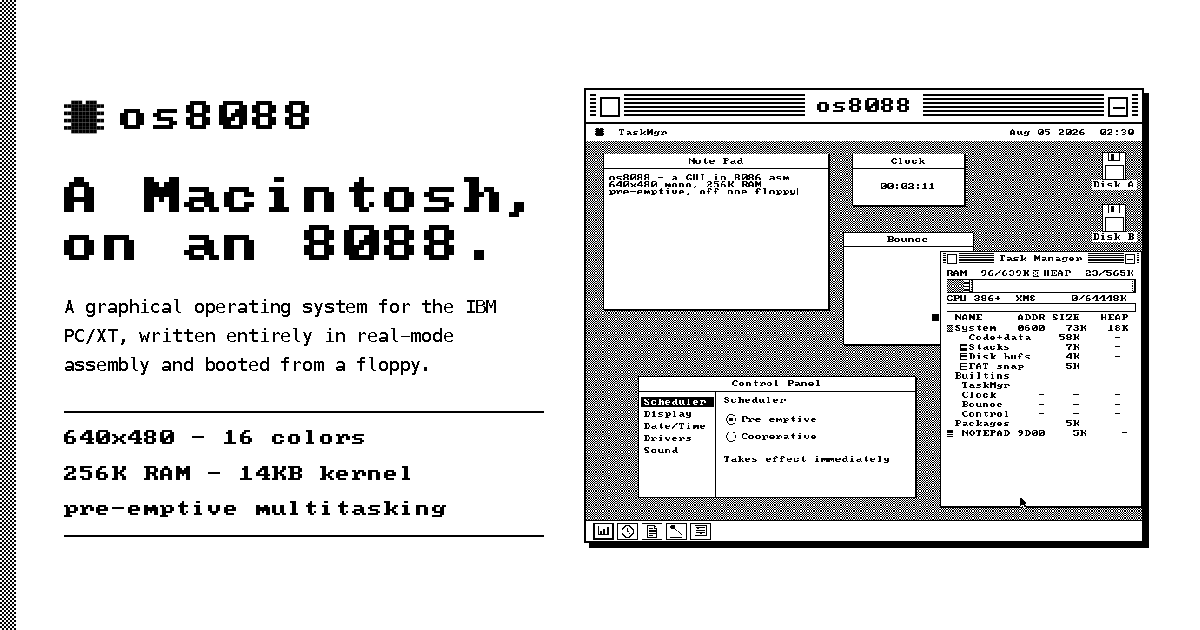
  • os8088 is an operating system written with AI tools in x86 16-bit assembly with an optional C/C++ app porting toolchain.

    It runs on anything with an x86 processor from the early 8088/8086 CPUs up to the latest CPUs. It supports CGA/Hercules + VGA. Sound Blaster, NE2000 network and MFM hard drive support is now available.

    We've also ported many cool apps: MOD trackers, TexPad, MS Word 1.1a (in ASM and C), CP/M 2.2 emulator with a ton of apps and games, and several ported games from the early arcade days.

    Run it in the browser at: https://os8088.com/demo

    Yes, the website has a lot of AI generated content. I'm working on a redesign and tooling to edit and rewrite the content by hand.

  • Since you're here let me ask a question i had the last time i saw this project: how does your AI handle the ginormous SPEC.md file?[0] (last time i saw it Github was still able to display it :-P).

    Are you feeding the entirety of it to Claude (i guess)? Doesn't that eat pretty much all context - and considering that (AFAIK) the spec file has everything about the OS, doesn't available context space put some sort of "hard ceiling" to what you can add to the OS?

    [0] https://github.com/jggonz/os8088/blob/main/SPEC.md

  • Interesting project. Have you been able to try it on actual hardware yet? What’s the minimum RAM?
  • So, this is less a technical than an aesthetic question—why does it look like an old Macintosh? I think I would have thought of GEOS [0] before Macintosh. There's also Windows 1.0 and 2.0.

    Why 3.5" floppy drive icons instead of a 5.25"? The images of the OS running on hardware [1] have mostly 5.25" drives.

    [0] https://en.wikipedia.org/wiki/GEOS_(8-bit_operating_system) [1] https://os8088.com/hardware/

  • Most likely because of AI slop.
  • High resolution CGA, maybe? With only 2 colors copying the Mac UI would make sense.
  • TBH Windows 1.0 (and to a lesser extent Windows 2.0) looked awful compared to Macintosh which is probably why the author decided to go with that. Digital Research agreed since they also made GEM at the time look very mac-like (and got sued by Apple for it :-P).
  • > Opening an encrypted connection means one very large multiplication. On a 4.77 MHz 8088 it takes minutes.

    I've done it.

    It took a lot of loop unrolling and optimizations in order to get the TLS 1.2 handshake to complete before the server timed out the connection, but I've successfully gotten it to work, and with only 384 KB of RAM.

    The implementation doesn't verify the server certificate (would certainly take too long), but it successfully performs an HTTPS request to Wikipedia as a proof-of-concept.

    One of these days I'll clean up the code and post it here.

  • Better off just using http://frogfind.com/
  • If you're doing AES, switching to ChaCha20 should save you a portion of time.
  • and with only 384 KB of RAM.

    A 2048-bit RSA key is 256 bytes. A 256-bit symmetric key is 32 bytes and ECDH keys are roughly the same size. The state size of AES is 16 bytes and its S-box is 256 bytes. Efficient implementations use only a few KB of state. The vast majority of cryptographic algorithms just aren't that big, relatively speaking; although as you mention, they are very computationally intense. Hash states are in the dozens to low hundreds of bytes. For TLS implementation, the record buffers are probably going to use the most RAM; 16K each direction + additional overhead.

  • I‘ve recently tried implementing the Noise protocol on a 7.8 MHz 68000, while it runs in 10 seconds I don’t think there is a way to make it constant time without using addition and running an order of magnitude more slowly :(

    MULU operations are not constant time but depend on popcount. That has an easy work around just also do the MULU of the bitwise inverse, both instructions sum to a constant cycle count.

    The brick wall I hit is related to the Macintosh SE ram being shared between CPU and video system. Every few cycles the CPU stalls instruction fetching, which turns the both MULUs together take the same amount of time each time into there is slowdown depending on the popcount of the first instruction.

    I don’t know if anyone has any solution for this, there is prefetching of one instruction so all should be well, but it seems like the cpu stalls the in progress instruction if the prefetch is stalled.