Join the discussion
Write your take first — we'll ask for email only when you're ready to publish.
- Hacker News
- "They don’t know what skills they lack. They don’t even know what skills are required because they haven’t put the effort in."
This is it.
Evolving into a developer role was more or less directly proportional to the effort you put in. Before AI I used to ask applicants to the department I oversaw whether they have a GitHub Account with a project to show, and bonus, which they are immensely proud of, no matter what.
You had to grind and hustle, no shortcuts, and no amount of stackoverflow.com copy and paste could save you.
And that leads me to two problems for the disguise of one: effort. This not only means reading and redoing simple exercises to complex projects, but committing to it instead of doom scrolling or TikTok frenzy.
I reserved weekends for certain technical books and was frustrated, that there was so few time and so much book left.
AI gave instant gratification a new dimension. It is horrible until AI gets as good as a perfect project from a prompt or we need to abandon it.
Poor young guys, the joy of tuning out is over either by design or habit.
And make no mistake. I don't blame them. We are all victims and perpetrators at the same time but on a different level.
- > This summer, we assigned the problem to an intern (that’s less tenure than a junior engineer). The intern led the development of this feature. They talked to the product manager to understand the problem and requirements. They wrote the design document on how to approach it, aligned with the team, and built it. Of course they did that with the help of AI, and the team they were working with.
So, interns can still produce some value. How much value?
> In our product, there was a feature which had been requested for years, but had not been built yet. It wasn’t overly complex, but it was not critical.
Said another way: The feature was of so little value that it was not even worth assigning to a non-AI-assisted intern! This is what most of us mean when we say “AI lowers the value of…”
by jt2190 - Sort of like how there's a running joke, "this meeting could have been an email"; I think that for all the substance I found in this "4 minutes to read" blog post, it could have been a one-sentence comment in some discussion thread somewhere instead.by samsari
- This is something I've been thinking about the last couple days: how to get junior engineers to be valuable.
I developed a system to help prepare for leet coding interviews so I never feel lost under pressure solving a problem again. It is like a debugger that steps through the code showing all the values of all the variables with data visualizations that reflect the logic so I can grok what it is doing. [0]
After I had the Claude build it, I started looking at the values and there were some mistakes. So, again, the coding agent ran all the code, recorded all the values, and made sure that they line up.
Here is the really cool thing about that. The coding agents can't be trusted. By observing the values stepping though, what I really was doing was debugging coding agent code. It is debugging code presented in a way that is extremely simplified.
What I've been thinking about yesterday and today is, can I do the same thing with a pull request? Have the coding agent run the code, capture all the values, and create a console for the reviewer to step through looking at with data visualizations that abstractly represent that code.
Two things. 1. Coding agents can't be trusted and 2. reviewing code is very difficult. But is it possible to use coding agents to make reviewing code easy for humans? I think so.
That would be a great way for junior engineers to be extremely useful. They only have to step through the code and make sure that all the values line up.
by dataviz1000 - > If the assumption is that AI is going to radically simplify the technical portion of the role, then the people who have started their careers with AI will be in the best spot once they have acquired the experience.
This doesn't make sense - AI is to allow unskilled people to produce what was previously only produced by skilled people.
IOW, how does having 2 years of experience using an LLM to generate code beat having 2 months of experience?
The whole point of using the LLM is that very little skill is involved; how does starting earlier with it provide an advantage? If it's as good as it is claimed to be, starting later with it won't make a single iota of difference to the generated results, compared to someone who started earlier.
by lelanthran - I think it is less about junior/mid engineers, and more just about the kinds of work inexperienced/cheap developers are often doing: assembly line, JIRA-ticket-taker type development.
This is especially impacting Indian tech workers in the US [0] since these are often the types of roles that InfoSys and other foreign tech consulting firms are staffing. The new $100,000 fee to sponsor an H1B visa has made it difficult to justify hiring foreign tech workers when most of the time they are just going to be using American LLMs to do their work anyway.
[0] https://thefederal.com/category/news/h1b-visa-indian-tech-wo...
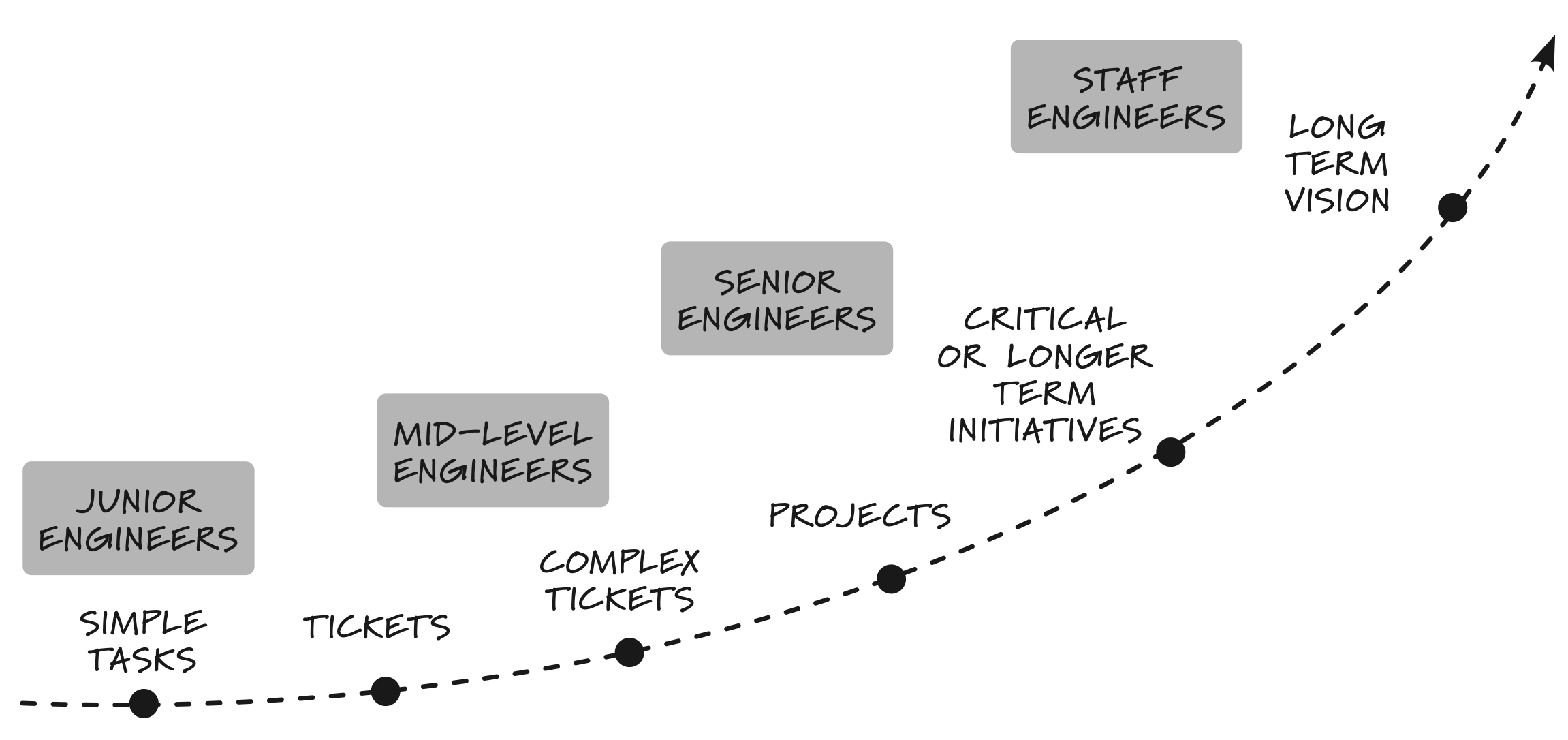
by petcat - > The junior engineer executes it, which nowadays means prompting it to an AI tool, and creating a pull request (PR). The PR receives feedback from more senior engineers. The junior engineer gets the feedback and takes it to the AI tool again, proposing changes.
Yeah this part should not exist anymore. It doesn’t where I work.
When I get a PR I just ask an agent to make the proposed changes. There is absolutely zero incentive for me to give feedback for you to give to an agent when I can give it to an agent myself.
Coding isn’t the job anymore. It’s understanding systems and architecture design, and ownership of what you work on. Being able to design solutions, understand them, deliver them and support them in production is the job now. Engineering is still engineering. End to end ownership is the job.
- It largely depends on the person. We have several junior engineers who cannot solve a problem without AI. When AI can’t solve it, they just keep trying and failing. And I mean weeks to months late. Then rinse and repeat on the next task. It used to be that they would have been forced to seek help from a senior engineer. Combine the teaching with a real struggle is what makes them better.
As it is now, they aren’t being taught and they’re not learning from what the AI is producing because they don’t understand it. The produced code is a black box, and the AI’s development is a black box too. All they know is that running it produces something like what they asked for. They have no idea about failure modes which is a fundamental concept of engineering. The worst part is that AI is covering up their deficiencies. They don’t know what skills they lack. They don’t even know what skills are required because they haven’t put the effort in.
There are obviously good junior engineers that are using AI judiciously and not as a crutch. They’re the ones who still interact with seniors to get help and actually learn. They would have been successful without AI too. These are the ones the author is talking about. In my experience, the momentum is moving towards the worse type of junior the more AI is adopted. Unless that changes, it will erase their value.
by olsondv