
Join the discussion
Write your take first — we'll ask for email only when you're ready to publish.
- Hacker News
- > M6 supports up to 32GB of unified memory to multitask across demanding apps and run LLMs on device for secure and private agentic tasks. It also provides up to 170GB/s of unified memory bandwidth — a 10 percent increase over M5 and a 2.5x increase over M1.
Isn't 170GB/s slow for bandwidth?
by egonschiele - M6 and M5 Ultra both have comparable memory bandwidth per GPU core. I think they will perform well.
- You would want to get the M5 pro version with 307gb/s if you were interested in running local LLMs.by kamranjon
- It's fast by computer standards and excellent for entry level chip. The Pro/Max/Ultra chips are always faster.
Compared to something like VRAM it's slow.
by scosman - Kinda. Strix Halo does 256GB/s of memory bandwidth, and is significantly slower than an M5 Max (614GB/s). Feels like intentional market segmentation?by tristor
- For max memory bandwidth you need to buy the Ultra versions (M5 Ultra: 1,2TB/s, this gets comparable to real GPUs regarding the memory bandwidth).by mkesper
- It's higher bandwidth than any dual-channel DDR5 desktop machine, but Apple never quote the memory latency, so hard to compare otherwise.by matja
- It is. That's the mac mini. For local LLMs you would want the Mac Studio, which tops out at 1.2TB/s.by blints
- Anthropic can't have their IPO soon enough (rumored October) if these Macs match their reported specs.
Maybe $17k for a 512gig system that can do 1.2TB/s seems like a pretty good deal for a small office.
- Sorry for being lazy, but is there a rough breakdown like "You get sonnet level for M5 and Opus for M5 pro, etc.", or is it still speculative. Or put simpler, do you get Opus level for the 256GB M5 Max?by vadansky
- With the newest Qwen 3.8 27B model you can get opus on just about any new Mac.
- Opus is probably ~2T parameter model, so that would probably not run on these. More like Sonnet.
- For local LLMs with a Mac, rule of thumb is you always want an Ultra (due to memory bandwidth). Even an M1 Ultra is superior to an M6 Pro in this regard.
There are no configurations even close to running something comparable to frontier model variants, they're simply far too large, but something like full precision Qwen 35b or DeepSeek 70b at 50+ t/s is well within available configuration, and potential for plenty of room for large context sizes.
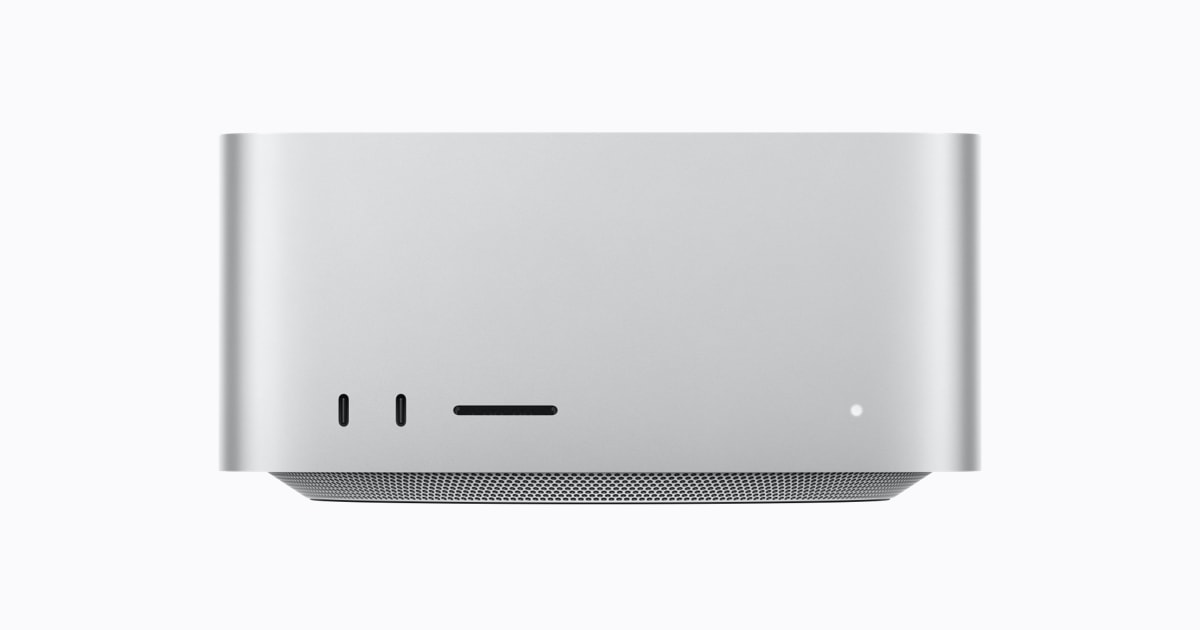
by root_axis - Mac Studio with M5 Max starts at $2,499 (U.S.) and $2,299 (U.S.) for education. Additional configure-to-order options are available at apple.com/mac-studio. Mac Studio with M5 Ultra starts at $5,499 (U.S.) and $5,099 (U.S.).
I am in Europe, and the Mac Studio M5 Ultra GPU 64 cores with 96GB RAM is up to 6.649,00 €. Ouch.
by meerita - > I am in Europe, and the Mac Studio M5 Ultra GPU 64 cores with 96GB RAM is up to 6.649,00 €. Ouch.
It would be significantly cheaper to fly to a tariff-free country and buy there.
- Don't forget that US prices usually do not include the VAT, while EU prices usually do include respective VAT.by alfanick
- To put this into a perspective, Google helpfully reminds:
> A fully configured IBM Personal Computer AT (Model 5170) with expanded memory and storage cost around $5,795 to $6,000 at its launch in August 1984, which equals roughly $18,600 to $19,300 in 2026 USD.
by nine_k - It looks like speculation that Apple would raise the base chip’s maximum RAM from 32GB to 48GB was wrong.
Apple also launched the base M6 today with a 32GB RAM limit, suggesting 512GB may remain the maximum for Ultra chips for some time. Since these Ultra chips combine 16 base chips:
32GB × 16 = 512GB
by alberth - they`re skipping m6 pro and ultraby HSO
- AFAIK these "rules" are artificial and there's nothing stopping Apple from having twice as much RAM. They just don't want to.by wmf
- They probably literally don't have enough NAND to go around. 768GB of memory (48GB x 16) is enough for nearly 100 iPhone 17s; that's $80k (corrected) of iPhones at MSRP, although likely much lower margins than these high-RAM boxes.by dannyw
- I wish they were offering 1TB of Unified Memory for the M5 Ultra. I already have an M5 Max MBP w/ 128GB of RAM for running local models, and while there's a /few/ models that I can run in 512GB that I can't run in 128GB that are interesting, where things really shift is at 1TB of memory which allows you run >1T parameter models w/ 4 bit quants reliably. 512GB is just on the edge of "enough", which is maybe the point of maximum frustration considering current memory prices.
Personally, I can't justify dropping the dosh for a 512GB M5 Ultra, but I would be able to justify it to myself if I could get 1TB of memory, because it'd guarantee the flexibility with local models I currently am missing. Seems a huge miss to not offer this... for a price.
by tristor - chaining an option?by f0cus10
- 1tb would likely be ~$20k - given the current >$10k price tag of 256gb. Would you still be considering it at that price?by kamranjon
- The thing that intrigues me the most is this:
"Storage performance is up to twice as fast, with a next-generation SSD architecture built on PCIe Gen 6..."
This is the first personal computer I've noticed that has PCIe Gen 6 storage. I've only seen enterprise PCIe Gen 6 SSDs up until now. Gen 5 SSDs in consumer devices already have high temperatures and thermal throttling, so I'm worried about how Apple's implementation will perform (I know they don't use off-the-shelf SSDs anymore, but I'd imagine the temps would still be a problem).
by OneWhereWhy - Apple puts the NAND flash controller on package, so it cooled as part of the SoC/CPU as they share an IHS. Given it is part of the fabric it only has to maintain signal coherence on millimeter to micrometer scales, while enterprise/consumer NAND PCIe have to adhere to standards which force them to signal at 800-1200mV and keep that signal stable for centimeter scale distances.
Basically, Apple gets to cheat because they shove everyone onto the same IC & make the OS that runs on this SOC.
by hugmynutus - I just barely got used to gen 5 and haven't even heard of gen 6 yet. Gen4 should be enough for most people these days, but it's good to see progress.by archon810
- I think this is wrong - it will likely be PCIe gen 5. Apple doesn't say PCIe gen 6 anywhere and this doubling would be from the previous Mac Studio, which probably had PCIe gen 4. So this would match what happened on macbooks recently - upgrade to PCIe gen 5.
I think someone made incorrect conclusions and everyone just copied them.
by muro - Im curious, how often is SSD / storage speed performance really useful? I feel like for many people it's akin to gigabyte wifi in that its nice to have, but not really particularly necessaryby meric_
- 1.2 TB/s bandwidth of M5 Ultra comes from two dies of M5 Max (each 614 GB/s) connected together using 4.4 TB/s inter-die fabric.
For a non-quantized Deepseek V4 flash on an ultra, I would estimate about 1000+ tokens per second prefill and 50+ tokens per second on generation. This is actually quite usable and near parity to cloud.
They mention "adds the GPU Neural Accelerators." which, if exploitable for LLM loads, would probably help the prefill a lot