Join the discussion
Write your take first — we'll ask for email only when you're ready to publish.
- Hacker News
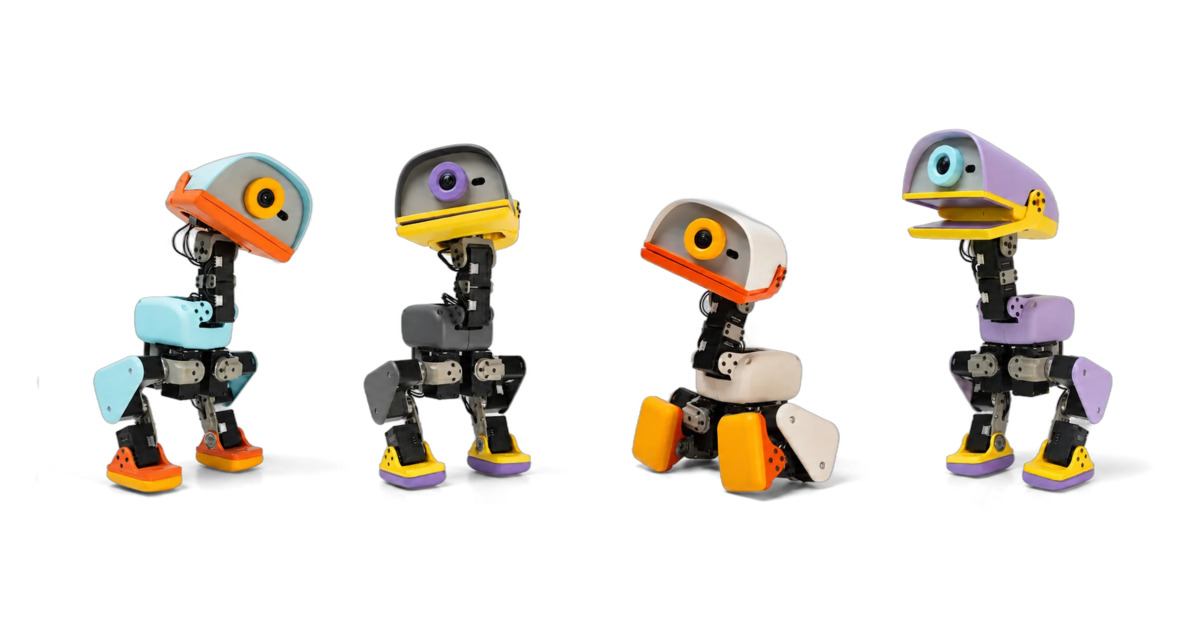
- It doesn't walk like a duck, but Reachy Mini by HF/Pollen Robotics is a great entry-level robot. And you get to assemble it!
Direct links: https://pollen-robotics.com/microduck/ https://pollen-robotics.com/reachy-mini/
by telecuda - Oh so this is why Nvidia (edit: trying to buy)/bought Hugging Face, $1B for all the ai sharing and stuff, and $12B for the duck!by trebligdivad
- What is really interesting for me is that they're not using Nvidia's Issac, which is famously impossible to get up and running for a custom robot by individual contributors. I can't tell how good their system is, but the fact that I got it running on my laptop in under an hour, vs wasting over a week of my spare time on Issac (ref: countless reddit threads by hundreds of people also failing to train their robot on Issac) gives me confidence I can finally convert my terrible IK stuff on my robot, to use this other framework.
This appears to be using mjlab, which is is MuJoCo Warp plus rsl_rl, which uses a completely different design/technology heritage from Issac, so that's worth a lot to me, since I've basically sworn off Issac for robot gait training.
by hadlock - It's either this or https://mondorobotics.com/ and I'm torn. Obviously it's for my daughter and I will just be safety checking, definitely, 100%.by _joel
- I found a few open-source small bipedal robots on the internet. There are actually many open-source robots available:
[1]. https://robotics.umich.edu/news/2024/a-smaller-simpler-biped...
https://github.com/daviddoo02/Legolas-an-open-source-biped
[2].https://github.com/MuShibo/Micro-Wheeled_leg-Robot
[3].https://github.com/Yuexuan9/Tinker
Quadruped:
[1].https://github.com/stanfordroboticsclub/StanfordQuadruped
by num42 - Page is so dense, couldn't find the specs:
Rockchip RK3566 processor with an AI accelerator, 1GB RAM, 32GB storage, Wi-Fi, Bluetooth, microphones, speaker, two NFC antennas and removable battery (~1 hour runtime). Onboard policy loop: 50 hertz, Dynamixel servos, weight: 800g.
Seven behaviors at ship: walking, sitting and standing, kicking, ground pickup, roller skating and self-recovery, can train additional behaviors locally or through Hugging Face Jobs, export to ONNX and deploy through open-source runtime. Software: SDK, a MuJoCo-based simulator, training scripts, tools for transferring policies from simulation to the physical robot.
by mrandish - Not sure many people know this - most of the robotics stuff that you see in the news is based on MujoCo (Multi-Joint dynamics with Contact) engine, that is used primarily to create simulated environments in which these robots learn the RL policies. This project is maintained by Google deepmind - https://github.com/google-deepmind/mujoco
- Tried out the simulator and was surprised to find that the movement keys are ZQSD; then realized that's the equivalent of WASD on an AZERTY keyboard. Checked and sure enough, Pollen Robotics is a French company.
They may want to at least add a preference for keyboard layout, pretty sure that QWERTY and QWERTZ are much more common worldwide than AZERTY.
by lambda